Den of Thieves
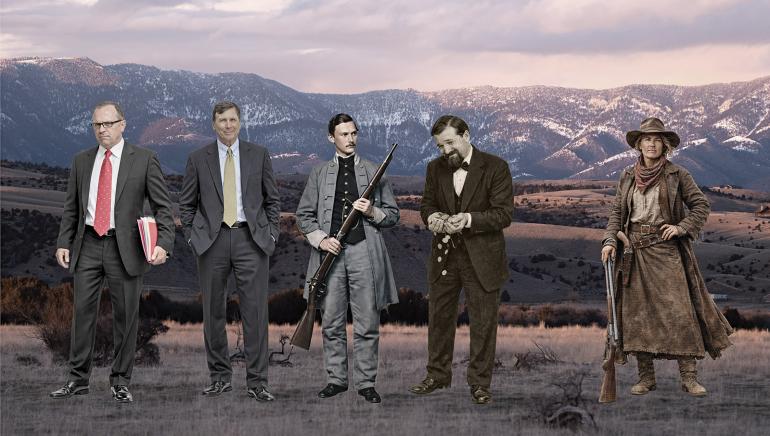
A history of infamous Gallatin Valley heists.
The Gallatin Valley has always inspired ambition—and not all of it honorable. From land seizures to financial sleights of hand, southwest Montana’s past is stitched together with bold moves, moral ambiguity, and people who saw opportunity and didn’t hesitate.
The Original Heist
Long before homesteads and rail lines, and even longer before apartment complexes and coffee shops, this area was frequented by the Crow, Northern Cheyenne, Salish, Kootenai, Blackfeet, Lakota, and Sioux. These tribes shared the valley for generations as a common hunting ground—a status that was later upended by westward expansion and treaty violations. In other words, heists.
In 1851, as westward movements ramped up, leaders from more than 20 indigenous nations gathered to sign the early Fort Laramie Treaty—declaring that the U.S. federal government was permitted to build roads and forts in specific areas, but would protect the tribes’ lands and hunting grounds, especially from the impact of the Oregon Trail. For more than a decade, it largely worked. As traffic surged, miners and settlers ignored boundaries and the American Indians’ resources diminished. This chain of broken commitments quickly led to tension, and later, war.
The Bozeman Trail
In 1863, John Bozeman and John Jacobs followed long-used Indian trails to carve out what became the Bozeman Trail. Never one to ignore a shortcut—or a business opportunity—Bozeman pushed a steady flow of wagons through these trails toward the gold fields of Alder Gulch, despite the fact that it was running through lands reserved by treaty for native tribes.
The Bozeman Trail is commonly framed as an entrepreneurial innovation, but from another side, it’s an appropriation—opening indigenous land to Euro-American settlement.
As traffic increased, indigenous nations pushed back against the intrusion, and the U.S. Army responded by building Fort Ellis, followed by Fort Parker. From these outposts, the federal government waged an aggressive campaign to claim the area, even stationing federal troops along the trail to protect settlers from resistance efforts.
The Bozeman Trail is commonly framed as an entrepreneurial innovation, but from another side, it’s an appropriation—opening indigenous land to Euro-American settlement.
Gold & Guns
In the mining-era, gold rarely moved quietly. After long bouts of mining, gold was packed into bags, saddles, and stagecoaches rolling out of Bannack and Virginia City, bound for distant banks and mints. These routes were predictable, the escorts thin, and the stakes enormous.
Sometimes there were no witnesses. Sometimes there were no survivors.
Henry Plummer, the sheriff of Bannack, led a group called “the Innocents,” who unlike their name, were the area’s heist-men. They mastered the terrain, routes, and timing of outgoing miners and struck groups when they had nowhere to run to, and no one to back them up.
Riders posing as travelers or deputies would close in, weapons drawn, demanding the traveling gold. Sometimes there were no witnesses. Sometimes there were no survivors. The speed of the attacks made them hard to trace, and the gold vanished as quickly as it was taken.
Private Powder, Public Fallout
Fast-forward to the late 20th and early 21st century, to the private alpine refuge for the ultra-wealthy that we all know as the Yellowstone Club. Timber baron Tim Blixseth and his wife Edra founded the YC in the late 1990s, with Blixseth buying tens of thousands of acres in and around the Gallatin National Forest, then trading sensitive pieces to the U.S. Forest Service in swaps that left him with roughly 13,500 acres right next to Big Sky. That checkerboard of public & private land are what originally made this private ski-and-golf playground possible—and it started with a heist of sorts, when Blixseth used his timber connections to outbid the Rocky Mountain Elk Foundation (RMEF), which intended to purchase Pioneer Mountain and turn it over to the Forest Service, closing the checkerboard pattern and creating more habitat for elk.
In the mid-2000s, Blixseth borrowed $375 million to expand the club and launch a grand, transnational concept. Courts later found that much of the money was diverted into his personal accounts, leaving the Yellowstone Club financially exposed.
Blixseth used his timber connections to outbid the Rocky Mountain Elk Foundation, which intended to purchase Pioneer Mountain and turn it over to the Forest Service, closing the checkerboard pattern and creating more habitat for elk.
In 2008 the Club filed for bankruptcy, brought down by heavy debt, mismanagement, and misused funds. Federal courts ruled that Blixseth’s double-dealing played a central role in the collapse, and ordered him to repay significant sums to creditors, even as he claimed poverty to avoid payment. When Blixseth and Edra divorced the same year, he tried to dodge responsibility by assigning the club and its liabilities to her while he kept cash and assets.
The Yellowstone Club did survive under new ownership, but the land-swap-plus-high-finance alloy that got it built in the first place remains an admonition about public land, private profit, and broken promises.
Fences & Fines
A tributary of the Beaverhead, the Ruby River has been fished and floated for generations. That was until 2003, when billionaire James Cox Kennedy moved in and tried to kick everyone else out. Kennedy installed fences at three public-road bridges on Duncan Road, Lewis Lane, and Seyler Lane. The folks in capes over at the Public Land & Water Access Association (PLWA) stepped in and successfully sued Kennedy, reaffirming Montana’s Stream Access Law and proving that even the deepest pockets can’t buy a river.
Land Grabs, Today
As more money and development plans flood into the valley, land-access conflicts have become familiar and are following the same storylines—the super-wealthy are buying up strategic tracts of land, attempting, and sometimes succeeding, to shoo off public access. The Crazy Mountain Land Swap has drawn criticism from public-access advocates who say it gives wealthy landowners more control, while asking the public to give up long-used trails in return for a longer, less direct alternative. Proposed BLM land-use changes have raised similar concerns, with locals worried that recreation and conservation could take a back seat to development. As properties change hands, disputes over private landowners closing or limiting access to trails and roads continue to make news, from parking feuds at Stone and Skunk creeks to trail diversions at Loch Leven Fishing Access and the closure of Beasley Creek Road in the Bridgers.
Public land often slips into private hands not with a transfer of deed, but through gates, “No Trespassing” signs, and threats.
Bozeman’s history makes one thing clear: the heists never really stopped—they just got quieter. As pseudo-rich newcomers buy up land, homes, and retail areas, they aren’t just driving up the cost of living, they’re reshaping the culture itself. (Hence the disappointing nickname: Boz Angeles). Trails get gated, rent skyrockets, and longtime locals are finding themselves priced out of housing in places that once felt like home. Public land often slips into private hands not with a transfer of deed, but through gates, “No Trespassing” signs, and threats. We can’t undo what was taken in the past, nor pretend that our beloved valley wasn’t built on a long series of land grabs. But we can pay attention now, ask harder questions, and notice who benefits when public land and access roads quietly slip into private hands. The next infamous area heist doesn’t have to be inevitable—unless we decide, once again, to look the other way.
Gone But Not Forgotten
Not all Bozeman heists come with lawyers and land deeds. Some come with bolt cutters, a pickup truck, and a sense of humor—or at least horseplay.
In a Pickle
In 2002, on a waltz home from the bars, a handful of guys had an ingenious idea: to take the Pickle Barrel sign. Although the intention was to return it shortly after, it remained missing for 20 years—stored in an attic and later a garden shed. In 2022, the heist-men decided it was time to make amends. The sign was returned after operating hours, left in a cardboard box with an anonymous letter.
Heavy Hiker
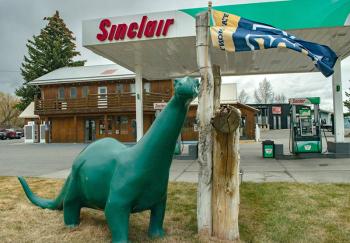
Halloween is a time for mischief, and last year Bozeman delivered. Around 3:30am, the 270-pound fiberglass dinosaur from the Sinclair gas station on Bridger Drive was carried away and hauled to the top of the M, where it was discovered shortly after the sun came up.
Cow in the Cupola
Next time you’re walking around MSU’s campus, take a look at the cupola atop Montana Hall. Notice anything? It’s a different color—and not due to architectural flair. In 1906, a group of students stole a cow and led it up into the cupola. Cows can climb stairs, but as it turns out, they can’t go back down. The solution involved a crane, a stuck cow, and a cupola that crumbled during the rescue. Montana Hall went without its crowning feature for years, until an anonymous donor funded its rebuild for MSU’s 100th anniversary in 1993. Today, the cupola stands tall again, reportedly with a small plastic cow tucked away up top, planted by the MSU carpenters.
—Jamie Rankin