A Tale of Two Shanties
Frugality & ingenuity in the winter woods.
When my father was younger, he would accept a nominal fee to chauffer people out into the backcountry, often shuttling them into the mountains around Cooke City with a snowmobile while they sat in a tow-behind sled, on canoe-style bench seats made from old bike tubes. His passengers were liable to be pelted in the face by snow and debris thrown from the snowmobile tracks, but it was a cheap ride—one he’d have taken himself.
Bill Blackford, or Bikeshack Bill as he became known, has always had a keen eye for good deals. He ran a shop that fixed bikes during the summer and shuttled skiers during the winter months. He was, and still is, crafty and resourceful, and used to joke that he would one day write a book on the 101 uses for old bike tubes. Even today, he still lashes his skis to his sled with that trusty old rubber instead of fancy (and costly) straps.
“If I have the choice, I may be out skiing. I don’t live here to work, you know.” —"Bikeshack Bill" Blackford
Always a fan of getting people out into nature, ol’ Bikeshack helped to spearhead Cooke City’s outdoor spirit decades ago. Although, he gets a bit of anxiety if you mention the Sweet Corn Festival. As Bill told an Outside Bozeman reporter in 2002, inquiring about his questionable attendance at the fabled winter fest, “If I have the choice, I may be out skiing. I don’t live here to work, you know.”
One winter, self-described wannabe professional freeride skier Joe Donovan hired Bill to bring him to the top of Daisy Pass so that he could straight-line down a slope and rent out Bill’s yurt on Lake Abundance. Joe was content to hike around, build booters, and chill, and the trip was the beginning of their friendship. While the yurt is long gone, their backcountry partnership remains.
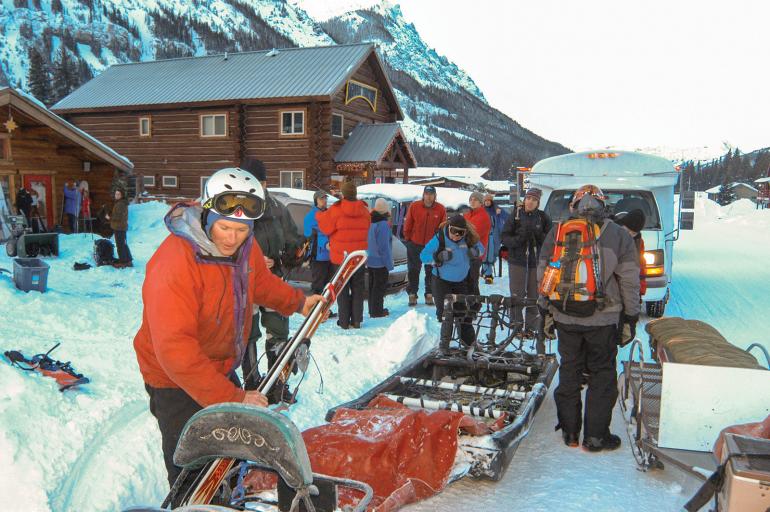
Bill loading up for the skier-haul to Daisy Pass, circa 2004
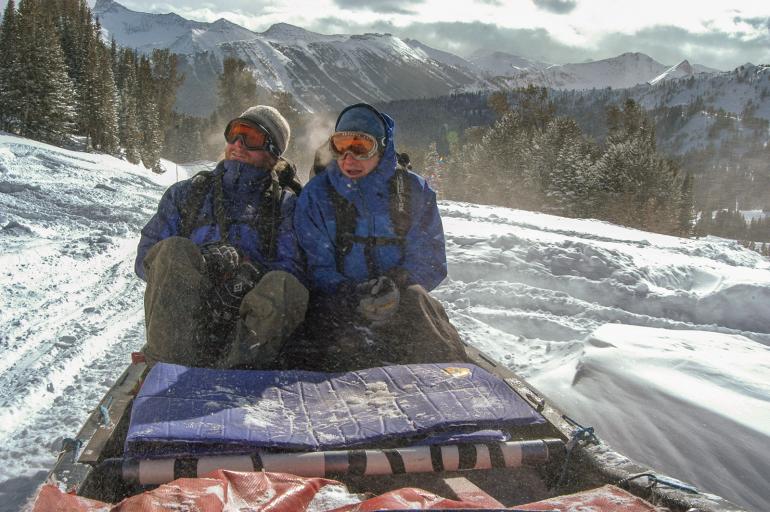
The cold, bumpy ride behind Bill's snowmobile, circa 2004
Bill has a weathered face that he shaves daily, and he still skis with a free heel. Joe has a large stature and an even larger personality, and he was hand-making no-boards long before they were cool. It’s been two decades now since Bill broke an arm packing his yurt out of the backcountry on a snowmobile—an incident that hastened its eventual disposal—but that wasn’t the end of his and Joe’s efforts to maintain the stoke and continue to bask among the moonlit mountains of southwest Montana. In fact, the duo recently decided to commit themselves to a new endeavor.
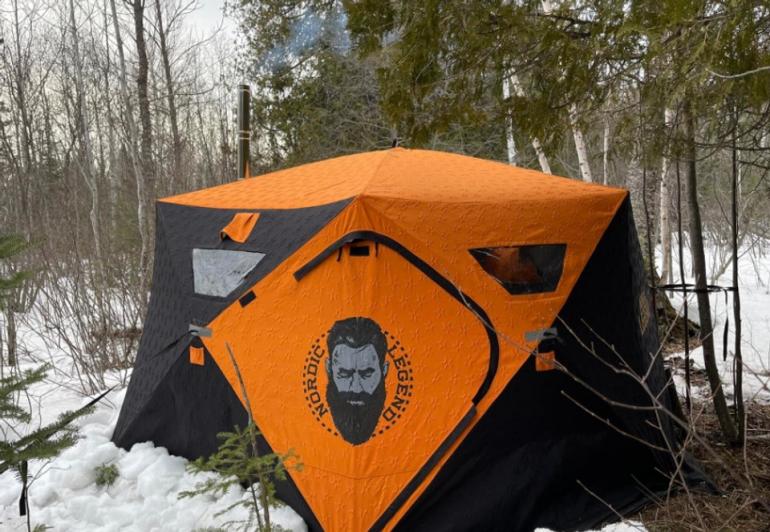
“I said something to Joe like, ‘Hey, we need to find a portable backcountry shelter,’” Bill recalls. Joe claims he searched for an “ice shanty with a stove jack” and forwarded to Bill a photo of an ice-fishing shelter known as the “Nordic Legend.” The pricepoint seemed reasonable—somewhere around $600—and Bill ordered it immediately. Joe dragged his feet a bit but did order one of his own once he laid eyes on Bill’s fancy new set-up.
The first time the two ventured out into the backcountry to set up their new digs—which are not advertised for this particular use—they dug straight to the ground. The tents have nearly everything you’d need for a temporary mountain abode: stove jack, zippered door, and several vinyl windows. But since their intended purpose is ice fishing, they don’t have floors. The digging was tiring, and eventually, the two realized that their shanties would work just fine on top of the snow, so long as there was a foundation of some kind.
Loading up his telemark skis, Bill jets off into the backcountry on his chariot, in search of good turns and cheap thrills, just as he’s done thousands of times before.
One of my first memories is of my dad and one of the other Cooke City locals climbing into a dumpster and wrestling for discarded, high-quality children’s toys. I can remember another time skinning with him: feathers from my high-tech, newly-torn puffy mixed into a particularly large-flaked, dry, and windblown snowfall that shrouded him as he plodded along through the woods in a rain jacket he’d found at the dump. The man is not financially challenged; he’s just practical, and he loves a good deal.
He became an avid fan of the Yamaha Viking Professional snowmobiles—a model used across Siberia for its reliability and easy repairs—so much so that he went through a fleet of seven over the course of his guiding career. Recently, as to reconnect with his past, he went so far as to hunt down a barn find with under 100 miles on it. Say what you will, the man knows how to make do.
Naturally, it only makes sense that for future camping excursions, that Bikeshack would use materials from the local transfer station to make the floor of his tent. “I found something like a pond liner, or a roof liner kind of thing. So it’s pretty heavy rubber,” Bill says, noting the benefits of his find. Joe, on the other hand, who is himself exceptionally pragmatic, opted instead to “splurge” on plywood for his own tent floor. “We’re not really sure which one ultimately is better, but they both work,” Bill says. “His is rigid, and mine conforms to the snow.”
Either way, the floors added a much-needed professional touch to the shelters, which each have sufficient space for a cot, table, stove, and ski gear inside. What’s more, the materials fit neatly on a tow-behind sled. Loading up his telemark skis, Bill jets off into the backcountry on his chariot, in search of good turns and cheap thrills, just as he’s done thousands of times before.
For Joe, the ice shelters’ advantages boil down to faster setup and the warmth of the woodstove. But don’t get the wrong idea—“It’s not all easy living,” he cautions. For instance, when left unattended under a heavy snow load, the tents can form a dip in the ceiling, creating condensation. “You can easily pop them back into shape, though,” Bill explains. Joe seconds Bill’s sentiment, adding that despite the moisture sometimes being worse than sleeping in a car, he still stands by the product for its easy setup, warmth, and reliability.
“I would change the window design in mine,” Bill says, in a tone hinting at more than a little trouble. “I feel like they leak a little bit if it’s raining, but I’ve learned how to divert the water. You’ve just got to accept that it’s going to drip a little bit.”
Joe seems more content. “I had a canvas wall tent before, but I didn’t party in that one as much—it got too frozen and icy,” he says. “These fishing tents just work a little better.”
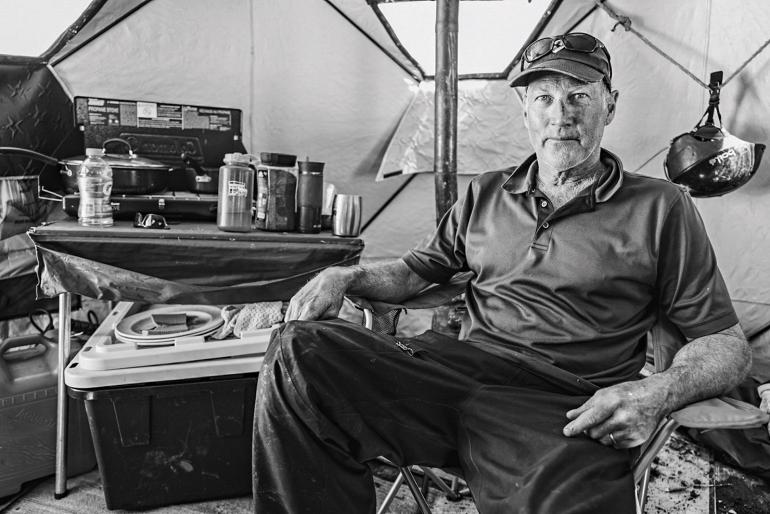
Bill in his (new) element
Bill is well-connected, having previously hosted groups like Level One and Teton Gravity Research. On one particularly memorable camping trip, he and the team were joined by professional skier Chris Logan. It was Logan’s first overnight backcountry trip, and he joined Bill and Joe in the Cooke City area to revisit the very place where he’d first had his mind blown, professionally, at 23. “It’s just this world that is not normal,” he says. “The characters out here are just unreal.”
While the Cooke City area attracts significant skier and snowmobile traffic during winter, Logan and his crew arrived in spring—a time when many would-be skiers were putting up their planks, dusting off their rafts, and breaking out the bikes. And so, up in the alpine, Logan and the gang had the whole place to themselves. Even with room to spread out, Logan recalls. “We brought way too much stuff, we really overpacked,” he admits. “Joe’s got his shit dialed, though! And your dad doesn’t need much.”
In true professional mountain-athlete form, Logan brought a North Face four-season domed tent, one that retails for 10 times the cost of a Nordic Legend shanty. Whether it was how things were organized, the warmth of the stove, or simply the vibe, Logan found himself drawn to the ice-fishing tents. “When we had to hunker down, when winter did show up on those trips,” he remembers, “we’d pile into those tents and just start hanging out and drinking to weather the storm.”
While there’s certainly a place for high-tech gear and creature comforts, there’s an often-overlooked simplicity to dump finds, old sleds, bike tubes, and repurposed tents. Though he’s upped his gear game quite a bit over the years, I still don’t know anyone who embodies this ethic and who gets out quite the same way as my dad, Bikeshack Bill Blackford.