Birds of a Feather

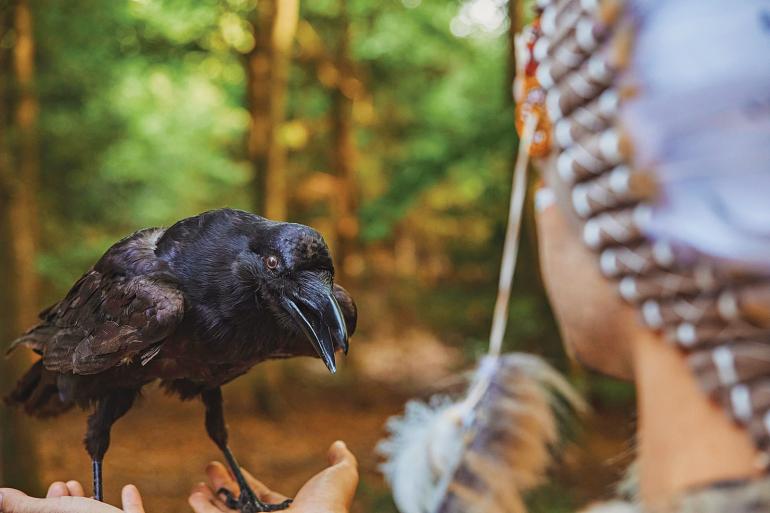
The raven’s shared journey with humankind.
Since that first cargo of belongings was dragged by hand across some ancient plain, traveling humans have been confounded by the overhead croaks and mocking chortles of circling ravens.
The common raven, known throughout most of the Northern Hemisphere, is the largest of the “passerines”—a major classification of birds that both perch and sing. Further organized by science within the family Corvidae—alongside crows, jays, and whiskey jacks—some would assign ravens the mantel of the most intelligent bird on Earth, perhaps even among the entire animal kingdom.
Looking back over my paths and travels, I sometimes contemplate these regular avian companions and wonder: Over these many thousands of years, did humankind foster the raven’s vaunted wisdom and intelligence? Or was it maybe just the other way around?
Perhaps key to ravens' near-universal presence is that humans share so many traits with these large, gregarious birds.
According to biblical legend, after 40 days of riding out the great flood, Noah released from the ark both a dove and a raven—to check on prospects. The dove eventually returned bearing an olive branch, which informed Noah the land had healed and a fresh start was at hand. The raven, though, returned only briefly to wheel overhead as it departed for its own paradise amidst the detritus of receding waters. The raven’s detached and self-serving abandonment revealed to Noah the flood’s complete and utter destruction.
And so the raven’s reputation as an enigmatic messenger became entrenched, at least within the Judeo-Christian canon. According to the Quran, though, a raven instructs Cain on burial as the best method to hide the sin of murdering his brother, Abel.
The Judaic tradition forbids eating the unclean bird, certainly due to its scavenging behaviors, including among human dead. In all of history, the settling of ravens marked the conclusion of great battles. Practitioners of open, or “sky” burials, among world cultures must have deeply contemplated the raven’s role over the centuries as transporter of the human soul to the hereafter.
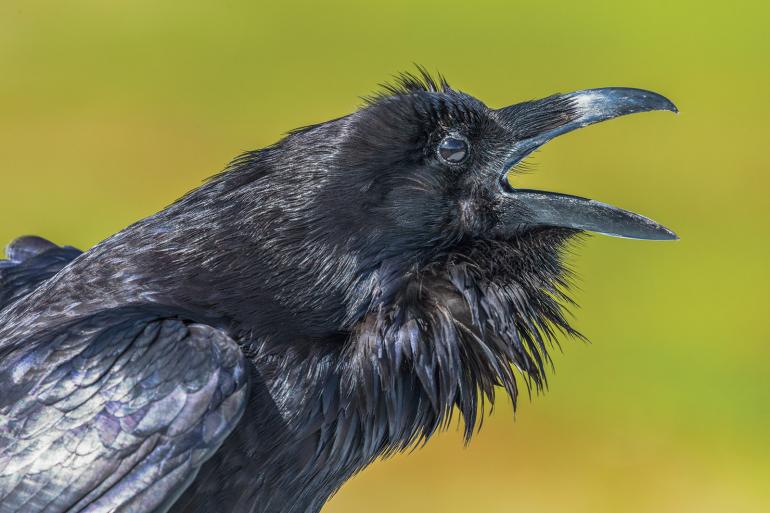
Generally lacking a Western concept of hell or the devil, Native American cultures are perhaps most embracing of the raven’s foibles. Natives have long acknowledged the raven’s intelligence and bearing upon the human condition, sometimes in a role as wise trickster. The Crow, or Apsaalooke Tribe, of the Northern Plains is more properly translated as “People of the Raven.” Pacific Northwest native peoples deeply incorporate the raven as well, building the bird into creation legends and as a major clan icon.
Norse and Greek legends, too, are populated by this multifaceted bird. German, Irish, Japanese, and Iberian cultural stories and fables feature ravens. The raven is the national bird of Bhutan and it is on the coat of arms of the city of Lisbon, Portugal.
Ravens possess remarkable memories and can apparently both remember and nurse grudges.
Medieval Roman Catholicism countered the darker aspect of the more northerly pagan view and has ravens delivering daily bread to the hermit saints and hiding their martyred bones for proper Christian burial.
Perhaps key to their near-universal presence is that humans share so many traits with these large, gregarious birds. Like humans, ravens tend toward long-term mating relationships, although transgressions are sometimes observed. Further, young ravens in particular seem to engage in joyful, playful activities such as remarkable aerial acrobatics, including flying upside down. Ravens have been seen sliding down snowfields. They play pranks and sometimes seem to tease landlocked animals, such as sleeping dogs.
Like other corvids, such as the seed-stashing Clark’s nutcracker, ravens possess remarkable memories. Unlike their cousins, though, ravens apparently both remember and nurse grudges, which may be why the bird appears on the coat of arms of Dublin County, Ireland.
Ravens can live nearly 20 years in the wild and older ones seem to become increasingly reticent and cautious around feeding sites. Some observers swear ravens sometimes gather to mourn their dead, but realistically, maybe they’re just grabbing a quick bite.
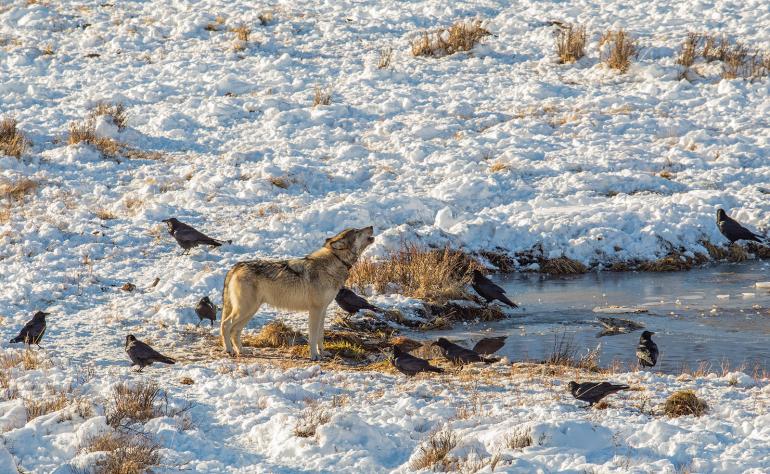
In North America, ravens have long been observed associating with wolves, coyotes, and badgers and possibly coordinating in hunting activities. These birds are known to arrive shortly after the report of large caliber rifles during Montana’s five-week-long big-game hunting season each fall. Yet shots fired outside the season reportedly do not elicit the same response.
Ravens have been observed using and even fashioning rudimentary tools, usually to secure food.
Standing almost two feet tall with a large strong beak, an adult raven is still not powerful enough to pierce carrion hides of elk, say, or moose, horse, or caribou. Consequently, a raven can only peck at the eyes and genitalia of a larger carcass until a coyote, or possibly an eagle arrives on the scene. This behavioral trait alone certainly contributes to the raven’s reputation as a dirty bird.
Still, ravens are omnivores, and their long association with humans may be central to their existential success. Populations seem to rise in the wake of human agricultural expansions and ravens are a constant presence at municipal landfills from the Arctic Circle to the great temperate deserts.
As a hitchhiking teenager in the early 1970s, the ornithologist and writer Kenn Kaufman notes in his memoir, Kingbird Highway, of being dejected to find himself at a south Texas garbage dump as he identified and checked off the Chihuahuan, or Mexican, raven from his “big year” bird list.
Ravens do not migrate significantly and the few species are closely related, although genetic differences have recently been discerned between isolated populations.
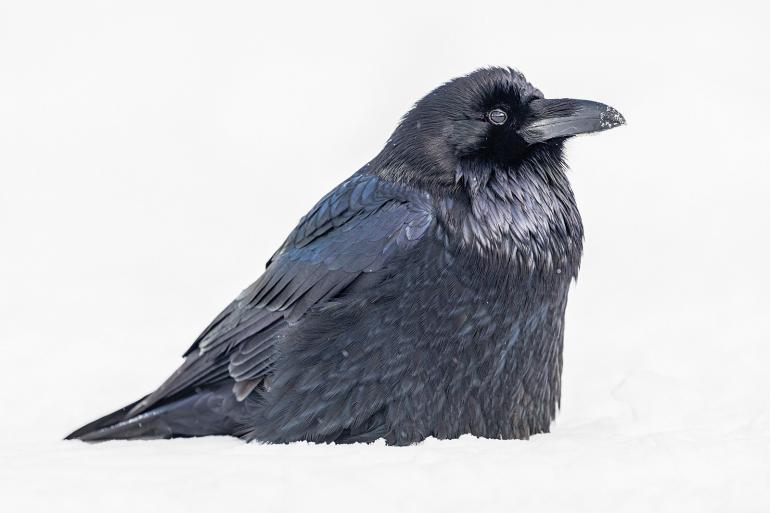
With their strong preference for “seasoned” meat, ravens have been exploited in a range of intelligence tests. The noted scientist, writer, and naturalist Bernd Heinrich conducted food experiments in the late 20th century that indicate wild ravens envision solutions to problems before taking successful action. Most famously, Heinrich tethered several feet of string to a horizontal perch with a meaty tidbit dangling from the end. Without practice, ravens consistently solved the problem, drawing up the string in phases with their beaks while stepping on it to prevent the bait from sliding back down. The morsel was soon within easy reach.
Ravens have been observed using and even fashioning rudimentary tools, usually to secure food.
And then there are those unique sounds and calls. The raven’s extensive vocalizations would seem less song-like than a discrete, secret language undecipherable to the human brain and ear. The range is broad, from deep single-note drumming to high-pitched gurgles and screams.
Who among us in our overland travels has not witnessed a couple of ravens gossiping on a horizontal fence brace and wondered: Are they talking about us?
Ravens are known to mimic the calls of other birds and even sounds in the larger human environment. It is said when a raven speaks, emperors listen.
Decades ago, as a college sophomore, I spent a December morning visiting a native family near the southern British Columbia mining town of Merritt. The family’s 12-year-old son owned a caged raven and demonstrated to me that he was teaching it a few single-syllable words. He enthusiastically informed me that splitting a raven’s tongue does not improve its language mimicry. Since this was my first close-up encounter, I couldn’t help notice the ease of this bird around people and its piercing reddish-brown eyes.
Even after years studying raven behaviors in Maine, the researcher Heinrich admitted to identifying the meaning behind only a few raven vocalizations.
Who among us in our overland travels has not witnessed a couple of ravens gossiping on a horizontal fence brace and wondered: Are they talking about us?
I happen to think yes, they are talking about us, at least sometimes, but only in passing and with a measure of dismissive arrogance.
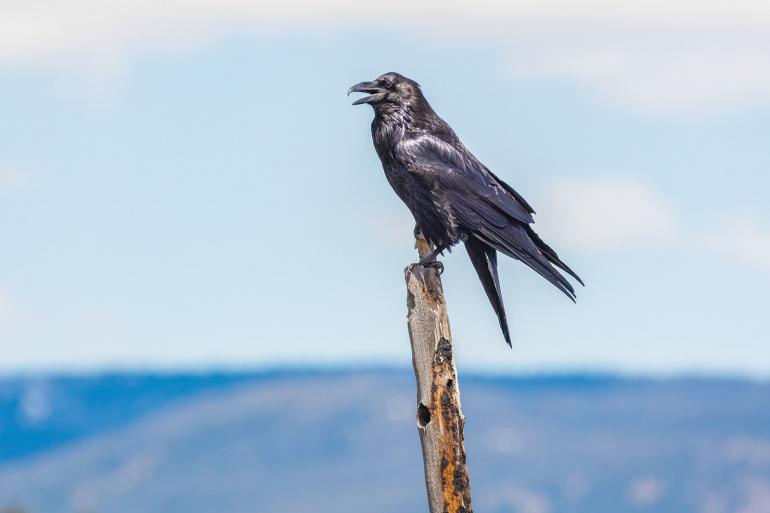
For my part, I talk a lot about Corvus corax these days, particularly the activities of a mating pair nesting in a large spruce tree near my house. I’ve been known to set out for them an open container of worms from a local bait shop and joke to friends that it’s a tossup which party—the raven or the worm—will get me in the end.
Still, each trip out, raven behaviors continue to confuse and delight me.
I feel just a bit wiser for having known ravens.