Montana Made Me Do It
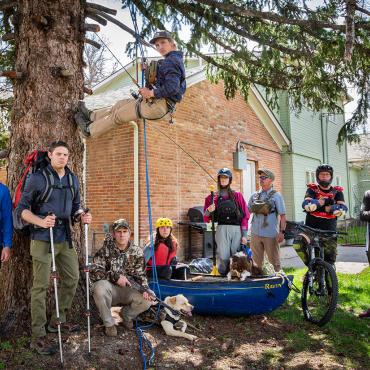
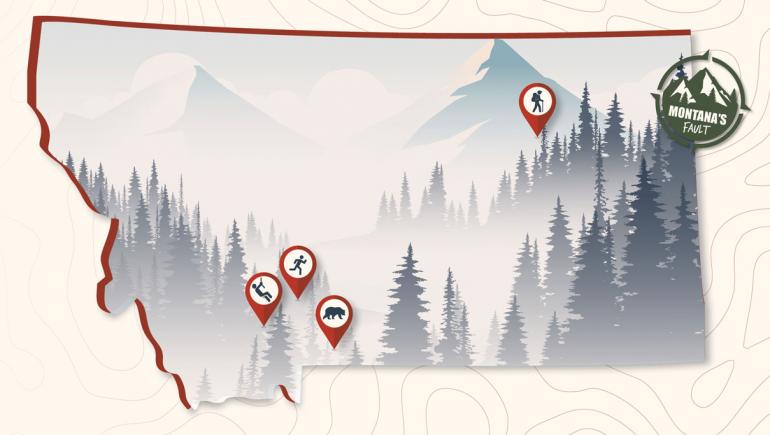
Contest submissions for Spring 2026.
It doesn’t matter if you’re born here, pass through on vacation, or move in from New York City—when the Big Sky gets in your bones, there’s no stopping it. You’ll do things you otherwise wouldn’t, even things you never thought possible. And if you survive, all body parts intact, you’ll probably do it again.
This is the truism behind Montana Made Me Do It, an ongoing compendium of outdoor adventure inspired by the spirit of this great state. In this first installment of stories, there’s everything from reckless route-planning to impulsive risk-taking—all pretty much indefensible to a detached, rational observer unaffected by the Montana mystique.
In each case, the question arises: was it freedom or foolishness? Boldness or buffoonery? Euphoric inspiration or dumbass delusion? You be the judge, but one thing is certain: it was Montana that made ‘em do it.
Tag, You’re It
by Eli Fournier
It’s a solitary May day in the foothills of the Absarokas. Just the wind and the smell of balsamroot as I hike off-trail into a hidden oasis—a spot where a verdant spring creek gurgles off a waterfall into a narrow canyon. Brown trout teem in a large pool at the base of the falls and a mossy nook surrounded by chokecherry bushes provides an idyllic nap spot.
I’m primarily out here to wander and clear my mind, but there’s a rifle strapped to my pack, just in case I cross paths with a black bear. The season’s been open for a while now, but nothing’s felt right. Today, like many other days lately, I don’t feel like killing.
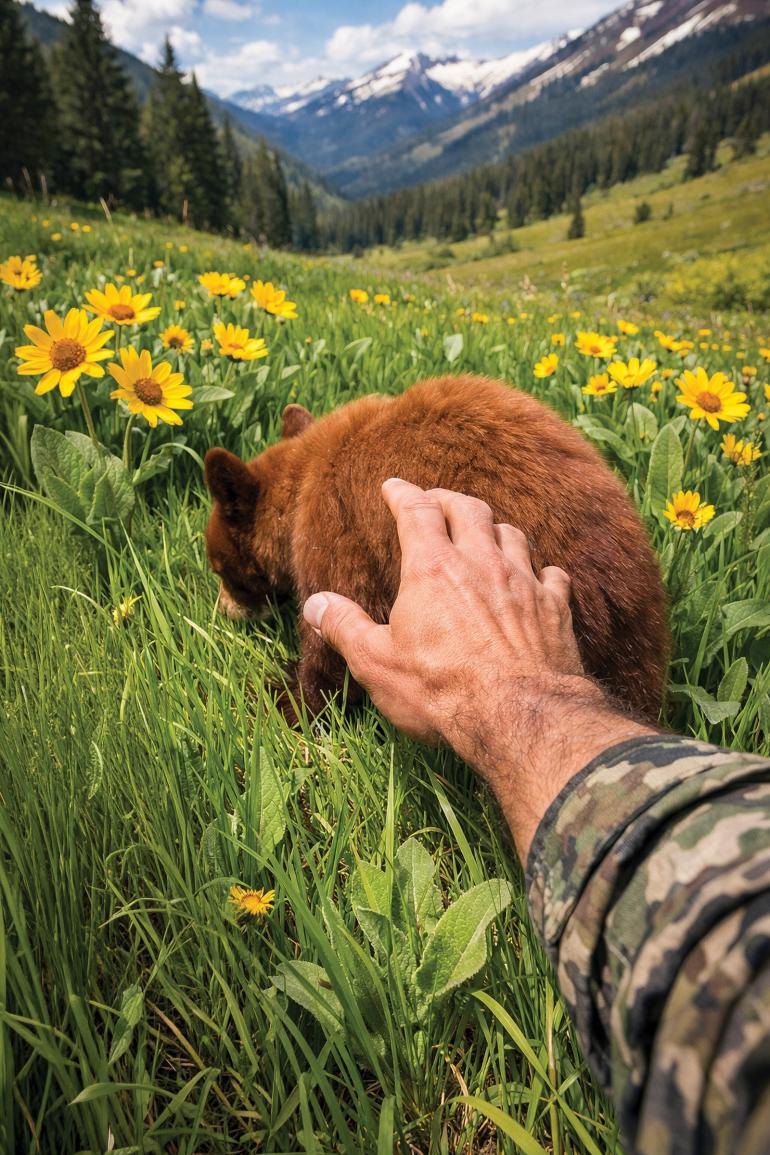
But as I descend the final hill into the canyon sanctuary, an incongruous blob catches my eye. It’s a beautiful black bear. His fur is an explosion of orange—every shade from light brown to red is visible in his pelt, shimmering in the sun. He’s feasting happily on wildflowers and grasses in a wide-open meadow. I pull my gun off and begin to close the distance.
Then I hear it: the mischievous little boy’s voice in my head. Touch it! Touch it! This bear, I realize, is not going to die today.
I creep around a rock outcropping and come out 100 yards above the bruin. The wind is ripping uphill, keeping my scent hidden. The bear doesn’t see me. I sneak in closer.
There’s no concealment now—nothing but a grassy field between us. I slowly rack a round and click off the safety. I could take him here, no problem, but I keep walking, one slow step at a time.
The bear continues to forage peacefully without a clue as to my presence. Then I hear it: the mischievous little boy’s voice in my head. Touch it! Touch it! This bear, I realize, is not going to die today.
I’m close now. A few yards, tops. I can hear the flies buzzing around his body; the sound of his jaws crunching on grass. I can see individual hairs on his back; the shimmer of his sweaty nose.
Then his neck twitches. Likely just to swat off a fly, but in my hyper-aware state I perceive the movement to mean I’ve been detected.
My inner calm snaps like a rope stretched taught. “Hey! Hey bear!” I shout, my voice frantic. The bruin twists his head to see what the kerfuffle is. A flash of sheer panic crosses his face. I can see it in his eyes: the “oh shit” moment before an unavoidable accident. That split-second when both skis pop off in midair and you’re going down hard. That instant when you’re looking down at your handlebars as you sail over them.
My heart is thumping as I stand there, mere feet from where the bear was feeding. I’m giddy with excitement and fear and adrenaline. I feel alive.
Nope, he definitely hadn’t winded me, I realize. I expect the bear to turn and face me—to square up and assess the danger. But before that split-second has passed, he’s running. And not just running—sprinting. Cartoon-style barreling downhill, back legs spinning so fast they look like circles as he charges down the slope and into the timber. Branches and logs snap as he busts through anything in his path.
And then, it’s quiet again. My heart is thumping as I stand there, mere feet from where the bear was feeding. I’m giddy with excitement and fear and adrenaline. I feel alive.
But that’s just what Montana does to a guy, I suppose. It brings out that little boy who wants to fish for frogs in the mud, or pop a salmonfly in his mouth, or balance on a log high above the ground. It makes a guy wonder what would happen if…, and then carry out whatever horrible, terrible, no-good, very bad idea was circulating in his head. It makes a guy do things he wouldn’t normally do, and in the process it makes him feel alive.
Those are the thoughts pumping through my head as I settle into my waterfall nook a few minutes later. I imagine my city friends asking, Why? Why try to touch a bear? What’s the point? There are some things, I realize, that can only be explained one way: Montana made me do it.
Foolishly Afoot
by Phil Knight
There’s a reason tens of thousands of Bozeman and Missoula license plates clog all the trailheads and campgrounds in Utah in April and May. If you’ve lived a few years in Montana, you know that spring is a seriously fickle season. It will tease you with a week or so of gorgeous weather, with snow trickling off the roof and down the storm drains and crocuses popping up everywhere. The chickadees proclaim, “Spring’s here!” and if you are a sucker, you believe them.
It was my sixth April in Montana, and you’d think I would’ve known better, but real lessons are doled out slowly and serious knowledge comes only with experience. My girlfriend Alaina and our friends Carla and Tom got scheming on where we could go backpacking without having to drive 12 hours to Moab. We loved the canyon country, and heard that Montana has some canyons—why not try one of them? The Missouri Breaks sounded spectacular: remote, colorful, wild, scenic, and only a four-hour drive. Surely they would be warmer than the mountains in April, as they’re at lower elevation.
Are you scoffing yet? Just wait. We called the BLM office in Lewistown and asked about backpacking the Missouri Breaks. They said no one does that (because anyone with any brains floats down the Missouri River). We asked if it was prohibited, and they said no. So we loaded up gear and food for a week of backpacking, and drove two cars to Lewistown. We stopped at the BLM office and asked again, and they said we were crazy, but good luck. Watch out for the gumbo, they said. Sure, sure, whatever.
As we progressed, the weather grew colder and windier. It snowed on us twice, and we hiked in several layers of clothing.
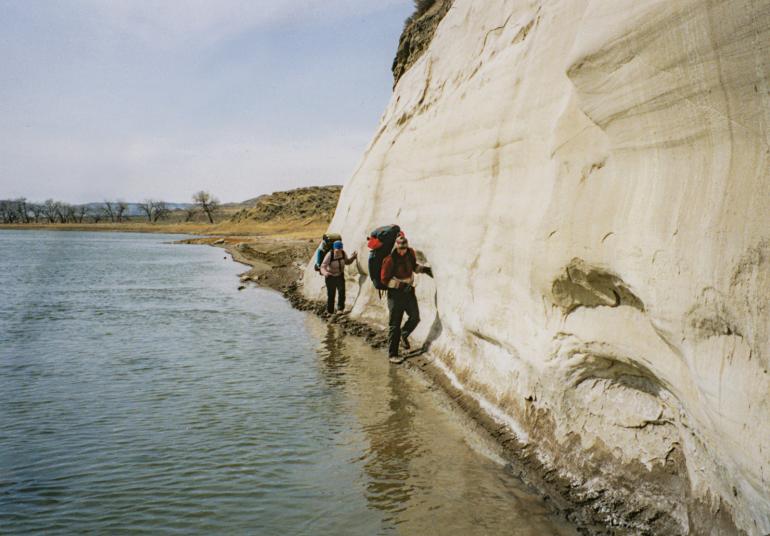
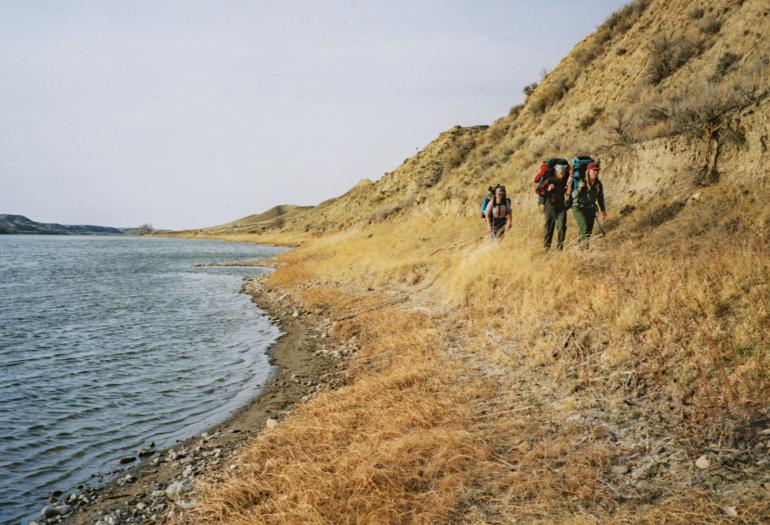
First we drove to the remote Judith Landing on the Missouri, then piled everyone into one car and drove back-roads to Coal Banks Landing. We started out in decent weather, trundling along up and down small canyons and around colorful and crumbly cliffs. Our plan was to hike the south side of the river through the White Cliffs, commonly known as the most scenic stretch of the Upper Missouri River Breaks National Monument. After a few miles, we gazed longingly at the smoothly flowing river, thinking about our canoes at home. But we saw no one boating the river. It was too cold out.
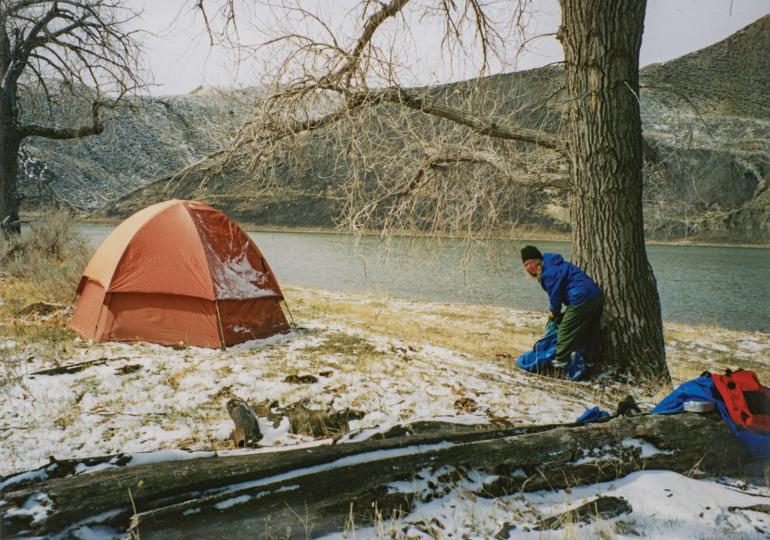
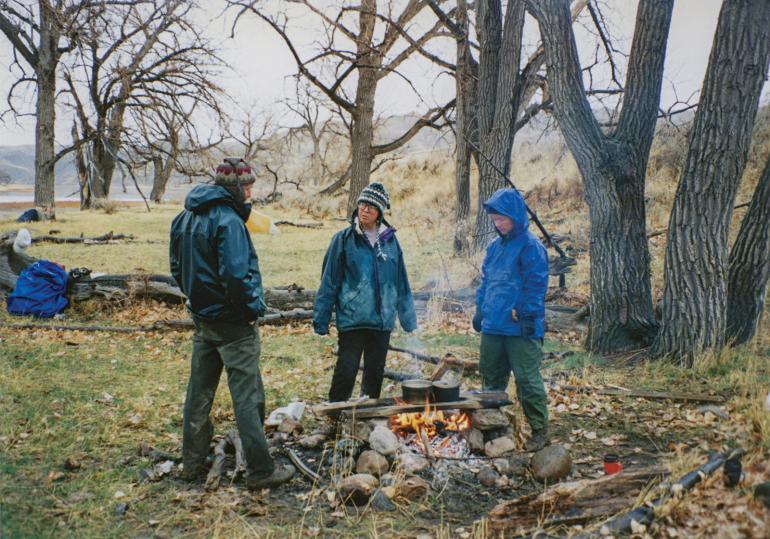
As we progressed, the weather grew colder and windier. It snowed on us twice, and we hiked in several layers of clothing. Temps in the 40s kept us chilled. Each night we huddled around a fire that was pushed around by the wind. One of the worst issues was water. Even though we had a huge river nearby, drinking it was not a good idea. The Missouri is full of runoff from agriculture and mining, and is probably loaded with cow shit, too. The old adage, “Too thick to drink, too thin to plow,” turned out to be accurate. But we needed water, so we had to filter the river. We used two Volkswagen fuel filters as pre-filters, and still destroyed our two actual water filters. The only clear water we got was when we stopped at the only ranch around to beg for water.
Another challenge was, you guessed it, the gumbo mud. The snow melted and turned the bentonite clay into a nearly impassable surface. Each step we made picked up more mud until we had “platform soles” which we would fling off by kicking or scraping on a log. Repeat, curse, repeat, curse.
We experienced the wild beauty of the Breaks, having completed a hike that maybe no one had done since Lewis & Clark or the last Blackfeet bison hunting party.
The infamous Montana East Wind kicked in toward the end of our crazy hike, blowing right in our faces. When we reached the camping shelters at Slaughter River, Alaina dove into her sleeping bag with her muddy boots still on, delirious with hypothermia. We made hot soup for her and all piled in, finally out of the wind.
Our absurd hike turned 47 miles of river canyon into 60 miles of hiking due to all the side-canyons. But we thoroughly experienced the wild beauty of the Breaks, challenged ourselves, and finished in milder weather, having completed a hike that maybe no one had done since Lewis & Clark or the last Blackfeet bison hunting party. We fled to Lewistown to the Whole Famdamily restaurant for vanilla raisin pie, and vowed to return—which we did, in May, with canoes.
What can I say? Montana made me do it.
Runnin’ on a Whim
by Mack Christoph
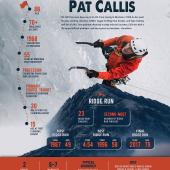
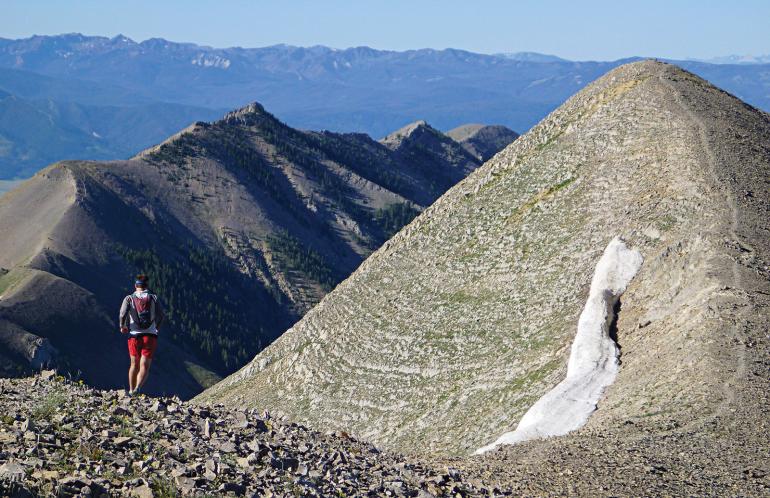
It was a beautiful Montana morning. The air was cool for July and I topped out on Sacajawea before 9am, despite the late start. It was my final training day before the full Ridge Run—an out‑and‑back to Ross Pass. Lower mileage than race day, sure, but plenty of elevation to keep the legs honest. From the summit, the Crazies glowed in the early light, and for a moment everything felt dialed.
Then I saw Matt.
I’d met him a couple times doing M laps—a fellow Ridge runner. He mentioned he was doing the entire Ridge that day. As we talked, I started doing the math in my head. Joining him would result in six extra miles, but probably less elevation gain overall… manageable, if I conserved water. So I asked if he wanted company, and just like that, my training plan became a Ridge recon.
We dropped off Sac and started down Naya Nuki, where we ran into Clint, also training for the race. A quick chat, a shrug, and suddenly we were a trio heading south toward the M, feeling strong and optimistic.
The morning air was still cool as we reached Ross Pass, which helped us conserve water. I reached for my GPS to double-check the route—gone. Somewhere between Naya Nuki and the Pass, it had vanished. I jogged back uphill for a bit, scanning the trail with no luck. So we pushed on, pulling trail descriptions from memory, which is how we made the classic mistake of dropping down the Foothills Trail. It took a full hour before we realized our mistake, but back up the trail we went, until we found a good spot to bushwhack our way to the Ridge. With the detour, we’d added a few of miles and put a noticeable dent in our water supply.
By the time we dropped off Baldy, we were sunbaked, salt‑stained, and running on fumes.
Still, spirits were high as we rolled through Bridger Bowl. The day was warming, but morale was high. We figured the hardest parts were behind us—right up until Saddle Peak came into view, towering over the Ridge like a granite dare.
The climb up Saddle was one of the hardest efforts I’ve ever put in. My stomach was rebelling from too many energy gels, and my water was nearly gone. Matt’s and Clint’s water supplies weren’t faring any better. But luck was on our side: a lingering snowbank appeared just below the summit. We filled bottles, drank melted snow, and found a few more patches as we trekked towards Baldy. Those snowbanks turned a desperate slog into something survivable.
By the time we dropped off Baldy, we were sunbaked, salt‑stained, and running on fumes. Matt’s wife met us at the trailhead with sandwiches and ice‑cold water—a small miracle after eight hours on the ridge. It was also where I learned that chugging a full gallon of water immediately after a massive effort is a bad idea. Matt demonstrated this lesson vividly.
As we carpooled back to Fairy Lake to pick up our vehicles, I watched the Ridge zoom past. The afternoon air had started to cool, and my mind returned to something I’d pondered for a long time: what pushes me to do these things. Ego? Pride? They probably both play a part, but, as I took in the rugged beauty of the where we live, I realized that Montana is what makes me do it.
Flying Free
by Katie Thomas
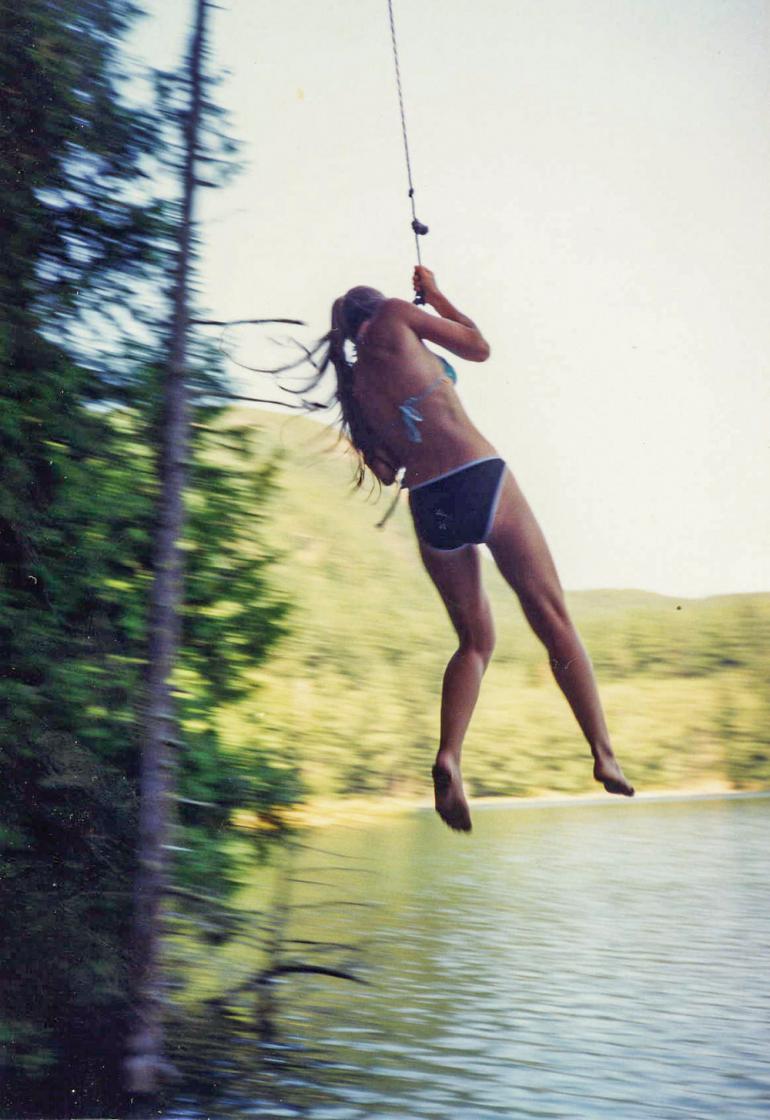
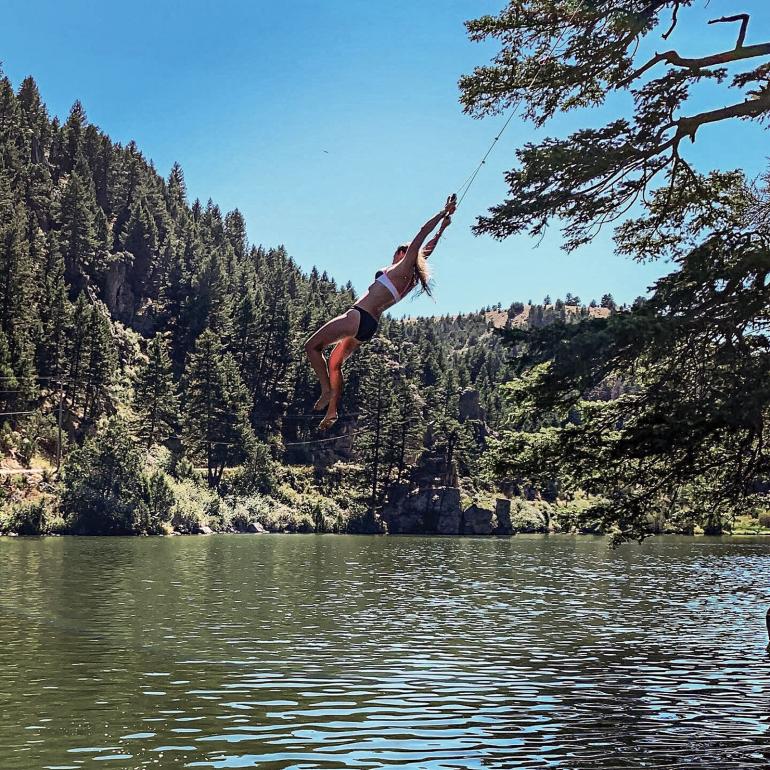
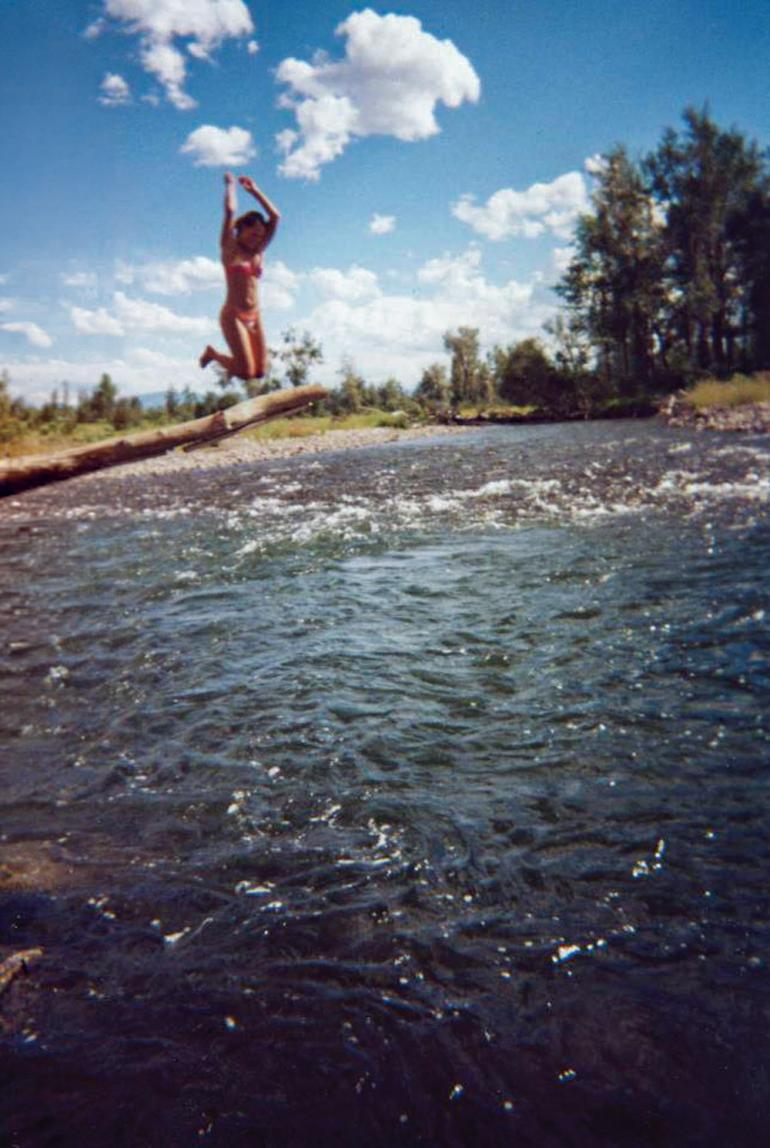
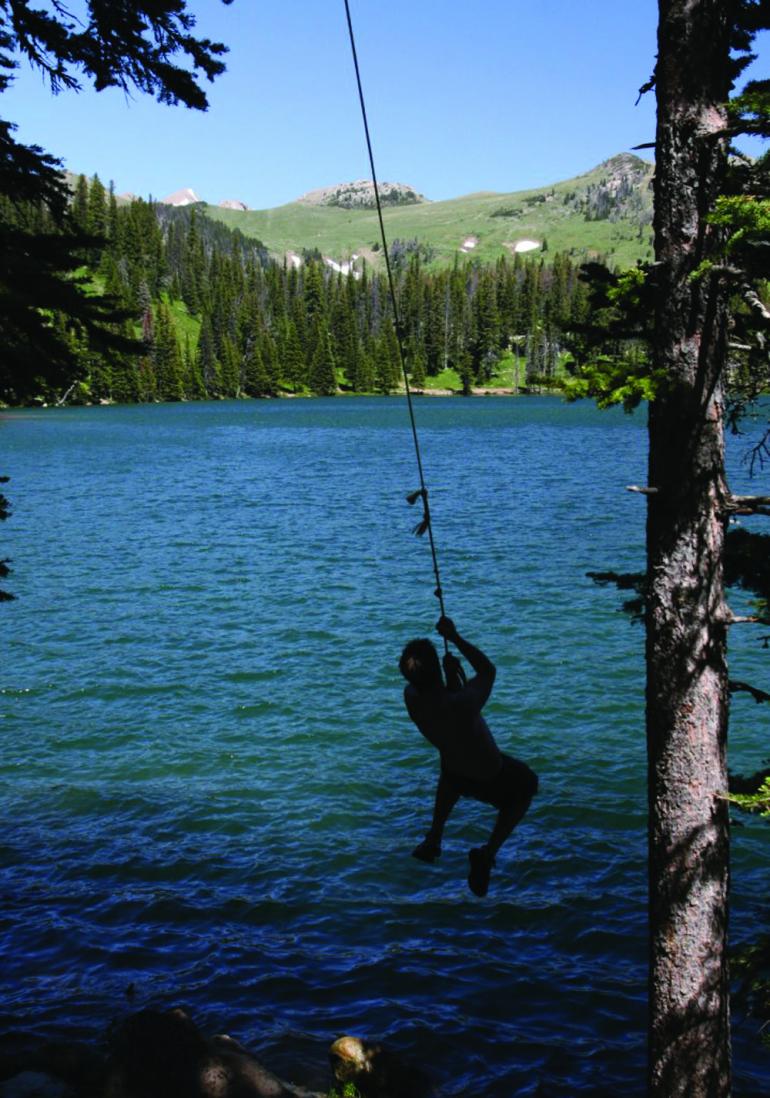
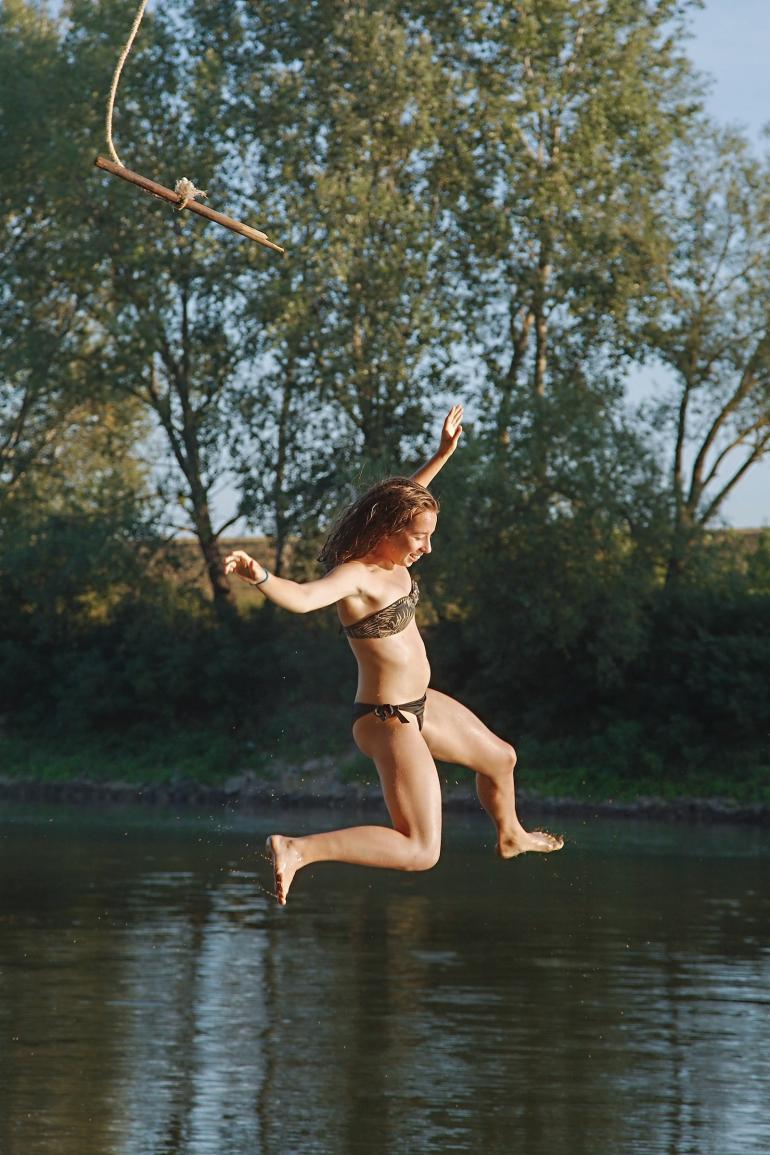
You’re never too old to fly off a rope-swing and into the healing waters of a Montana river or lake. Few things beat this particular version of soaring through the air, knowing you’ll land in the Gallatin or the Madison or whichever waterbody has an established swing. It’s smart to test the water depth ahead of time; nobody wants a broken body. But rope-swinging is a marvelous warm-weather pastime that everyone should try at least once.
My love of swinging on rickety, probably unsafe ropes began in high school at Cameron Bridge. This was before the place was discovered, and my friends and I spent hours out there, undisturbed, as we flew through the air on a rope that some nice (and tall—how did they get up there?) people had constructed. “Meet you at the rope-swing,” we’d yell to each other out the windows of our beat-up Hondas and Jeeps, as we left parking lots and driveways with Marlboro reds hanging from our lips.
This swing meant business—high up a steep bank, tree-root steps leading to a manmade platform, upon which the hopeful swinger stood, waiting for the stick.
Neptune must have smiled upon me, because in college I found myself working summers on a large island, where another benevolent person had installed a rope-swing on the edge of an inland lake, off of which we’d swing before swimming over to a small island for some serious naked sunbathing. When I ponder those days gone by, I think not of the dangers, but only of those hot summer days when I pretended to be Tarzan on a magical island lake.
Cut to another stroke of good luck, where my middle-aged inner fish became friends with an Ennis resident. Despite spending most of my life in Bozeman, I’d somehow missed the swing at the head of Beartrap Canyon. This swing meant business—high up a steep bank, tree-root steps leading to a manmade platform, upon which the hopeful swinger stood, waiting for the stick. Someone else had to pass the rope handle—a repurposed waterski rope—using a large branch, because it hung too far away to reach. The launch was scary, the hang-time huge, and the rush beyond compare.
I’m happy to report that it’s possible to enjoy rope-swinging at any age, and I hope someone has a phone handy to take a picture when I’m doing it at 70.
Got your own tale of Montana-inspired adventure or tomfoolery? Enter here to be featured in the next issue.