Feel the Heat


The innumerable benefits of sauna culture.
“We might as well be on the moon,” I say to James Salter, as we trudge through walls of white that break every few minutes to reveal a false summit ahead and what is clearly another world in the valley below. The Bridger Bowl elder statesman doesn’t hear me, and wouldn’t if I screamed. I glimpse him fleetingly between gusts and barely manage to find his footprints before they are blown clean.
My mind wanders, seeking its own escape from this harsh world of snow and ice. Soon, I’m back in the sweat lodge we shared earlier with our friends from Pine Ridge, South Dakota. They had come to sing and drum while we all “washed off”—a phrase I always assumed referred to places soap and water won’t reach. In the dark and the heat one can clearly hear the sound of the drum beating and the piercing songs that seem to bubble up directly from the earth around us. Drumbeat, heartbeat, heat, and the sound of cold creek water over volcanic rocks that haven’t been this hot since they dribbled out of the bowels of the earth as molten lava. “Grandfathers,” they call them. And as they glow red in the pitch black of the lodge, I can understand how and why we awaken them.
Sweats, saunas, hot springs, and our relationship to them aren’t exclusive to just one culture or region. I’d argue it’s an essential part of our shared humanity that most have forgotten altogether.
The polarities between the heat of that sweat lodge and the biting cold of the wind-hammered mountain are not lost on me. My spirit seeks the warmth of the lodge, while my physical body moves slowly upward through the blinding white towards a steep descent from the summit and a few moments of soft snowy bliss in a chaotic world. Ahead of us, like a mirage, I visualize the first sweat I ever encountered, a dome of red willow tied together with strips of deer sinew and canvas sitting behind an old adobe house in New Mexico. I can trace a line from that first sweat and the little boy I was then, to each and every sweat, sauna, or hot spring that followed, to this mountain ridge all these years later following Salter into the white, and how each of those sweats built the community that stretches from there to here like a story, or a song.
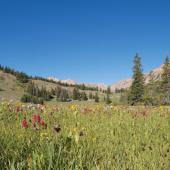
Sweats, saunas, hot springs, and our relationship to them aren’t exclusive to just one culture or region. I’d argue it’s an essential part of our shared humanity that most have forgotten altogether. Many cultures around the world have held strong to their version of the sweat house: the inipi or sweat lodge, which is native to this country; the sauna (Finnish); banya (Russian); temazcal (Mesoamerican/Aztec); hammam (Turkish); and onsen (Japan). This Valley of the Flowers has its own sweat traditions, where the Blackfoot, Lakota, Crow, Nez Perce, and who knows how many others, sweat and sang over millennia. I’d say we’ve lost the importance (and certainly the sacredness) of this simple ritual in our daily lives.
It is well-documented how the first European colonists marveled at the cleanliness of the indigenous peoples they encountered here, unaccustomed to sweats and hot springs, or even bathing for that matter, which was considered laborious and even unhealthy at the time. The majority of us have forgotten the simple benefits of sitting together in community, or alone, in hot, sacred spaces. Sure, there’s been an awakening in recent years, with all the celebrity endorsements and Instagram ads of a sauna / cold plunge lifestyle. Evidence of the rising popularity of saunas surrounds us, from their availability at the local hot-tub superstore, to the new, upscale bathhouse opening on Willson, and from young entrepreneurs who drive around town with a sauna trailer you can rent by the day. It’s no surprise, really, as simply getting in the sauna four to seven times a week decreases all-cause mortality by 40% (according to the health experts, anyway)—not to mention the innumerable benefits to your mind, body, and soul: decreases in inflammation and depression (seasonal or otherwise), improved recovery for sore muscles, etc. We don’t need an excuse to sauna or sweat—it’s just something that ought to be part of the ceremony that is being human and alive.
To emerge from the darkness of the sweat, or a sauna—body steaming, head spinning—and lay on the ground looking up at the infinite leaves me feeling being born anew, weightless in a heavy world.
Sweating is sacred, like being on this mountain. There is no hatred there; no political or religious lines drawn. Everything is stripped down to the essentials, and what remains is the heat, and the sweat, and the community that gathers there.
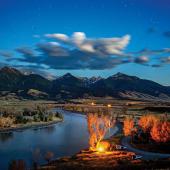
As my mind and body return to the present and the line of white opening up below us comes back into focus, I struggle with all the equipment that allows James and I to momentarily survive atop this mountain. Another break in the clouds reveals the small farm in Springhill where a sauna now sits unused, but where many years ago we gathered with friends and family, building our community around wood, fire, and heat. I can see the cut in the hills ahead that hide the sweats of the Crow and Lakota. How I passed them for years not knowing they were there until I was in them sweating with strangers who became friends. Sweating is sacred, like being on this mountain. There is no hatred there; no political or religious lines drawn. Everything is stripped down to the essentials, and what remains is the heat, and the sweat, and the community that gathers there.