
A new sportsmen’s group breaks ground.
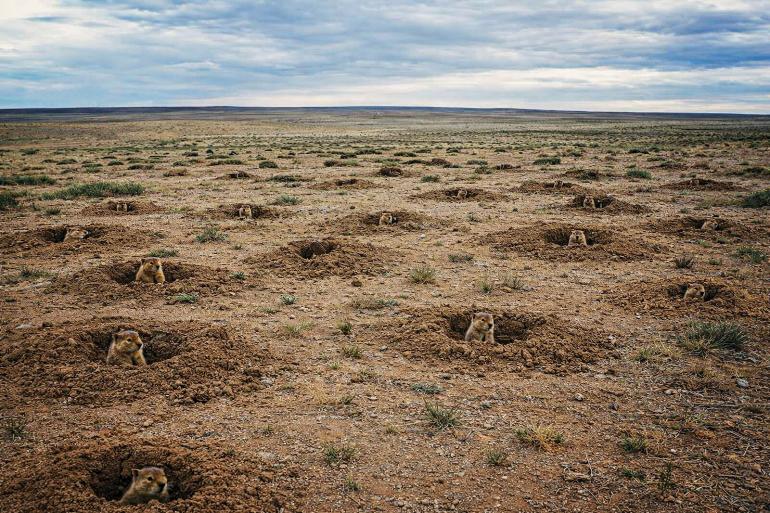
It looks like a scene from the movie Holes: a half-dozen young men, dressed in t-shirts and dirty pants, bent over their shovels, grunting & sweating in the heat of a late-spring day. They’re digging holes—but not just any holes. Nope, these are gopher holes. And the men are volunteers. It’s the latest iteration of a habitat-improvement project for a newly-formed sportsmen’s group in southwest Montana: Gophers Unlimited (GU).
The man behind GU is retired orthodontist Bill Burroughs, who first made a name for himself by training German shepherds to detect the scent of lost retainers. Frantic vacationers, especially those leaving town the next day, paid exorbitant fees for this service. Burroughs later hit the orthodontic jackpot when he redesigned braces using livestock fencing, shortening the wear time from two years to two weeks. At its peak, Burroughs’s revolutionary practice had a dozen technicians, tightening rich kids’ braces and administering extended-release anesthetics five days a week. After retiring at age 40, shuttering his company, and transferring his assets to offshore accounts, Burroughs spent several years traveling the world with a fly rod, jumping between lodges in Belize, the Christmas Islands, and Argentina, searching for big fish and hiding from personal-injury attorneys. But it eventually got boring.
"Fighting a 10-pound bonefish feels great, but can it really compare to the thwack of a well-placed hollowpoint? That’s what I call a real bone-job.”
—Bill Burroughs
“I’d be in the Seychelles, casting streamers in the flats and shuffling funds between shell companies,” says Burroughs, “but in the back of my mind I was sitting on my porch outside Belgrade, shooting gophers in the neighbor’s pasture. I mean, fighting a 10-pound bonefish feels great, but can it really compare to the thwack of a well-placed hollowpoint? That’s what I call a real bone-job.”
A few years ago, Burroughs returned from a tarpon trip to find bulldozers on the adjacent property, razing it to bare earth to make way for a new housing development. He tried heading up Springhill, only to discover recently subdivided 20- and 40-acre ranchettes employing aggressive gopher-control measures to prevent broken legs by horses that never get ridden but sure do look pretty. Everywhere he looked in the Gallatin Valley, it was the same story: gopher habitat was being lost, and at an alarming pace. “I knew I had to act,” he says, “and quickly, before all the gophers were gone.”
VIP guests enjoyed gourmet meals, happy-ending Thai massages, and shooting lessons taught by a Navy SEAL.
Using his network of equally unscrupulous doctor friends, including a cosmetic proctologist who made a fortune selling Botox suppositories, Burroughs made some phone calls and quickly had his first round of donors for the new nonprofit. He organized the inaugural GU Rendezvous, a weekend gathering on a fishing buddy’s 30,000-acre ranch in the Ruby Valley. Along with guided gopher hunts, VIP guests enjoyed gourmet meals, happy-ending Thai massages, and shooting lessons taught by a Navy SEAL. A boisterous live auction capped off the event, with participants paying upwards of $15,000 for high-end .17-caliber precision rifles, customized La-Z Boy shooting chairs, camouflaged riding mowers with gun racks, and rare Winslow Homer ground-squirrel paintings. Homer’s outstanding Jumping Gopher, donated by the Brooklyn Museum of Art, brought in a whopping $25,000. A concomitant online contest involved local artists gathering pledges for AI-generated gopher-themed masterpieces, including the Gopher Lisa and Vincent Van Gogh’s Self-Portrait with a Bandaged Gopher, which added another $10,000 each to the tally.
With full coffers, the fledgling GU got to work. Burroughs recruited former patients from Big Sky, Jackson, and Sun Valley, whose locked jaws and broken teeth had rendered them even more useless in the high society of the Rocky Mountain West. Eager to find meaning and purpose in their lives, they eagerly took up trenching shovels and got to work. “Ip’s good heppin’ da gopers,” mumbles crew chief Stanley Albright IV, whose tanned skin and sinewy frame belies the years he spent hiding his deformed face in his family’s guest mansion, day-trading and playing Super Smash Bros.
Meanwhile, Burroughs worked with the Gopher & Vole Land Trust (GVLT) to establish “gopher-grotto” conservation easements around southwest Montana. The first agreement was with the aforementioned Ruby Valley Ranch, owned by renowned conservationist and tech tycoon John Cook Kassidy. The deal reduced Kassidy’s property taxes in exchange for agreeing not to develop the ranch, which he never intended to develop anyway.
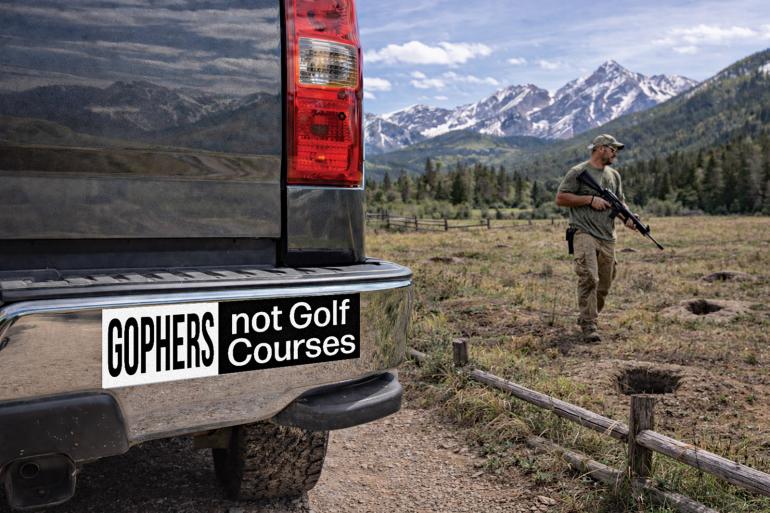
For his part in brokering the deal, Burroughs landed exclusive gopher-hunting privileges on the ranch. He was also tasked with overseeing the habitat-improvement work, which involved berating Albright and his crew for not speaking more intelligibly. After a month of hard labor, staying motivated by singing the classic chain-gang song “Mom Nature Looks Better in Mesh,” the team had tripled the number of gopher holes on the property—landing GU an award from renowned easement facilitator Maximizing Little Rodents (MLR), who gifted the group a thousand of their signature Gophers Not Golf Courses bumper stickers. As Burroughs noted in his acceptance speech, “Home is where the hole is.”
Pasting Little Wild Animals (PLWA) advocates a more traditional approach, one that balances the needs of gophers with the ineluctable bloodlust of red-blooded, gun-toting Americans.
Not everyone in the Ruby Valley, though, was happy with the project. Watching the hole-diggers at work, neighboring rancher Gunner Mann leaned on a fencepost and sighed. “What in the hell,” he grumbled. “I’ve spent my whole life chasing them rodents off my fields, and here these pricks are helpin’ ’em out? What’s next, they gonna pour feathers in there to make the critters more comfy at night? It just don’t make a lick o’ sense.” Mann, who remembers earning 10 cents for each gopher-tail he brought to his grandfather back in the ’70s, just couldn’t wrap his head around the new paradigm.
But ranching in modern-day Montana makes a man adaptable, and Mann soon saw an opportunity. Hmm, he thought, scratching his whiskered chin. Maybe I can charge some of these dipshits to shoot gophers on my place? A quick conversation with Burroughs, and things changed for the better. Albright’s team posted No Trespassing signs along the entire perimeter of Mann’s ranch, and Burroughs ran an ad in the GU newsletter. Within a week, the ranch was booked out.
Mann reserves Wednesdays for golfers, who claim that the added incentive of rendering an unsuspecting gopher unconscious from a perfectly placed chip shot improves their short game.
To appeal to a wider audience, Mann opened his land to more than just gun enthusiasts. “On Mondays & Tuesdays,” he says, “I limit it to paintballers lookin’ to improve their aim. Them gophers don’t know what to make of it. I saw one get hit 11 times. By the end of the day the thing was damn near tie-dyed, like one o’ them Grateful Dead dancin’ bears.” Mann reserves Wednesdays for golfers, who claim that the added incentive of rendering an unsuspecting gopher unconscious from a perfectly placed chip shot improves their short game. On Thursdays, Mann allows kamikaze drone enthusiasts to have their own brand of fun. “It ain’t my cup of tea,” he says, “but I do get a kick out of watchin’ them crash their expensive drones into the gopher burrows while screamin’ ‘Tora, Tora, Tora!’”
Friday through Sunday remains open to traditional hunters. “I charge a $100/day gun fee,” Mann explains, “and the city slickers come shoot the gophers for me.” Gazing across his cowpie-laden, paintball-splattered pasture, he grows thoughtful. “This shit would blow Grandpa’s mind.”
“We don’t want gophers going the way of the elk. Gopher-hunting should not be a sport reserved for the super-rich.” —Ben Blastin
Not everyone appreciates Mann’s opportunistic attitude, however. A local sportsman’s group has stepped up to stop what they see as a dangerous precedent: the privatizing of public gophers. Pasting Little Wild Animals (PLWA) advocates a more traditional approach, one that balances the needs of gophers with the ineluctable bloodlust of red-blooded, gun-toting Americans. In addition to access, PLWA has proposed a permitting system to maintain fairness. “We don’t want gophers going the way of the elk,” says executive director Ben Blastin. “Gopher-hunting should not be a sport reserved for the super-rich.”
PLWA is not alone. Other sportsman groups, along with a few Ruby Valley ranchers, have filed a joint lawsuit against Kassidy, citing “loss of enjoyment of life” due to the blocked access and the monopolization of Richardson’s ground squirrels (this is the actual species name; “gophers” is a colloquial misnomer). “All the gophers have moved off my place,” says Dee Prived, “and onto Kassidy’s, where they know they’re safer. He and his rich buddies don’t even shoot ’em, they just fly-fish for ’em now.”

Despite the opposition, GU appears to be gaining momentum. The group’s coat-of-arms, a gopher standing proudly with an AR-15 in each hand, is now a ubiquitous bumper sticker around Bozeman. The nonprofit is even working on an official DMV vanity plate bearing an idyllic gopher-filled pasture and the tagline, Montana: One Hole of a Place. Smith & Wesson launched a new rifle, the M&P15 GG (Gopher Gun), emblazoned with the GU logo. It retails for $699, with $100 from each sale supporting gopher-habitat projects.
Back at GU’s Belgrade headquarters, Burroughs has big plans for expansion. He anticipates hiring several full-time positions, including lobbyists in Helena and Washington DC to push for habitat protections, and potentially even a “Threatened Species” listing from the US Fish & Wildlife Service. With deep pockets and nothing but time—not to mention a few locked-and-loaded gopher guns—the future looks bright for Gophers Unlimited.
For more information, visit gophersunlimited.com.