Reflections from the Crazies’ Story Trail: On climbing Mount Everest, from the first attempt to the closure of a family tragedy seven decades later.
Two summers ago, many of our 1995 American Mount Everest Commemorative Expedition team gathered in Montana’s Crazy Mountains to dedicate Story Trail in honor of the 100th anniversary of the final attempt by George Leigh Mallory and Andrew Irvine to reach the top of the world’s tallest peak.
Designed as a guided walking adventure in one of southwest Montana’s unique landscapes, Story Trail offers an experience of remembrance in presenting some of the life lessons of select authors, artists, and adventurers from other times and landscapes. Their perspectives may still teach—useful in discussing the host of meaningful intangibles informing the Crazies landscape—and in looking back at how those before considered their own. Encountered are Henry David Thoreau, John Muir, Edward Abbey, Emily Dickinson, Chief Plenty Coups, and others perhaps better or lesser known. Embraced, too, is the story of the pioneers whom intrepidly walked off the planet’s known map in 1921 to discover a way to the top of the world—and became through the dauntless grit of their attempts what Ken Kesey described as “the kind of men we’ll never know again.”
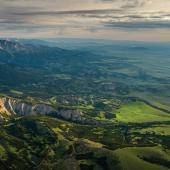
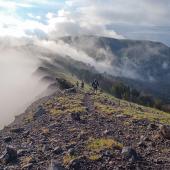
The privately accessible walking tour of Story Trail begins near the eastern edge of Montana’s Crazy Mountains—an island range in a prairie sea the indigenous Crow might call Aa-Maa-Laa-Iila-Da: “Wild Sacred Land.”
While the mystery of whether Mallory and Irvine were the first to summit Everest continues to dominate the narrative of these earliest pioneering expeditions, more than a residue of earned virtues still compellingly resonates from these seminal 1920s climbs: that exploration begins in the imagination, that persistence is the best antidote for failure, that greatest loss may lead to greater wisdom. That triumph is in the trying. That givers make a better climbing team—with none better at this than Sherpas from the high Himalaya. Immeasurably, that honoring the process of getting up the mountain is as important as standing on top.
This mystery, and the pair’s position on Mount Everest when they were last spotted, vaulted Mallory and Irvine to legendary status. Even today, historians and mountaineers speculate that they were the first to climb to the top of the world, almost 30 years before Edmund Hillary and Tenzing Norgay. In 1953, the feat was monumental—had it taken place in 1924, it would have been little short of miraculous. Disciples of H.D. Thoreau’s Walden, and chastened by World War and pandemic, these adventurers chose to “live deliberately” as they pursued the seemingly impossible, “and, not, when they came to die, discover that they had not lived.”
Hillary would set the tone of our own expedition in a letter he wrote before our departure, with characteristic grace: “In my view Mallory will always go down in history as the great man of Everest, the man who made the first great footsteps which some of us later followed.”
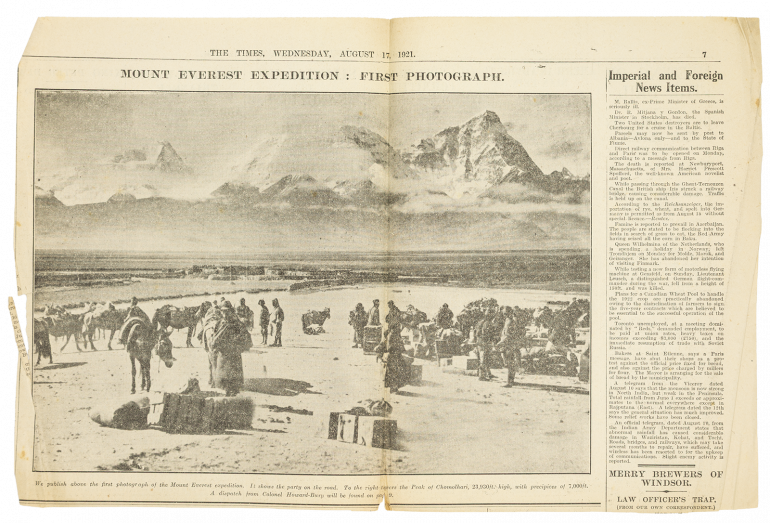
First photograph from the 1921 Reconnaissance Expedition
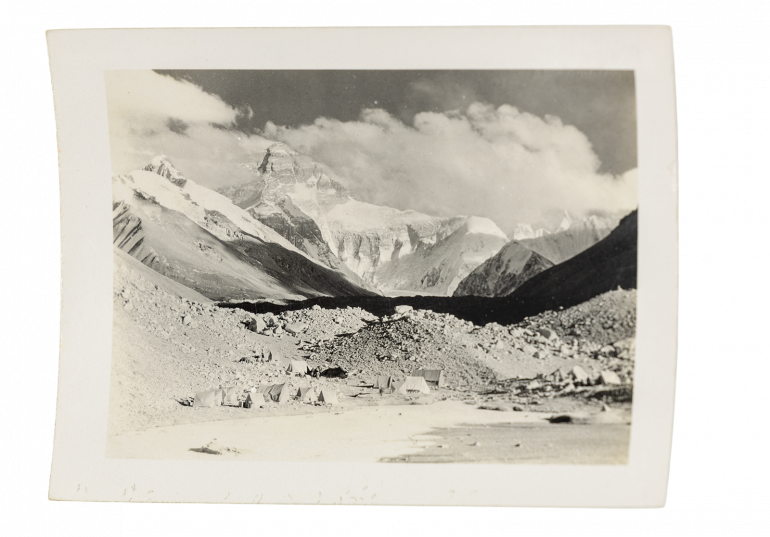
1921, 1922, 1924 Everest Base Camp
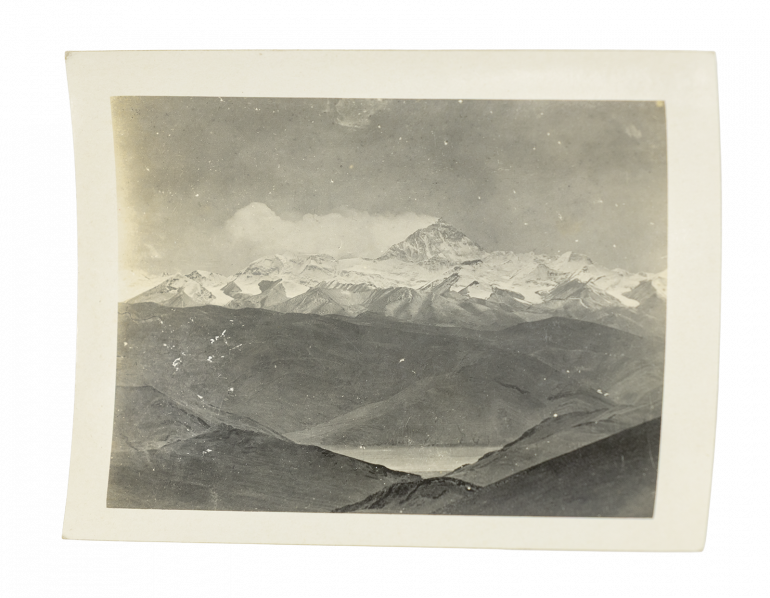
Mount Everest's north face and summit plume, 1924, likely taken near the Pang La (Pass) and Tibetan Rongbuk Monastery
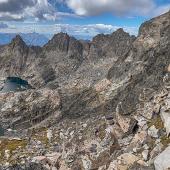
Fittingly, the privately accessible walking tour of Story Trail begins near the eastern edge of Montana’s Crazy Mountains—an island range in a prairie sea the indigenous Crow might call Aa-Maa-Laa-Iila-Da: “Wild Sacred Land.” Formed in part by volcanic activity—seeping magma through sandstone and shale—like Everest and the Tibetan Plateau, this landscape also teaches. Where the life lessons of these British mountaineering pioneers, and other explorers and artists, may be celebrated. Among them, the Crow Chief Plenty Coups, whom experienced his iconic vision quest presaging the defeat of Custer’s 7th Cavalry—and not far from Story Trail: “I decided to go afoot to the Crazy Mountains, two long days’ journey from the village. The traveling without food or drink was good for me, and as soon as I reached the Crazies, I took a sweat bath and climbed the highest peak.”
The Crazies, like the Himalaya, are places of remembrance and landscapes for the eternally curious. Where, as Edward Abbey was graced to discover in Desert Solitaire, “the air is untroubled and you may become aware… of the immense silence in which you are lost.”

Eastern edge of the Crazy Mountains

Story Trail, heading west
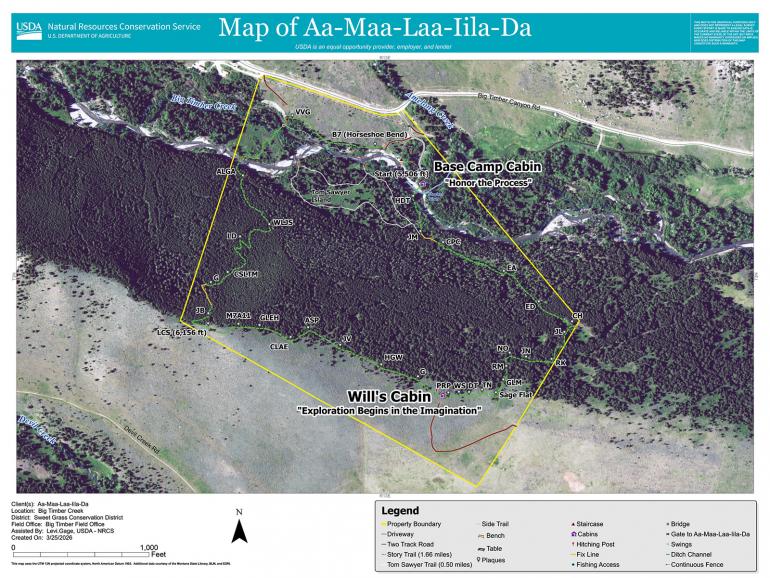
Map of Story Trail and surrounding environs

Story Trail interpretive guide.
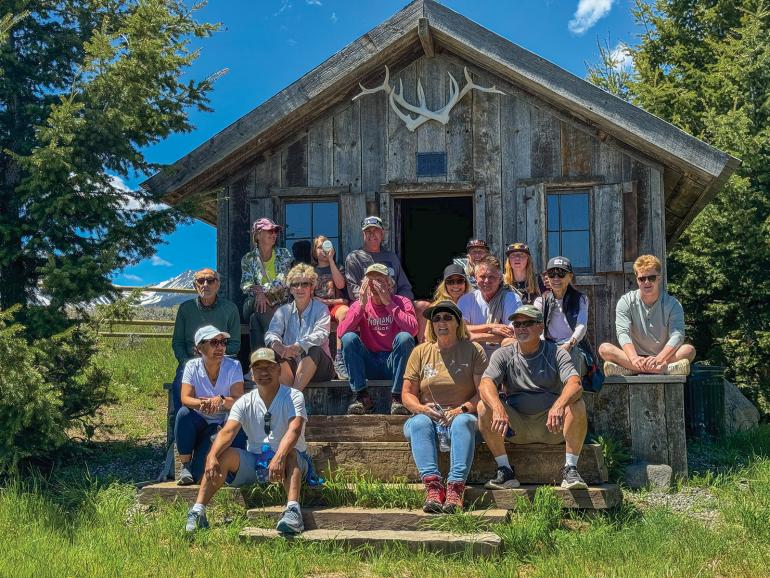
Story Trail dedication team
In 1995, our expedition had retraced the route of the pioneering British expeditions, with teammate George Mallory—grandson of the iconic Everester—summiting the mountain by essentially the same route his grandfather and Irvine had attempted, and may have succeeded, nearly 71 years before. Blessed with the extraordinary DNA of his grandfather, George was one of the first from our team to summit.
His father John, just three years old at the time of his legendary father’s death, joined him at our base camp—the original site of the 1921, ‘22 and ‘24 British camps—in come-full-circle tribute following the tragedy that had changed the arc of his family’s lives on June 8, 1924. In the years before our adventure, getting to know Clare Millikan—sister to John and eldest daughter of George Leigh and Ruth Mallory—had proved the synchronistic catalyst that ultimately resulted in recommending her nephew to our expedition.
I hoped the memorial would act as a reminder to future generations of mountaineers of the need to keep in reserve enough time and energy for a safe descent, that climbing Mount Everest is not worth the loss of one’s life. —John Mallory
In the days before our George would make his summit attempt, John arrived in the company of renowned Everester David Breshears and British mountaineering historian Audrey Salkeld to dedicate a memorial plaque on behalf of those lost on the pioneering climbs.
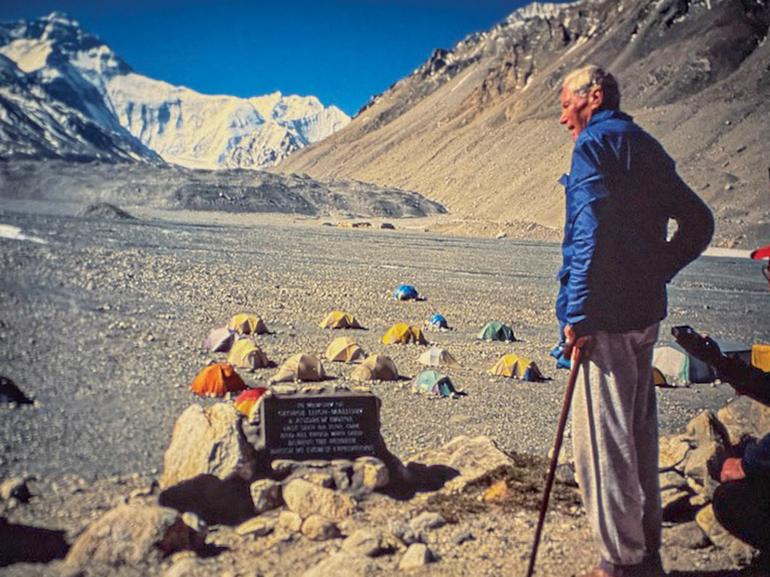
Years later, in a letter from his home in South Africa, John recalled: “Early on Saturday morning, when the sun was giving some welcome warmth and before the cold wind had started to blow, we gathered for a little ceremony of dedication. George read two passages from books about his grandfather. I thought I was prepared to speak, but found the occasion so poignant that I was almost struck dumb! Eventually I did say that I hoped the memorial would act as a reminder to future generations of mountaineers of the need to keep in reserve enough time and energy for a safe descent, that climbing Mount Everest is not worth the loss of one’s life.”
And, in the same letter, with “excitement, joy, and pride” in his son’s success, but more in his safe return, John reflected on Providence’s role: “It seems to me that those mysterious forces which ultimately control the universe have a way of bringing things together far better that we mere mortals could ever had managed … So often I have found the timing of events so apt, so perfect, that I have to believe it has not happened through random chance.”
A glow on the eastern horizon signaled that sunrise was imminent. It then occurred to me that very few climbers, if indeed any at all, had witnessed sunrise from the highest vantage point on Earth. —grandson George Mallory
When first invited, George was reluctant to join our expedition. The prospect of missed opportunity and unfinished business on Everest’s North Ridge, however, nurtured the necessary clarity to change his mind. “My decision approached like a juggernaut—Everest was inevitable. The expedition, for which I was surely destined, was knocking on the door.” Later, invisibly accompanied by Beethoven's 7th Symphony, 2nd movement, he recounted his emotion on bringing closure to the tragedy of the Mallory family legacy:
“A glow on the eastern horizon signaled that sunrise was imminent. It then occurred to me that very few climbers, if indeed any at all, had witnessed sunrise from the highest vantage point on Earth. The thought so inspired me that I decided to race the sun to the summit and so increased my pace.
“Chirring and I were about halfway up the final pyramid when the sun’s first rays struck the snow and I realized I had lost the race. I looked out to the west and saw Everest’s immense shadow stretching to the horizon past a multitude of Himalayan giants and experienced a growing sense of imminent victory. After a few more minutes of struggle, we emerged onto the final summit slope and there, just 100 metres away, was the top of Mount Everest. Emotions overwhelmed me as I realized that nothing would stop me.
“From my pack I retrieved a small laminated photograph of my grandparents George and Ruth, and knelt down to place it in the snow. This was a profoundly moving moment, and which symbolized the unarguable completion of a family project. No more did my grandfather’s name weigh me down. Jeff, relating to the moment, said: ‘George, your grandfather would be proud of you.’ The love George and Ruth had for each other always inspired me and I find it appropriate that their photo is on the summit of George Mallory’s dreams.”

George Millikan, Clare’s son and grandson to George Leigh Mallory, was invited to contribute his thoughts on dedicating Story Trail: “At 84, I am the oldest grandchild… I think that my grandmother, Ruth, could probably have dissuaded her husband from going to Everest in 1924, but she felt he would be diminished for the rest of his life, if he missed the opportunity to be part of a successful team. He told her he would be careful, but I think they both knew that it would not be the safest adventure in the world.” In retrospect, George knew his grandparents well. In a letter to Ruth shortly before his final attempt, the grateful Leigh Mallory wrote: “Darling I wish you the best I can—that your anxiety will be at an end before you get this… Great love to you, Ever your loving George.” And after, her terrible loss undiminished, Ruth—ever the giver—with gratitude, would write “It is his life that I loved and love.”
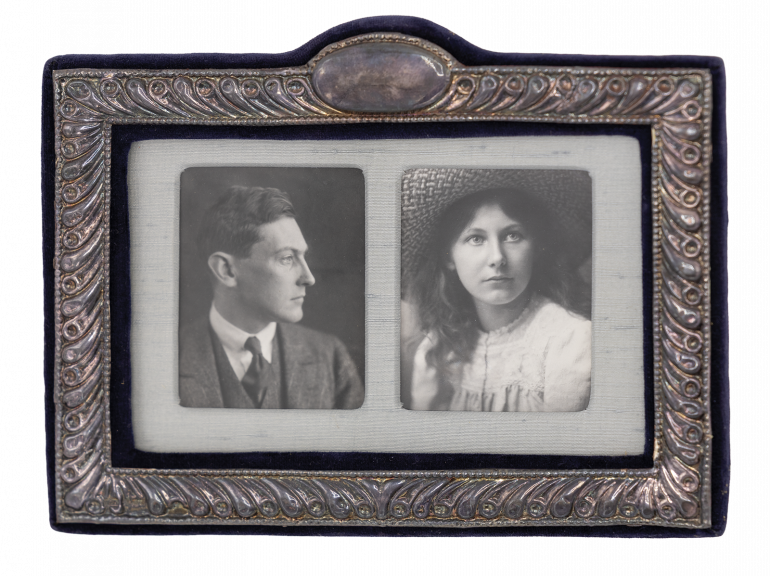
In the years before our expedition, a host of historical research served as the foundation for the commemorative perspective of our adventure. Testimony from surviving ’24 pioneers Noel Odell and John Noel compellingly recounted memories of their lost teammates. Input from ’53 Everest expedition members John Hunt, Edmund Hillary, George Lowe, and Michael Ward was also gratefully welcomed. And, too, from later Everest climbing generations: Tom Hornbein, Chris Bonington, Reinhold Messner, and others.
Before his death, Odell met me at Cambridge’s Blue Boar Inn, a tavern that his Everest teammates had frequented, where he carefully recalled his last sighting of Mallory and Irvine. Blessed with a Renaissance intellect and abundant kindness, he was the essential teammate, and later in life a geology professor at Harvard and Cambridge. His discovery of Everest’s fossil record would confirm that the world’s tallest mountain was once a seabed, an evolving landscape tectonically forged to become the planet’s highest stage—and for climbers, its most ruthlessly indifferent adversary. Over the din of the inn’s younger crowd, Odell, with certainty, offered: “I can give very little that is convincing to anybody, having seen them as I did, definitely on their way up the snow slope and not at the Second Step as I made a mistake, but below the First Step.”
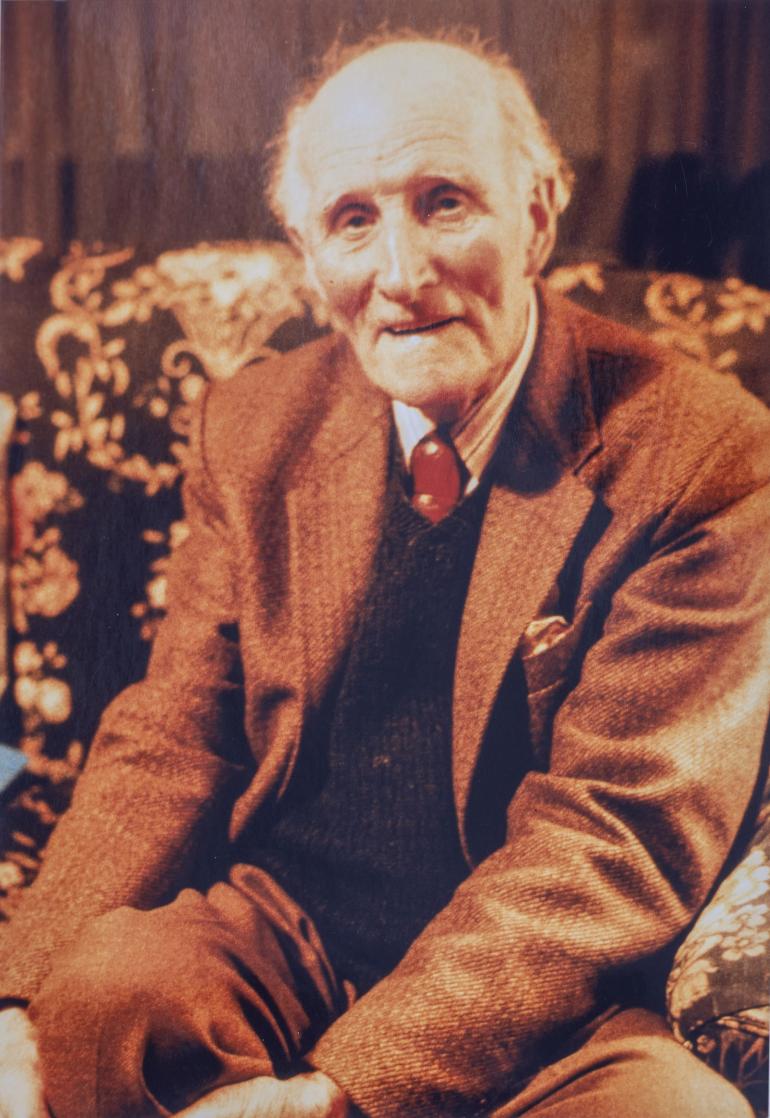
Mallory and Irvine were never seen again. And though Odell continued to the North Face high camp, in hopes that his friends might have returned, he found nothing. He signaled the simple message “DEATH” to Lieutenant-Colonel E.F. Norton—the leader of the ’24 Expedition and successor to General Charles Bruce—who was anxiously awaiting at Camp 3. Inevitably, the tragic news reached England, with the nation left in mourning.
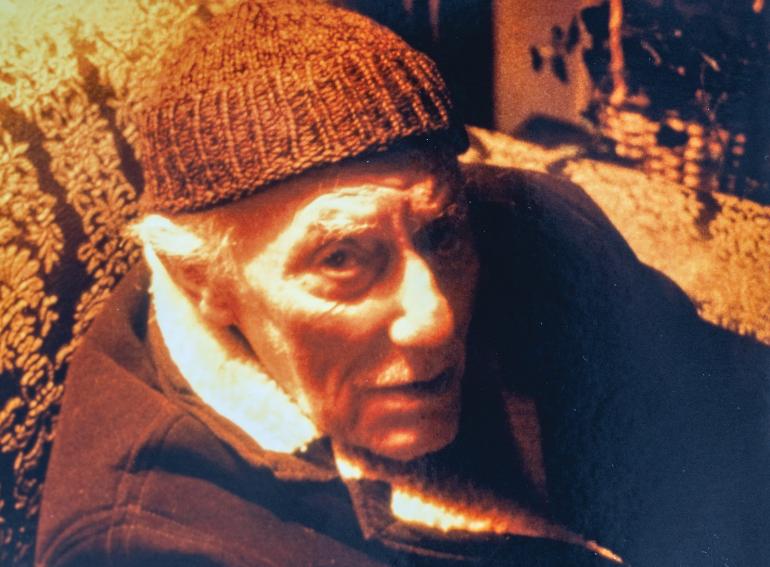
In the year before meeting Odell, a late-night London train delivered me to Romney Marsh and the home of the ’22 and ‘24 “Epic of Everest” cinematographer, Captain John Noel. In 1913, ever the adventurer, he inventively traveled in disguise as a Buddhist pilgrim through forbidden Tibet while on leave from his regimental posting in India, escaping armed bandits, and nearly reaching Mount Everest. Now, as the rain pattered on century-old windowpanes, he spoke of his role in the ’24 Expedition. A wood fire cast deep shadows across the otherwise darkened cottage as the 95-year-old British officer told me of his lost friends. His clear blue eyes glimmered in the dim light, belying his age.
“When last seen, they were four hours behind schedule—nobody knows why,” Noel said, his words almost inaudible because of the pattering rain. “They were seen to be going forward toward the top. Did they ever get there? That’s what people ask. They never got back, and they were never found. What happened to them is an everlasting mystery.”
In life these were Thomas Wolfe’s “Men in Full”—pioneers who possessed “The Right Stuff” well before their Mercury and Gemini and Apollo brothers would ever fly to the moon.
But getting to know the iconic George Leigh Mallory and the era that would define him and his teammates was best served in reviewing the years of correspondence with beloved wife, Ruth. Archived at Cambridge’s Magdalene College, the sustained beauty of their relationship—with challenges presented by the 1918 pandemic, world war, the fatigue of loneliness, but also resilience—meticulously chronicled the shared intimacy of these mostly tumultuous years. Research in England at the Alpine Club and Royal Geographical Society converged to reveal a nuanced understanding of the seminal beginnings of these 1920s expeditions—and the complex political, logistical, and team dynamics needed to successfully launch them.
This would lead to experiencing the landscapes that shaped the lives of these Great War survivors: the fields of France where the trenches of 1914-18 had seen so much death, and the wild of North Wales’ Snowdonia that had sowed so much joy—and where George Mallory had honed the foundation of his climbing skills. Time spent at "Westbrook" house in leafy Godalming, England— home to George and Ruth during his Everest years—still resonated with the imagined laughter and chaos of their young children Beridge, John, and Clare. Interviews with then-aging Charterhouse students of Mallory informed of their abiding respect for his thoughtful kindness. And expeditions to Everest’s North Peak Changtse in 1988 and 1990 contributed to our greater familiarization with the route-finding challenges that had plagued the 1921 Everest Reconnaissance Expedition. In all, a collection of experiences that converged to define the commemorative spirit of our team.

At the English seashore, between Everest expeditions, George Leigh and smiling first daughter Clare
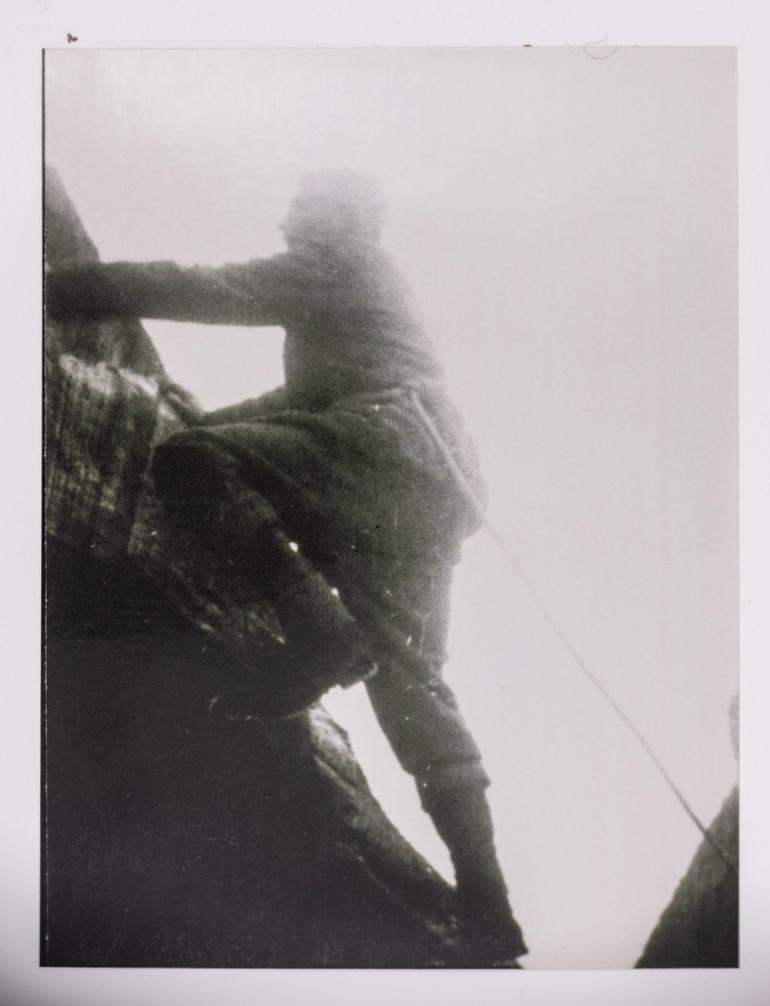
George Leigh Mallory before his Everest years, in rare climbing form, Snowdonia, North Wales
In 1999, Mallory’s remains would be discovered not far from our North Face high camp, where his grandson set out for the summit just four years earlier. In 2024, the universe would also reveal what appeared to be the partial remains of Irvine, thousands of feet below his climbing companion’s final resting place, on Everest’s Central Rongbuk Glacier.
Separate, though, from the forensic significance of these converging revelations—potentially contributing to the resolution of one of the greatest mysteries of 20th-century exploration—is the more compelling reminder that in life these were Thomas Wolfe’s “Men in Full”—pioneers who possessed “The Right Stuff” well before their Mercury and Gemini and Apollo brothers would ever fly to the moon. These Everesters “dwelled” in Emily Dickinson’s “possibility”—with carbon-hard commitment and Providence to challenge Earth’s “Third Pole” their best antidote against failure. As Kipling’s poem “If” reminded from their childhood, that undiminished persistence through the “Triumph and Disaster” of their pioneering climbs would become their North Star.
Primitively dressed in gabardine and silk, cotton and wool, and hobnailed boots, these were the first astronauts—their success in the trying—venturing to an oxygenless, Force Ten landscape as deadly as the mustard-gas battlefields of the Somme and Argonne many of them experienced from 1914 to the war’s end. Undaunted, joyously, they did their best. And just as John Muir a generation before exalted in climbing the Cascade’s Mount Shasta—“The great storm continues. The wind sings gloriously in the pine trees…”—so, too, did Mallory, as he and Irvine left from the shelter of their canvas shell to a final rendezvous with the stars: “We shall stomp to the top with the wind in our teeth.”
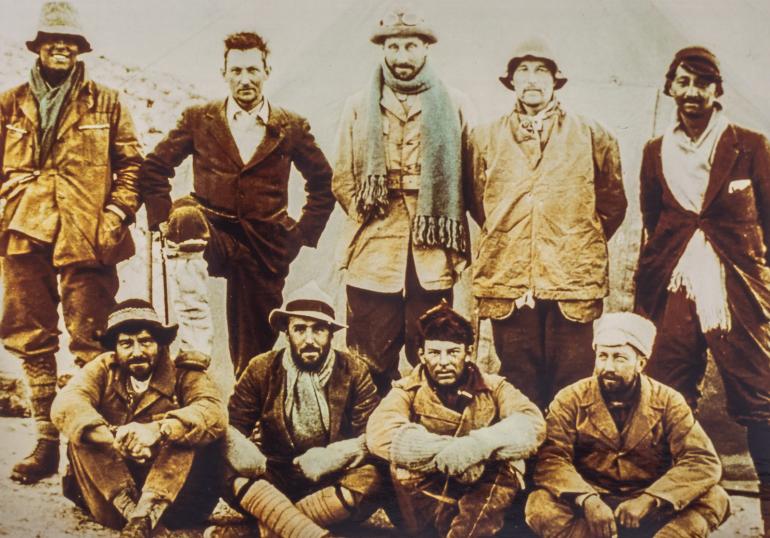
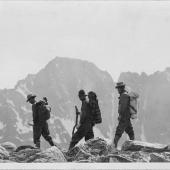
1924 Everest team. Back, L-R: Irvine, Mallory, Norton, Odell, Macdonald. Front, L-R: Shebbeare, Bruce, Somervell, Beetham
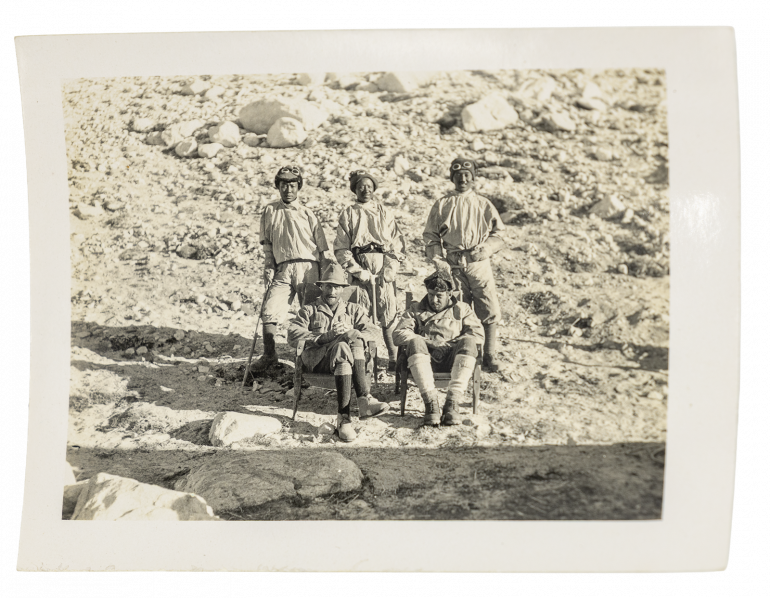
The first Sherpas to carry oxygen above 8,000 meters in support of the 1924 British summit attempts. Back, L-R: Sherpas Norbu Yishe, Lhakpa Cheri, Semchumbi. Front, L-R: Norton, Somervell.
In years to come, John Noel, himself a survivor of then-described “battle fatigue,” would mindfully contrast the calamity of death he had witnessed on the Great War’s Western Front with the loss of his beloved teammates: “If you had lived as they had lived in the heart of nature, would you, yourself, wish for a better grave than a grave of pure white snow?”
There may yet be lessons learned from the exquisite tragedy that consumed Mallory and Irvine. Our team faced this, too, with the death of teammate Dave Tollakson on a training climb in the year before our expedition. And like Captain Noel, we would find measured comfort in leaving some of Dave’s ashes on Everest’s pure, white snow. To the top—the symbolic completion of his quest to climb the highest mountain on each of the planet’s continents.
Borrowing from C.S. Lewis’s Miracles: “Everything is connected with everything else, but not all things are connected by the short and straight roads that we expected.” And in looking back, as stardust, the not-so-little trail of synchronicities that had inevitably led our team to the high Himalaya and Story Trail in Montana’s Crazy Mountains was not the “short and straight road” that any of us might have expected. Connected, though, were the learned lessons—remembrances—from each landscape, and from those who lived before. As Chief Plenty Coups might have said, and Sherpa Tenzing did: “Thuji Chey, Chomalungma.” I am grateful. The most meaningful intangible of them all.
Paul Pfau was the 1995 American Mount Everest Commemorative Expedition leader. With others, he built Story Trail on his property, near the end of Big Timber Canyon Road at the eastern edge of the magical Crazies.