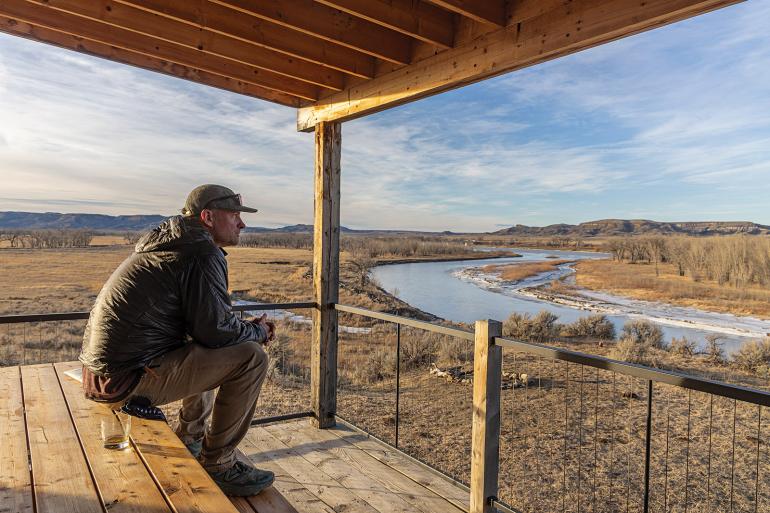
Reflection and solitude on the American Prairie.
Setting out across the landscape from the Lewis & Clark Hut, Simon calls out, “The Mighty Mo!” We are on the westernmost property of American Prairie—often referred to simply as “AP.” The parcel we’re on today encompasses nearly 60,000 acres, but collectively AP has acquired over 600,000 deeded and leased acres, from the confluence of the Judith and Missouri rivers, extending east to the borders of the Upper Missouri River Breaks National Monument and the Charles M. Russell National Wildlife Refuge. It’s a seemingly endless corridor of protected public lands interspersed with private rangeland.
AP’s goal is fairly simple: restore the great, western prairies. But considering less than one percent of the short-grass prairie that once covered North America, from the Rocky Mountains east to the Mississippi, now remains, it’s an audacious goal. And it’s not without opposition.
As you approach the AP from Winifred, the last outpost in a cowpie- and alfalfa-laden landscape, you begin to see “Save the Cowboy” signs on the side of the road. They’re intended, I suppose, to invoke some fuzzy western nostalgia that I do not possess. Before the cowboy, there were the myriad indigenous tribes that were part of a diverse and abundant landscape, harsh and unforgiving as it was. And before them, maybe just the wind and water over sagebrush and yucca; and before that, dinosaurs. If all of this adjusted to what came next, what makes the cowboy special?
As we navigate the cuts and mudbanks through fields of sagebrush, it’s mostly silent save the wind that blows us east with a fury. It’s early spring out here in the Breaks, and we seem to be the only things moving around on this 50-degree afternoon.
Whatever one’s position on these political land squabbles, nothing gets done on this scale without collaboration of all the peoples that now call this place home, from the Aaniiih Nakoda community on the Fort Belknap Reservation to the north, to the agricultural and “cowboy” communities in the tiny towns like Winifred.
Today, Simon and I are setting all that aside. We’re simply here to enjoy the landscape. As we navigate the cuts and mudbanks through fields of sagebrush, it’s mostly silent save the wind that blows us east with a fury. It’s early spring out here in the Breaks, and we seem to be the only things moving around on this 50-degree afternoon. Long gone are the herds of wild bison that were once large enough to shape the very landscape we now traverse, but AP is tending a small, growing herd that roams mostly free on their properties and adjacent, leased public lands (see editor’s note at end).
Historically, bison footfalls and wallows were as essential to this ecosystem as the prairie-dog community we just stumbled into. I can hear the alarm call from a sentinel, who stands tall above his burrow. The prairie dogs have different calls for all the predators out here: rattlesnakes, coyotes, weasels, eagles… the list goes on. But I can’t tell the difference, and am content just to watch them run roughshod for their burrows in a panic.
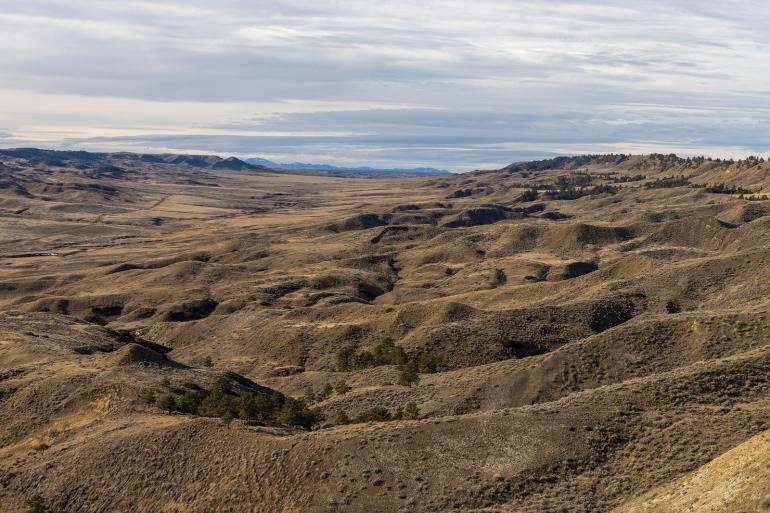
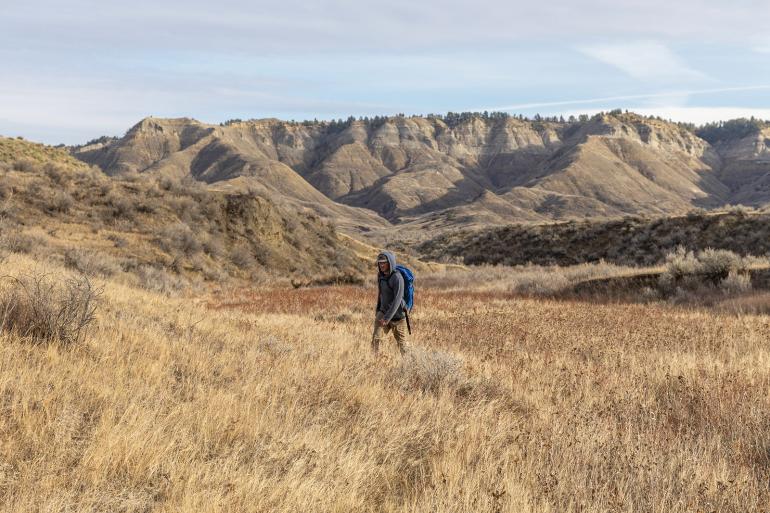
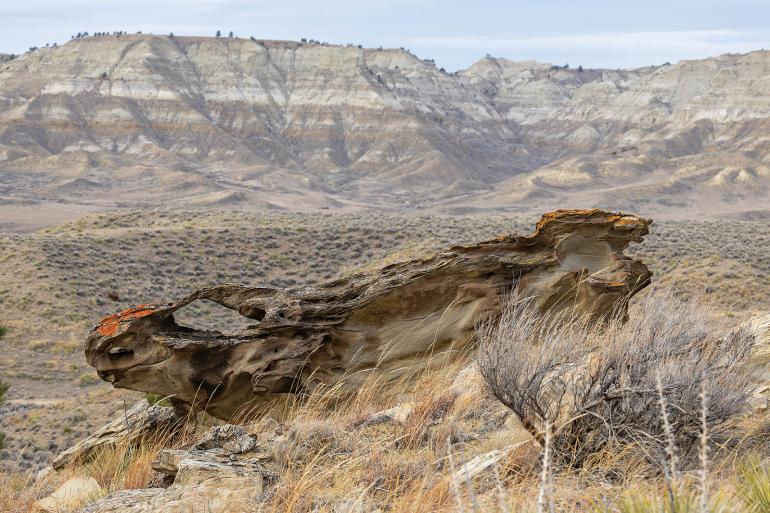
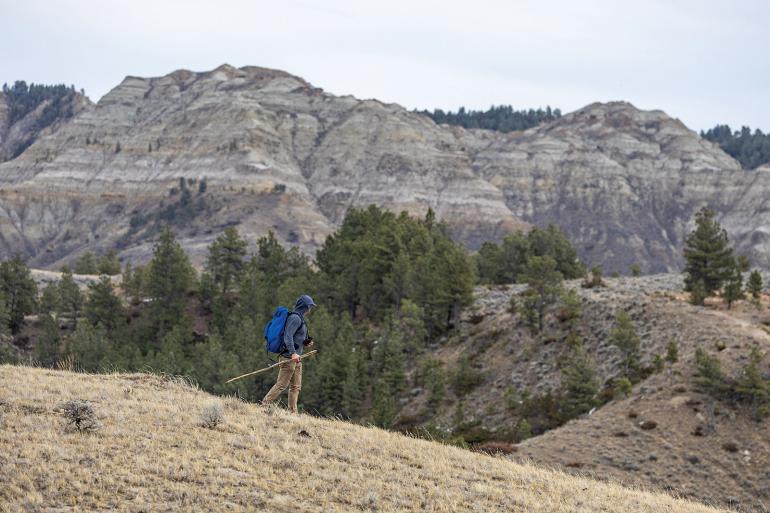
We then cut north and try to reach the river, following the running water that seems to come from everywhere as it forms deep channels in the landscape before trickling into the Missouri. Most of the side canyons are impassible and we must go further up the plain to cross and continue north. The smaller canyons, we glissade into and scurry up the other side with an underlying sense of panic at that ancient animal instinct of being momentarily trapped.
Old gnarly cottonwoods line the bank here, another keystone species for this ecosystem that can’t do its regenerative work due to the lack of natural flood cycles that ensure the species’ survival. Their scattered sheds or “widow-makers” litter the ground from the incessant wind. Hiking the riverbank now, we search for animal carcasses and watch the eagles work the water. “Land snorkeling” is what they named the phenomenon in the info book back at the hut, and it’s something I imagine Simon and I have been doing since our parents first opened the door and told us not to come back until dark. As perhaps the last generation to have grown up without phones stuck to our faces, land snorkeling was just a normal part of our adolescent lives, and something the harsh realities of adulthood could not rob from us. In part, it’s why we are friends, and why we are out here with smiles on our faces in the wind and the mud.
There seems to be no limit on how far we could go or where we can roam.
Out here, the landscape strips away everything that’s not important. Taking off across the plains, following the contours of the land, the paths of least or moderate resistance, and following our curiosity as we roam and look, listen, and explore, are essential parts of what make us human. In a world of boundaries and deadlines, barbed wire and No Trespassing signs, the AP is creating spaces for us to connect to the landscape on our own terms. What better way to garner support for saving a place than by allowing the public to access it? Forming relationships—like this one—is paramount to conservation, as we are less likely to destroy something we know and love.
I can see Simon in the distance now. We’re moving across the landscape roughly in the same direction, but far from each other and certainly not on any trail that I can find. I spot him again through the binos and can see he has fresh mud caked all over his pants from one of the many cuts we ungracefully negotiated in different places. He has his camera up and is doing that thing that good photographers do in a landscape like this: searching for light at the right angles, and capturing it momentarily.
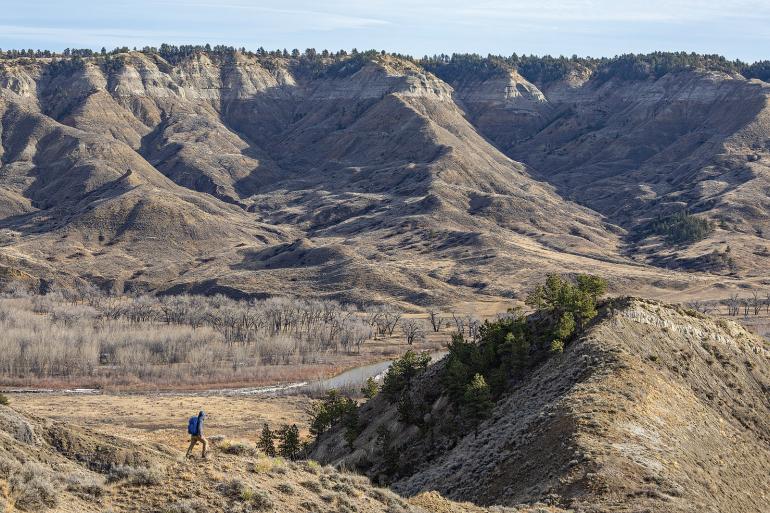
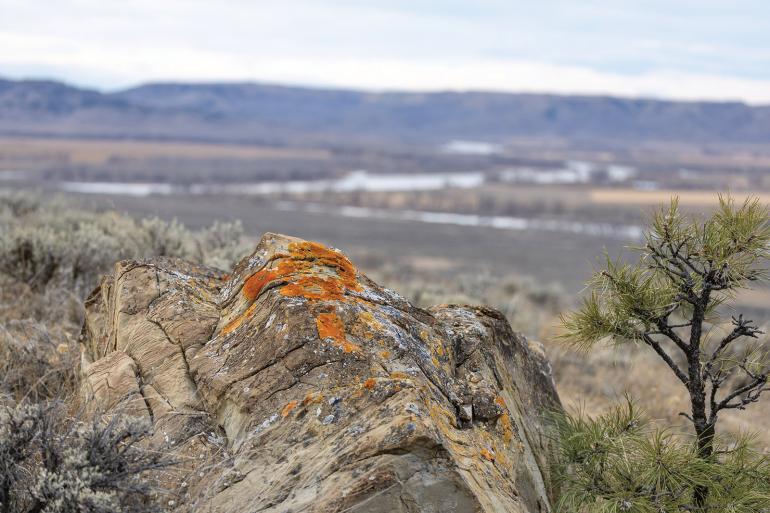
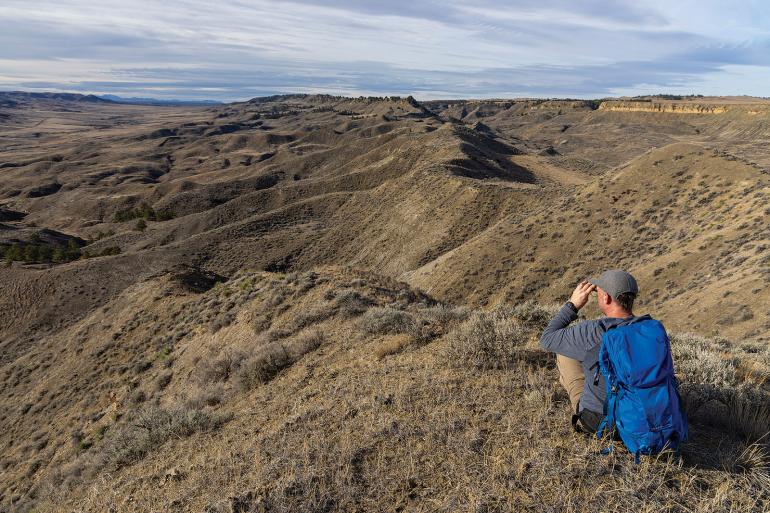
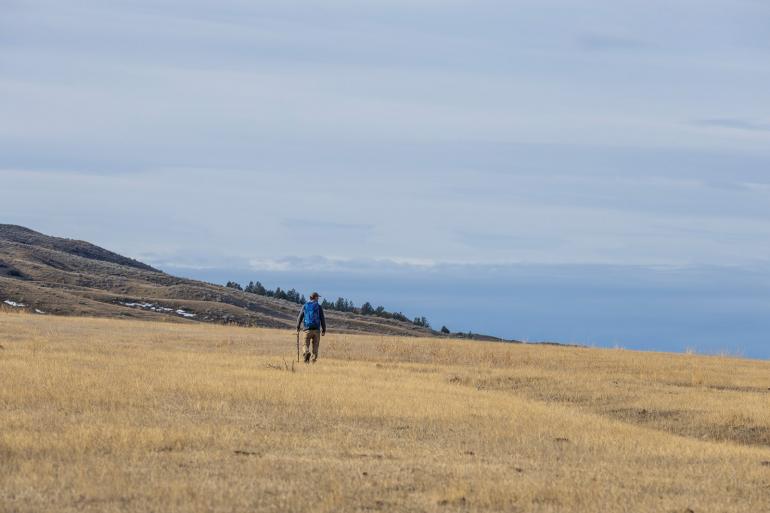
After a few hours we both reach the far point on the horizon we were aiming for. From here, looking farther east into the heart of the Missouri Breaks, there seems to be no limit on how far we could go or where we can roam; but the day is waning and so we turn back reluctantly, following the high ground and the southern border of this AP section back to the hut. Walking the fenceline that delineates agricultural land and the protected AP property, it isn’t hard to tell the difference between a mostly-intact ecosystem and one that’s been completely degraded, or “productive” as some like to call it.
Near dark and with no moon, these quieter places can be a little unnerving if you aren’t accustomed to them. Not that it’s particularly quiet. Even in early spring the landscape is alive and letting it be known. Beavers slap their tails on the water in the fading light, geese numbering in the hundreds are anxiously flying and honking, the coyotes calling out for them to land and settle in for dinner time. Quiet is a big commodity here, as is darkness. I imagine it is much the same on the other AP properties. I watch the lights of a distant tractor-trailer disappear against a lava-colored sky, its sound swallowed by the landscape long before it reaches my ears.
Like most humans traversing a landscape, we seek the high ground for both perspective and reflection.
In the morning, we head to a more western and larger section of AP, where there are two more rental huts on roads far too muddy to drive this time of year. Come late spring, I imagine, with the higher sun and longer days, these roads would see more traffic. But for now, we are alone out here as we once again pack our bags at a gate and head out on foot. Immediately, the sound of coyotes warns whoever might care that we are coming.
We head up toward the Judith, where in harder times there was a military post (Montana’s first and most remote) and soon after a trading post that got supplies off of steamboats heading up the Missouri towards Fort Benton. The area still feels like the last stop before heading into the unknown. “It must have been a muddy life for those early pioneers,” I say to the cows as I kick the gumbo off my shoes for the tenth time. Beautiful in ways we can’t now imagine, but muddy.
Like most humans traversing a landscape, we seek the high ground for both perspective and reflection. We cross lion tracks in the muddy wash, along with coyote and deer—the original inhabitants of these cuts and washes. From the top of some unnamed hill we can easily see the Craighead Hut nestled in among the cottonwoods along the banks of the Judith River, but we can’t quite find the Founder Hut, which lies due west hidden in the folds of land.
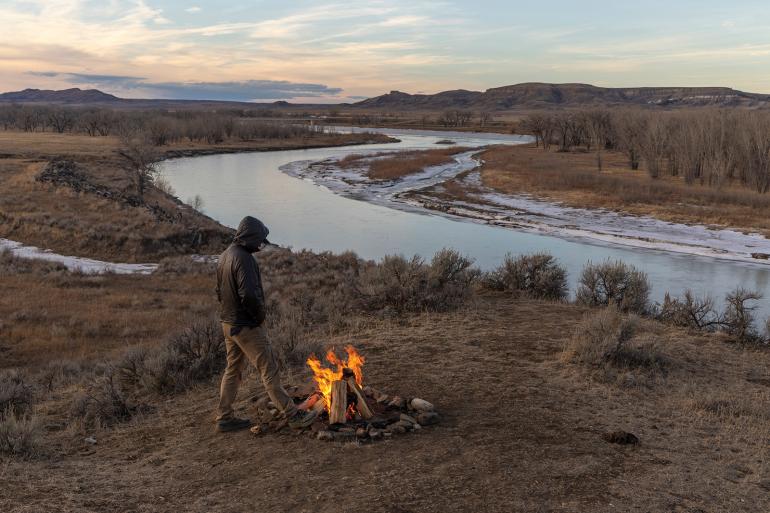
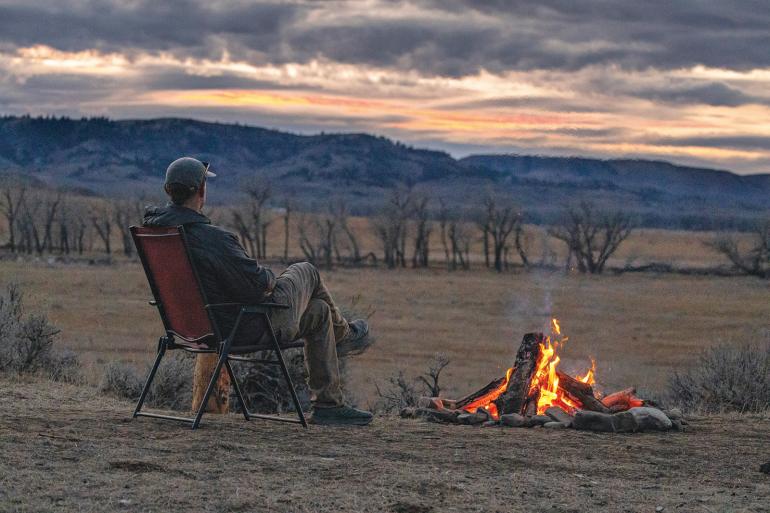
At dusk, the stars finally make their appearance in what was a warm and cloudy sky. Now, it’s clear and cold. Jupiter, the sentinel planet, appears overhead followed by Castor and Pollux just to the north, making it seem as if Gemini were laying astride and cradling that giant ball of gas. Orion, Taurus, and Pleiades appear before the sky erupts into a vision of the cosmos most absent in the American landscape—yet more than abundant here on the prairie. The sky here is incomprehensibly dark.
I smile as I reflect on how much this one-percent of remaining prairie habitat has shaped and molded my existence over the years, and how it’s likely done so for many others as well. Vowing to return to explore the rest of the AP properties on my bike when the trails and roads are more forgiving, I climb into my sleeping bag and think about my place here within the cosmic sandwich. I can see my grandfather in his last days, Lewis & Clark and their band, those lone soldiers stationed here on the frontier, and of course the native peoples that sat staring up at this same sky across the vastness of time and this beautiful prairie space. Much has changed over the last thousand years, and yet some things haven’t changed at all.
Editor’s note: At press time, the BLM had revoked the AP’s bison-grazing leases in Phillips County. It’s a move that has been applauded by “the cowboys,” but could hinder the expansion of AP’s 900-head bison herd.