Shades of Gray
Wolves and wolf tourism in Yellowstone Park.
“I’m gonna need you to pull over,” I howled, as we rounded another steep curve. We’d been driving west through the Lamar Valley for about an hour, the road growing narrower with each turn. Quinn, our wildlife-biologist guide and driver, wasn’t speeding—the limit was 45mph, and he was barely doing that. But I was in the back seat, having given the front to my travel buddy Sarah, and the twisty road was making me nauseous.
We finally coasted into a dirt pullout, behind a row of oversized spotting scopes on tripods. While my stomach settled, Quinn delivered a thorough mini-lesson on the conglomerate rock layers of the Absaroka Volcanic Supergroup, then hopped out of the car to talk with a woman standing behind one of the scopes. He chatted with her for several minutes while Sarah and I warmed our hands in front of the car’s heating vents. We’d been going since 6am, it was now 11, and the sunny April morning was still cold. I should have worn mittens.
We were searching for wolves. So, it seems, was the rest of the world. Since their reintroduction into Yellowstone Park in 1995, gray wolves have fueled an explosion of wild-wolf tourism, drawing visitors from all over the globe. Once-sleepy towns like Gardiner and Cooke City are now home to hopping year-round businesses offering wolf-watching trips, from half-day to week-long excursions. Sarah and I had chosen Yellowstone Wolf Tracker out of Gardiner, owned by ecologist and Gardiner native Dr. Nathan Varley, because we liked his biologist-led approach.
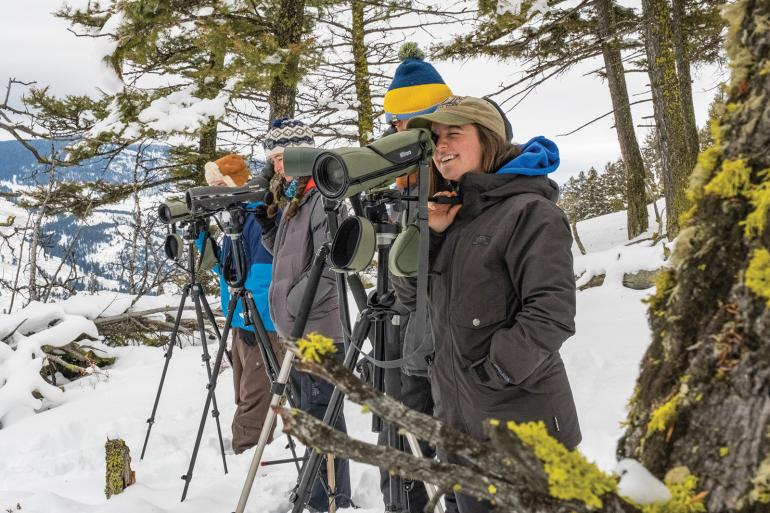
Spotting scopes are key
As Quinn explained to us, there is nowhere better than Yellowstone for viewing gray wolves. “This place exists within a global pantheon of destinations that are specific to certain communities of species,” he said. “You want to see polar bears, you go to Churchill in Canada. You want to see jaguars, you go to the Pantanal in Brazil. You want see tigers, you go to a tiger reserve in India… and if you want to see wolves, you come to Yellowstone.”
Today, plenty of people want to see wolves. But like all apex predators, wolves have always had an audience of humans that just want to see them gone. Nineteenth-century settlers moving westward did their best to eradicate wolves, due to ongoing livestock losses. (Ironically, all those wolf predations were caused in no small part by humans reducing wolves’ natural ungulate prey through over-hunting and habitat destruction.) Aggressive, government-supported trapping, shooting, and poisoning of wolves nearly rendered the animals extinct in the lower 48. By the late 1930s, nearly all of Montana’s resident packs had been obliterated, and Yellowstone’s pack population reached absolute extirpation in 1926, a status the Park retained until the 1995 reintroduction.
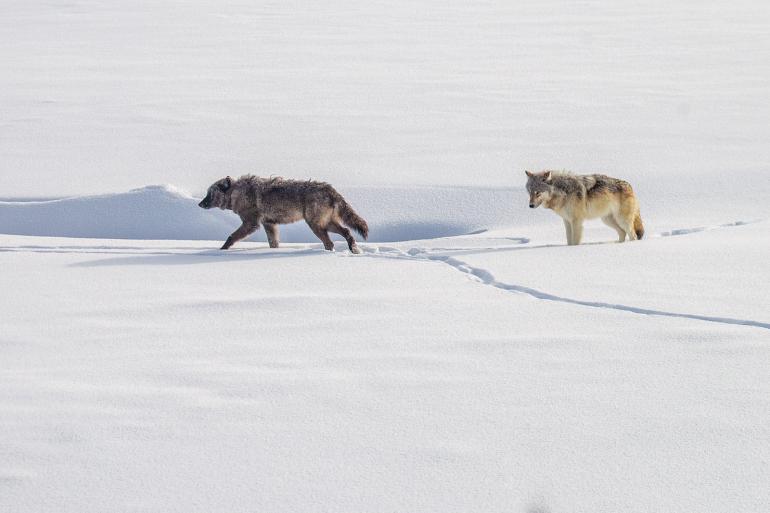
Fossils confirm that gray wolves, which can range in color from white to brown to black to many shades of gray, populated the mountain west for thousands of years. Historical records show that they resided freely in what became Yellowstone National Park at the time of its establishment in 1872. But by 1915, government bigwigs declared wolves a menace and began efforts to wipe them out within the Park. Being intelligent and adaptable, wolves learned to somewhat avoid hunters and traps but had no way to detect the strychnine and alkaloid, poisons that cause severe pain, respiratory failure, and convulsions, used by Park management to lace bison and elk carcasses.
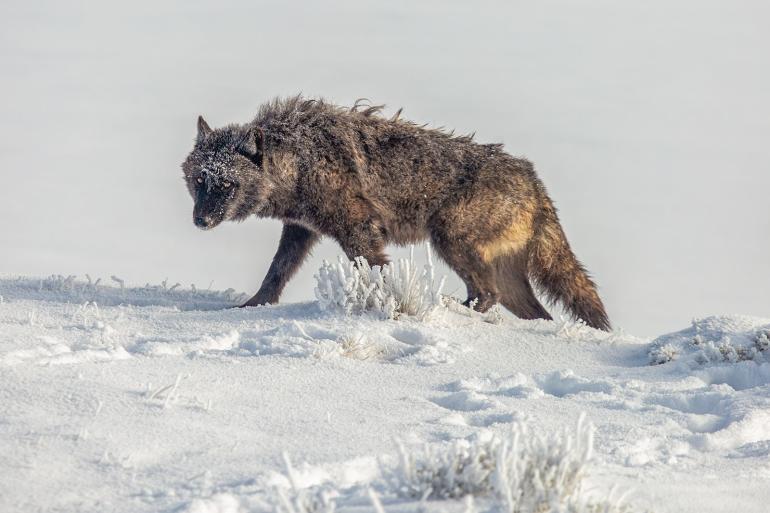
The enigmatic dark wolf
Finally ascertaining that gray wolves had been eliminated from about 98 percent of their historical range in the lower 48, the U.S. Fish and Wildlife Service (USFWS) listed the canines as endangered under the Endangered Species Act in 1974. Yellowstone officials noted that the elk population of the northern range was swelling without many predators, causing elk to take a toll on the Park’s vegetation. By reintroducing wolves, they were hoping for a trophic cascade, the ecological phenomenon by which the addition or removal of a top predator causes a ripple effect down through the food chain. (While a positive balance did result to a certain extent for many species after wolves’ reintroduction, scientists strongly emphasize that definitive outcomes remain subject to ongoing research.)
In 1987, the USFWS Northern Rocky Mountain Wolf Recovery Plan was published, and revival efforts grew. In 1994, U.S. Secretary of the Interior Bruce Babbitt approved the reintroduction of gray wolves into the Park and the central Idaho wilderness. Fourteen wolves were flown into Yellowstone from Alberta, Canada, in January 1995. They were monitored in acclimation pens for about 10 weeks under the care of lead biologists Mike Phillips and Doug Smith before being released into the wild. According to current Senior Wildlife Biologist Dan Stahler, manager of Yellowstone’s Wolf Project, these wolves were presented with “one of the most abundant elk populations ever recorded,” and after 10 years, the wolf population had increased by over 100 animals.
“Wolves don’t really get into trouble in Yellowstone,” Quinn explained as he drove us back toward Slough Creek. “There’s tons of research on wolves here, but there’s not much management, because wolves really keep their distance from people.” Quinn’s radio had told him about a wolf pack traveling east, so we were hoping to catch sight of one at the next stop. We were delayed by a large herd of bison promenading down the highway, where a camper had stopped and its occupants—a couple and their two tiny children—had climbed out and were creeping alarmingly close to the now snorting and stomping herd. “Now that is what not keeping your distance looks like,” Quinn told us, nodding toward the humans while easing the car around the giants.
We continued without incident to another pullout, where more tripods told us there was something to see. Sarah and I looked through Quinn’s scope and binoculars at an enormous grizzly, surrounded by ravens and gnawing on a bison carcass. I lowered the binoculars to see if the bear’s silhouette could be made out with the naked eye. I barely saw a dot moving in the distance; there’s no way I’d ever notice that without optical aid. We spent another 15 minutes watching the bear, while Quinn gamely answered questions from random tourists and addressed his crackling radio. But there were no wolves yet.
Today, there are about 80 wolves in Yellowstone, which Stahler says is considered a stable, healthy population. Biologists regularly track and study about 25 percent of these, using radio collars, bioacoustics studies, and remote cameras. The wolves bring in an estimated $82.5 million annually to Yellowstone’s gateway towns, benefiting local economies and altering value systems. “We’ve been the beneficiary of a growing industry, being able to employ more people each year,” explained Varley when I booked the trip. “And now there’s much more of a winter season; instead of just cross-country skiers and late-season elk hunters, you have people coming to see wild wolves.”
In the car, Quinn seconded the motion: “Wolf tourism is putting food on tables and gas in cars; it’s sending Gardiner kids to college. Wolves have gone from being seen locally as something that costs us elk to what’s driving our economy. So, we no longer want to manage them as a cost on the landscape. They’re a benefit.”
Varley further noted that, unlike hunting and fishing which must be regulated to prevent over-harvesting, there’s nothing inherently consumptive about the actual act of viewing wolves. “Thousands of people can watch wolves feed on an elk carcass in Lamar Valley,” he explained. “You could be there or not, and the wolves are going to do the exact same thing.” Of course, one of the basic tenets of ecotourism is that it’s sustainable; that what you’re seeing isn’t being compromised by the volume of people trying to see it. In addition to fossil-fuel use and emissions, Varley acknowledged that the industry is becoming more saturated, resulting in heavier traffic and in the animals becoming habituated to humans. Therefore, a top priority for biologists is managing wolves’ waning fear of people.
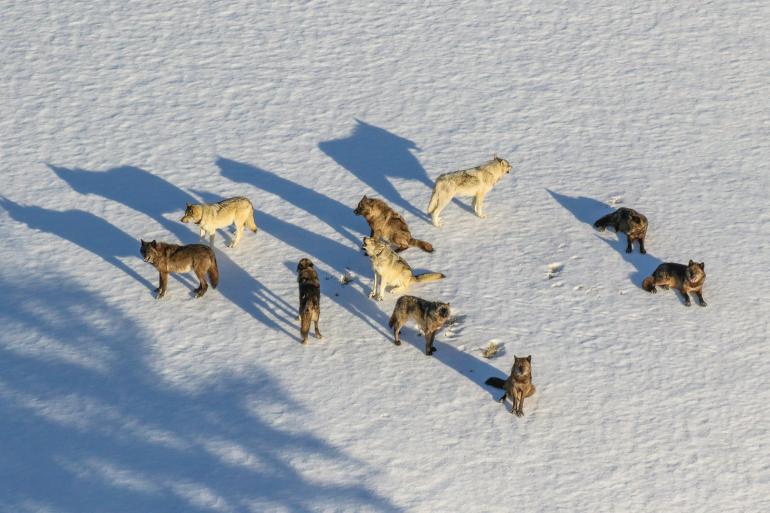
It’s illegal to kill wolves within the Park’s boundaries. But naturally, sometimes animals roam outside said boundaries, putting them at risk of being hunted. Roughly 250 wolves are legally shot or trapped in Montana each year, and Yellowstone wolves account for about four to eight percent of these, varying by year. FWP utilizes strict, micro-level quotas (typically capped at three wolves per district) in Wolf Management Units 313 and 316, which directly border Yellowstone’s northern boundary near Gardiner and Silver Gate.
In early 2026, Yellowstone’s oldest surviving wolf family from the 1995 reintroduction, Mollie’s Pack, traveled outside Park boundaries and denned near Shoshone National Forest in northwestern Wyoming. This movement to public land sparked controversy as the September 15 hunting season drew near, raising concerns from both wolf opponents and advocates. But the pack, named for the first female director of the USFWS, Mollie Beattie, returned to the Park in late summer, with none of its members harmed.
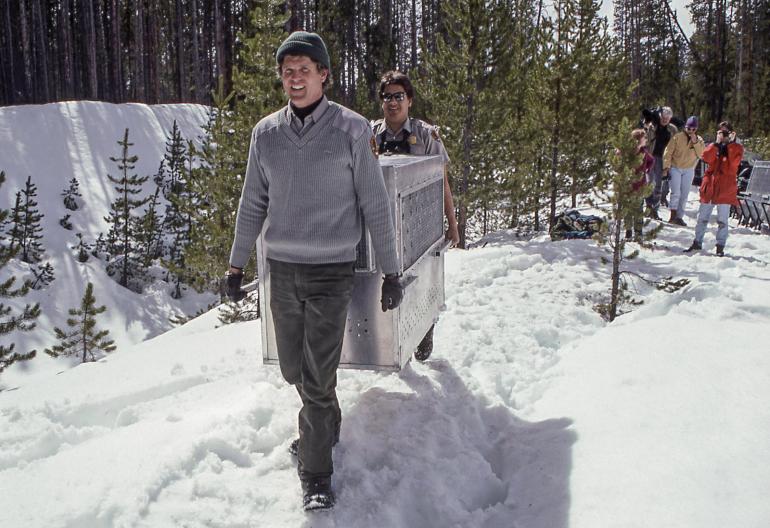
Doug Smith transporting the transplants, 1995
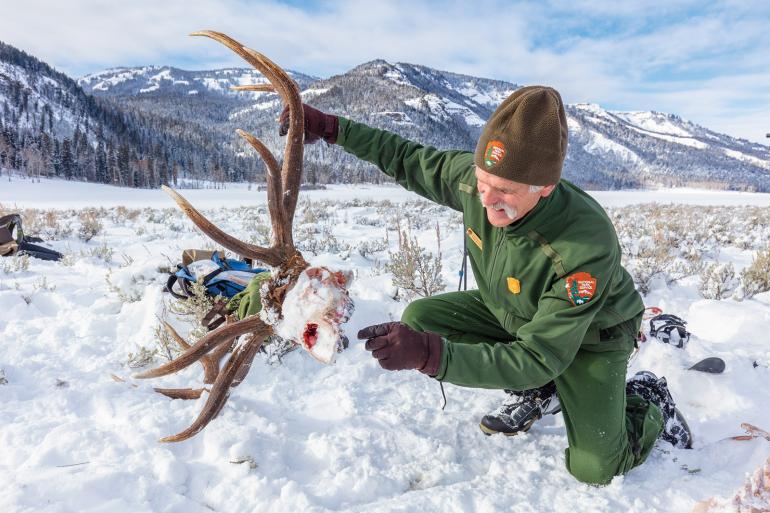
Doug Smith examining bite marks, 2019
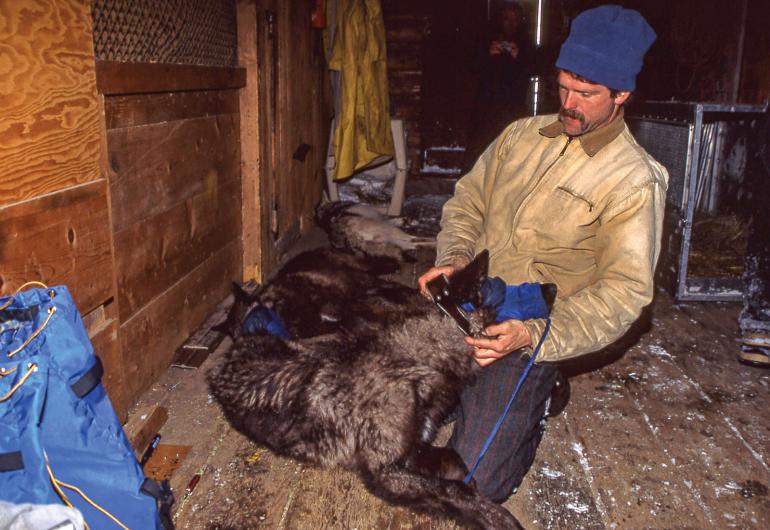
Wolf pup collar
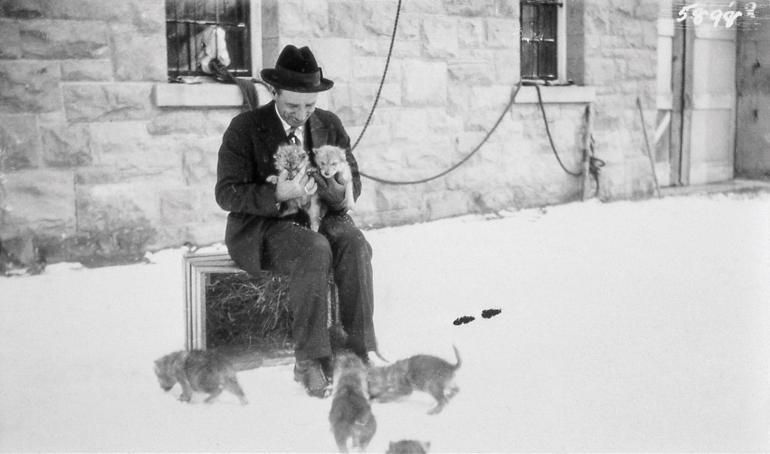
Sam Woording with wolf pups
This is good news for animal lovers. Being in that category, Sarah and I kept this success story in mind as we made one last stop. Quinn took us to Hellroaring Overlook, an incredible vantage point that looks like the origination of all the Earth’s beauty. An immense bowl of dark blue streams, patches of snow, and rounded, almost-pink hills spreading into high brown granite cliffs splayed out before us, and my eyes were drawn to the confluence of Hellroaring Creek and the Yellowstone River.
“Aren’t we too far up to see anything?” I asked, squinting. I still couldn’t imagine spotting an animal from way up here, even with the scope.
“We’re giving those wolves time to pop out on our way back through,” answered Quinn. “On a day like this, a lot of animals avoid direct sunlight. Their coats are designed to catch solar radiation and warm up with that, so when it’s sunny, they’ll book it for the timber.
That was not what Sarah and I wanted to hear. It had been an amazing morning full of wildlife, but of course we really wanted to see at least one wolf.
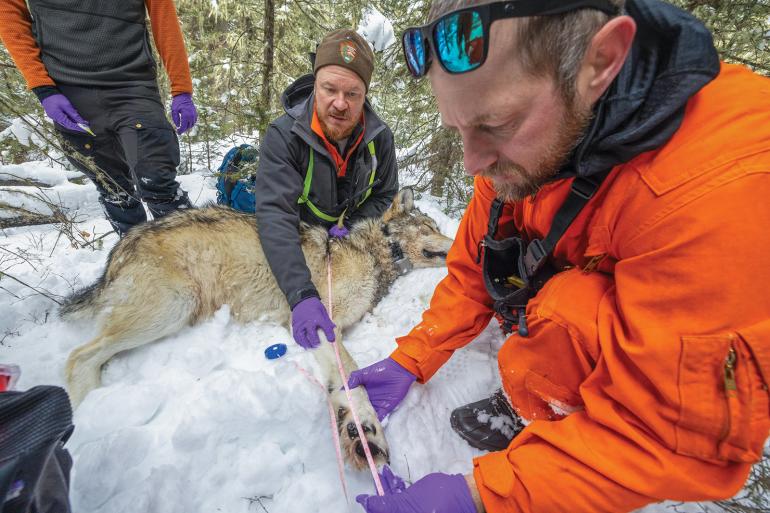
Dan Stahler and Matt Metz at work
“Look,” Quinn commanded suddenly. Sarah hustled to the scope and I took the binoculars. A streak of black with bright yellow eyes slowed to a trot, revealing a dark gray wolf, leading a pack of 14 on her long, graceful legs. Her mate was close behind, looking back and forth as they loped northward. Watching them wade across a stream and over a small rise, I was reminded of Loxi, my own dog, and found myself thinking how much the animals moved alike. Both struck me as exotic and normal at the same time.
Does wildlife exist only where human beings allow it to exist? As a civilization, we nearly wiped wolves out altogether, and then we helped bring them back. Can we now preserve these extraordinary animals while simultaneously capitalizing on them? Varley is cautiously optimistic because, as he told me, “Wolves in the Park are in their perfect element—I wish we had more Yellowstones.” If humans can respect these masters of resilience, stealth, and stamina, and keep our distance as we admire them, the future is a bright shade of gray.
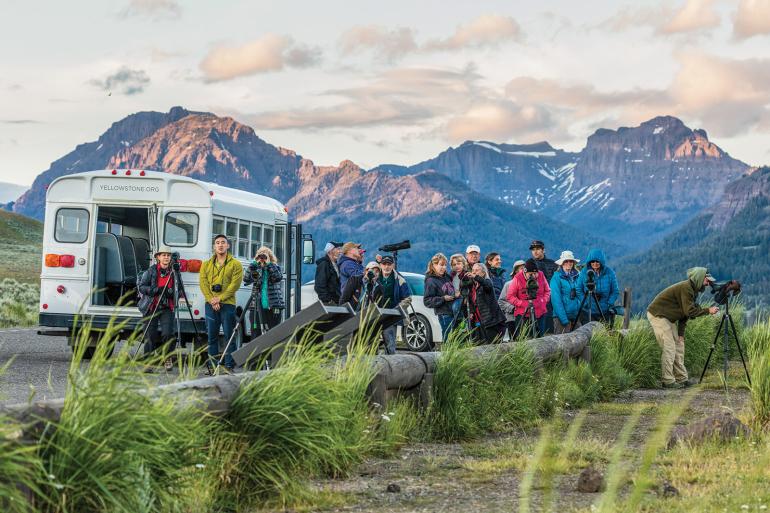
Impromptu bus stop, Lamar Valley