Armchair Advocacy
Fighting for public lands, from the couch.
Public lands need our help. Once they go away, we don’t get them back. If that’s not news to you, then the need to call your local representative and attend a town hall meeting probably isn’t either. If you’ve been doing that, kudos to you. We appreciate you.
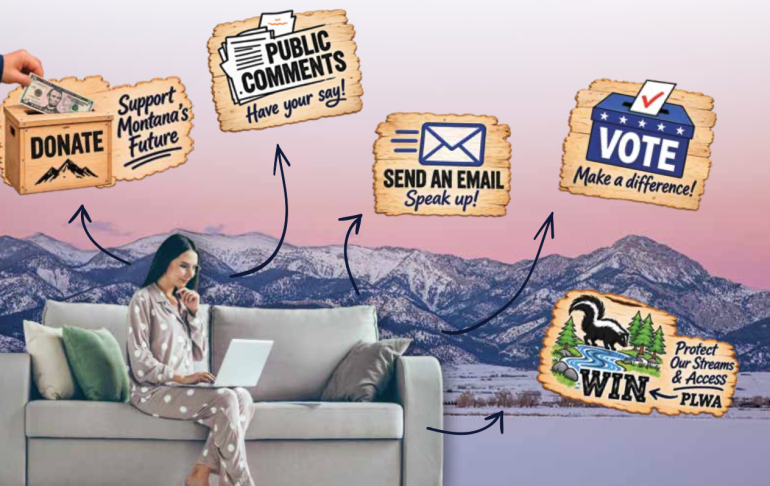
If that isn’t you, but you still care, then these words are for you. What follows is a field guide to protecting your public lands from the couch. It’s our way of saying, if you care about public lands and their future, there’s no reason not to do something. You don’t always need to drive to Helena, stand on a street corner with a protest sign, or spend your weekend knocking on doors (again, kudos if you do). Sometimes, you can make your voice heard over morning coffee in your PJs.
Public Comments
Public comments might sound like dropping your thoughts into a government-shaped black hole, but they’re one of the more direct ways to have a say in what happens to public lands. Montana Fish, Wildlife & Parks regularly opens comment periods on everything from environmental assessments and land acquisitions to hunting and fishing regulations. The Montana Department of Environmental Quality also maintains a running list of open comment periods, and many federal proposals can be found through regulations.gov.
You don’t need to write a novel. Read about what’s at stake, figure out what you think, explain why, and send it in before the deadline. Specific, fact-based comments are the most useful, but if you’re short on time, using a prewritten template is still better than saying nothing. Speaking of which...
Vote
Every election. Local, state, and federal. The big ones with nonstop commercials, and the small ones where you have to do some digging to figure out who is even running. Public lands are managed by elected officials and agencies influenced by elected officials. Who represents you matters.
Sign Up for Action Alerts
Staying in the loop doesn’t require hours of scouring the internet and following local news outlets. Conservation organizations and public-land groups already have people doing the legwork, all staying up to date on proposed legislation, land-management decisions, public comment periods, and other opportunities to join in on. Sign up for their alerts and let them keep track for you.
Send an Email
Once you know what’s happening, send a message to your representatives (it doesn’t always have to be a phone call). Conservation organizations even give you a starting point, so you don’t have to stare at a blank email wondering how to eloquently (or aggressively) explain your feelings. Personalize it when you can. A few sentences about why a place matters to you can go a long way.
Donate
Five bucks. That’s barely a coffee in this town anymore. You don’t have to bankroll an entire conservation campaign to make a difference. Hundreds or thousands of people pitching in a few dollars can add up quickly. Which brings us to a pretty good example.
In 2023, the Greater Yellowstone Coalition raised $6.25 million to purchase the mineral rights, leases, and claims associated with a proposed gold mine on Crevice Mountain, just north of Yellowstone National Park. More than 1,300 individual donors from 47 states and seven countries contributed to the campaign. The money allowed the mine threat to be extinguished before it ever started. (To read more, go to greateryellowstone.org and search “Crevice Mountain.) One person didn’t save Crevice Mountain. A whole bunch of people chipped in.
Share Accurate Information
Your social-media feed can be useful for something other than doomscrolling. Share information. Share public-comment deadlines. Share articles. Share opportunities to get involved. But before you hit that little arrow, read the thing.
Outrage travels quickly. So does misinformation. If we’re going to use the internet as a platform to advocate for public lands, let’s get our facts straight. And while we’re at it, share the good news, too! Because if you constantly tell people that every public-land fight is hopeless, eventually they’re going to believe you.
Tell People When It Works
We’re pretty good at sharing the bad news. Maybe we should get better at sharing the wins, and southwest Montana has seen its share of them! Take Skunk Creek Rd. in the Bangtails, a legal access point to national-forest land. When a new landowner started blocking parking areas and threatening to tow vehicles, members of the public raised the alarm. The Public Land & Water Access Association got involved, documented the public easement, and worked with the Forest Service throughout the dispute. It took some legal wrangling, but eventually a federal judge ruled in favor of public access, and the road remains open. (Learn more at plwa.org/skunkcreek.)
This win and others like it remind people that advocacy isn’t just a never-ending parade of bad news. Sometimes, all those comments, emails, meetings, and conversations actually add up to something. That’s the part worth remembering when your comment feels insignificant, your five dollars feels too small, or your email feels like it’s disappearing into cyberspace. Conservation successes are rarely the result of one grand gesture. They’re usually the result of a whole lot of people doing little things and continuing to do them.
Public lands need people who will fight for them. And those people aren’t always wearing suits and political buttons. Some of them are sitting on the couch, coffee in one hand and phone in the other.