Blown Away
A day to remember on Hyalite Reservoir.
Locals recite a mantra about Montana weather forecasts: “Nine months of winter and three months of relatives.” Right on cue with this weather cliché, our nieces and nephews arrived with the first high-pressure system of summer. The phenomenon is like an instinct of migration. How does an arctic tern know to fly 25,000 miles to Antarctica, or a monarch butterfly to Mexico? How does someone from suburban Chicago know to book a non-stop flight to Bozeman? And so they come, spilling out of rental SUVs, exuberant with anticipation of the great Montana outdoors.
We’re glad to have them. It’s a treat to see small ones get big and older ones get mellow. The visitors expect a guide & outfitting service, and it’s up to us locals to provide. Headgear and footwear, rods & reels, bug dope and maps. But the overriding good is that it gets us outside with them. How many summers do we say we didn’t get out enough? Now’s our chance.
We assembled a fleet of three kayaks and a canoe, heaved them atop two vehicles, and set off.
During past family expeditions, we’ve inhaled morning mists, signed registry books on mountaintops, and contemplated the mystique of a Montana sunset. But the wonders of the outdoors have been offset by the occasional mishap. There was the altitude headache at Emerald Lake, an infected horsefly bite, and a glissade that went wrong on Sacagawea, ending with shredded palms. And there was the adventure that started as a peaceful outing on Hyalite Reservoir.
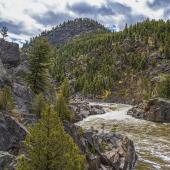
On a warm but cloudy morning, we decided to keep explorations close to home. We assembled a fleet of three kayaks and a canoe, heaved them atop two vehicles, and set off. As we rounded the curves up Hyalite Canyon, the small SUV in front of me comically carried the big green canoe, like an ambitious ant hauling an oversized leaf. When we arrived at the reservoir that early July morning, we found space to park the two vehicles and an easy launch. We slipped into the water and began a quiet paddle. It was lovely.
Overhead the sky was without feature, a uniform dirty gray. The air was still as still can be. Almost stale. The only ripples disturbing the surface were made by a few mallards who paddled away as we approached. The air had a thick feel, not the usual crisp freshness of a morning in the mountains. But this atmosphere did not subdue the mood of our family armada; everyone was all smiles. The inexperienced kayakers quickly felt they’d mastered their crafts. The duo in the canoe stroked smoothly, belying the fact that they, too, were beginners.
The distant forest had become animated, so much so that it was easy to see the tall Douglas fir trees waving. Not waving, more like thrashing.
We hadn’t paddled long when the first raindrop dinked the surface. Not to worry, I had everyone in raingear. The interval between drops was long enough that you could almost count them. These few drops weren’t going to interfere. But of course, there followed the usual dialogue:
“Is it supposed to rain?”
“It’s raining now.”
“The forecast said rain at six o’clock.”
“It’s raining now.”
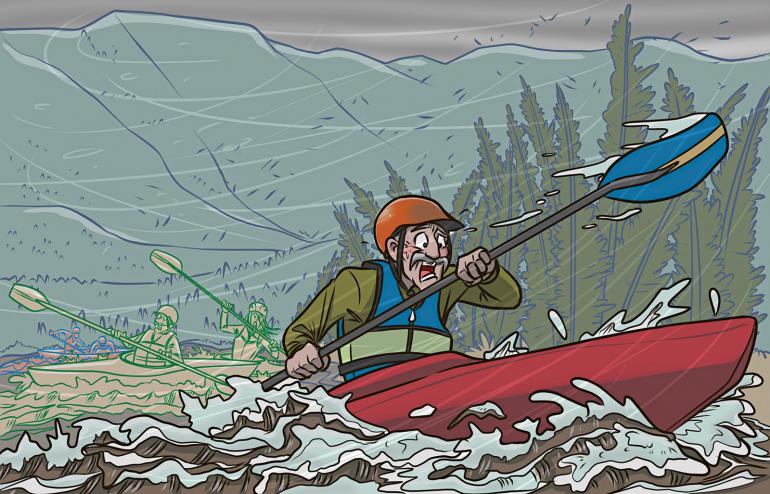
Our group was drifting here & there, so I called out for everyone to get a little closer together. We might need to cut the trip short. All was quiet and the rain inconsequential, but you just never know. Sure enough, a few minutes later something caught my attention to the north, beyond the dam. The distant forest had become animated, so much so that it was easy to see the tall Douglas fir trees waving. Not waving, more like thrashing. I couldn’t figure it out; we were in dead calm. Next thing I noticed was that the surface of the lake near the dam was taking on a peculiar white tone. What’s going on? Then I saw a froth rapidly moving toward us, the distance closing in a big hurry. Whitecaps! An angry sea.
I was worried but helpless, unable to do anything to provide aid to my novice, and surely frightened, family.
I hollered to the group to paddle for shore—and to paddle like crazy. Give it your all. Wham, the whitecaps and wind smacked us at once. I couldn’t hear anyone and no one could hear me. I had turned my kayak upwind, and all on its own it assumed a stable angle about 30 degrees to the wind. I was positioned in such a way that I couldn’t see anyone. I quickly discovered it was impossible to turn or maneuver. The kayak seemed to like pointing in one direction only, and any deviation from that relative stability put me in peril of capsize. The only hope was to keep a blade in the water for balance and maintain that same attitude. I feared a big gust would dump me in an instant, but the wind, though ferocious, held steady in direction and intensity. Never mind what I wanted, I was inexorably being blown to shore. I hoped that our boating party was upright, intact, and having the same luck as me. I was worried but helpless, unable to do anything to provide aid to my novice, and surely frightened, family. A dunk in ice-cold Hyalite Reservoir, even in the summertime, can end badly.
Before I knew it, I was beached, not far from Chisholm Campground. I popped out of my kayak in ankle-deep water, and was happy to see every boat upright, tossing & bobbing, about to strike safely ashore. One by one the boaters emerged from their crafts, bearing the aura of relief and wonderment of someone who has dodged yet another backcountry bullet.
The storm front, dramatic as it was, passed quickly. The wind tapered to a breeze, and the rain soon petered out. We made the decision to once again trust ourselves to our watercraft and paddle back to the put-in. Soon we had the boats strapped on the vehicles. After a few high-fives, we passed out granola bars and convened a family forum. We reached the unanimous decision that we deserved beer at lunch.
We also agreed that it was Bob Dylan who captured the most apropos philosophical truth: “You don’t need a weatherman to know which way the wind blows.”