
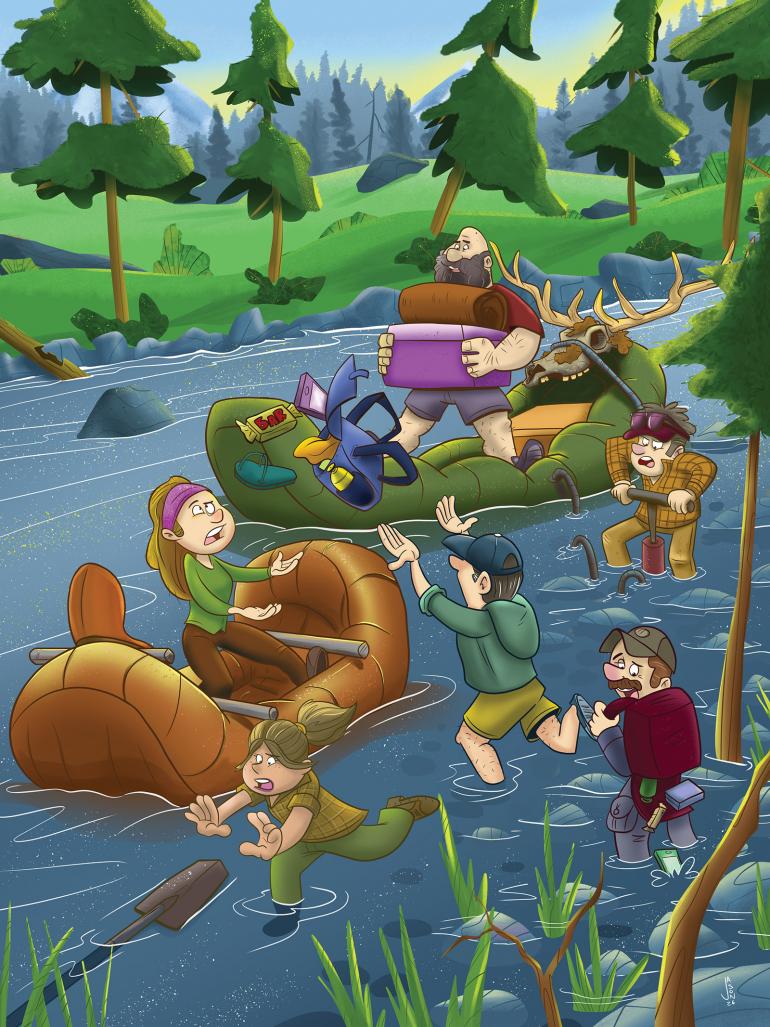
Smell and high water on the Yellowstone River.
The call from Travis came in May: “It’s on.”
“It” being the mighty, undammed Yellowstone, and “on” meaning it hadn’t yet climbed to a dangerously high level of runoff. Together, that meant it was time to rally the troops for an overnight float trip on the ’Stone—the first of the year, carrying on a tradition that has almost become a right of passage into boating season.
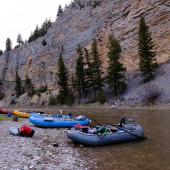
Along with a few other friends, we piecemealed together the gear for a weekend on the water: two rafts, fishing rods, camp games, a soccer ball, and an assortment of booze. It would be the maiden voyage for the bucket-boat that Travis had picked up from an old-timer in town for a couple hundred bucks. Even with extensive patching, it was clear the boat would need to be nursed along.
On Saturday morning, our party was met by an empty boat ramp near Emigrant. It appeared we’d have the whole river to ourselves. Spring caddis were fluttering in the air as we rigged up rods, stripped down to t-shirts and bathing suits, and cracked the first round of beers. The water, though high, was still clear enough to fish—for the time being.
The tips of two massive antlers protruded from a shallow, island-adjacent gravel bar. Next to the antlers was a large, grey blob—the body of a bull elk, dead in the water.
Nothing was biting as we rounded the first handful of bends, and soon all the rods were stored away. Everyone seemed content lounging on the boats, soaking up sun after a long winter.
But the peace was soon interrupted.
“Elk! Elk! Elk!” I screamed—my voice calling out from habit, before I’d fully registered the object. Following my pointed finger, everyone looked to the left bank and saw it at the same moment: the tips of two massive antlers protruding from a shallow, island-adjacent gravel bar. Next to the antlers was a large, grey blob—the body of a bull elk, dead in the water.
“Pull! Pull!” I called out at Peter, who was on the oars. He grunted and dug in hard, struggling against the river’s strength to ferry us across the main current. We barely caught the last patch of willows on the island, grasping for branches before we flew past.
Once both boats were tied off, everyone picked their way back up the island. As we neared the carcass, it became apparent this wasn’t any old elk. This was the king of Paradise Valley in full form—head, body, antlers, and all. It was easily the biggest elk anyone in the group had ever laid eyes on.
Indeed, it was something to behold—and to smell. The stench of the rotting carcass was nearly unbearable. Enough to send a couple folks off into the bushes to prowl for morel mushrooms. Jackie was undeterred, however, as she rolled up her sleeves, broke out a pocketknife, and stepped up to sever the skull from the body.
“Are you guys sure you wanna take it?” Travis asked.
“Are you insane?” I questioned in return. My very own hunting buddy. He should know better.
With the assistance of another dull knife, Jackie and I went to work twisting and cutting and sawing and prying until half an hour later, the head rolled free. By that point, we were covered up to our shoulders with the putrid, rotting stench.
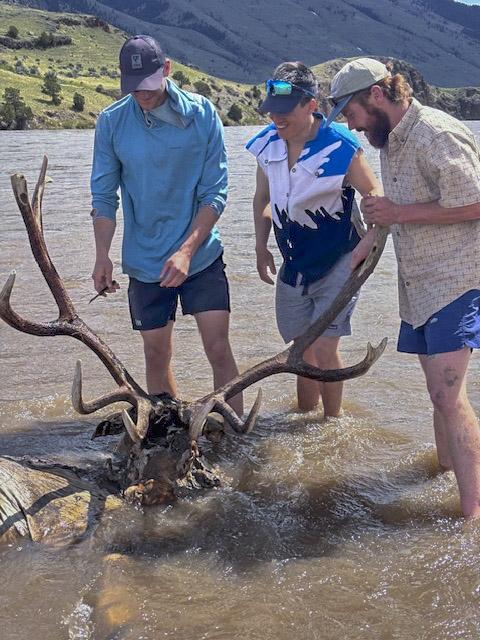
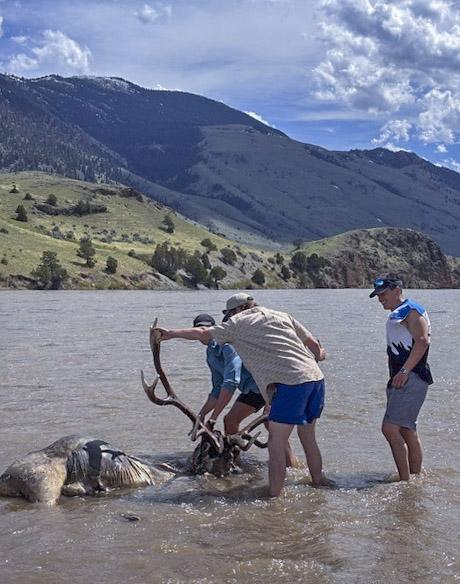
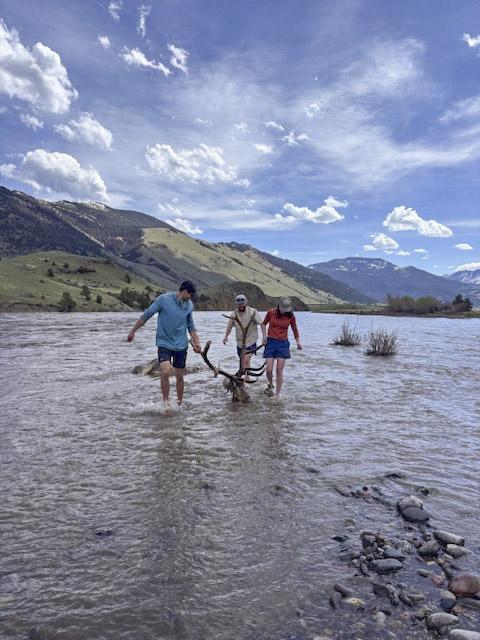
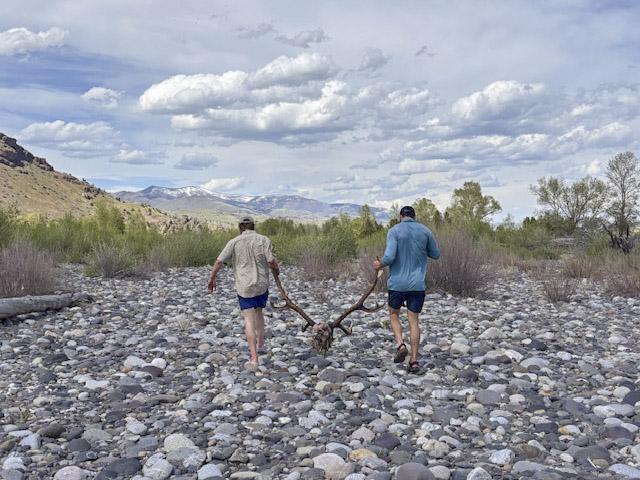
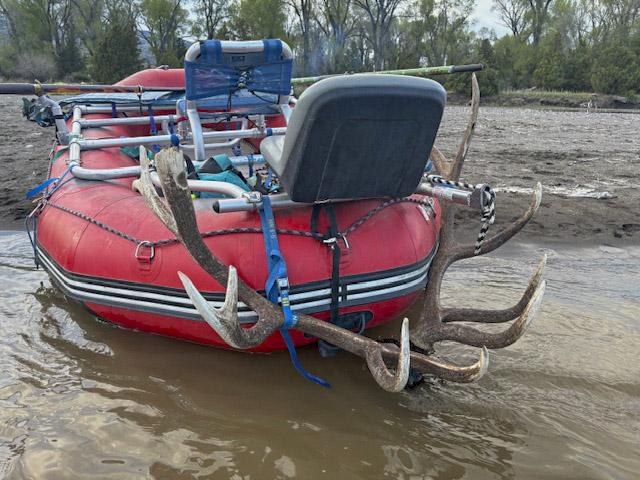
Around that time, the mushroom hunters popped out of the bushes with a handful of morels. The hunt was on.
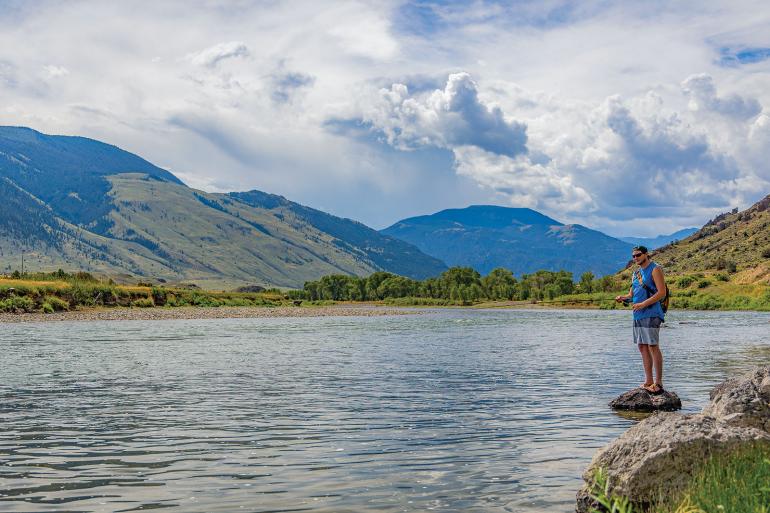
The rest of the afternoon was spent floating, fishing, and scouring islands for more mushrooms with moderate success. As dusk neared, we pulled over and set up camp on a large gravel bar tucked on the inside edge of a large island—a spot selected for its nice sandy beaches and close proximity to morel habitat. We lounged away the evening, wrestling in the mud, playing games, grilling burgers, and sitting around a driftwood fire—the very reasons we all anticipate the first float trip every spring.
Slowly, people trickled off to their tents. Once everyone had gone to bed, I threw down a tarp next to the boats and rolled out a pad to cowboy camp under a seemingly endless sky, next to the roaring Yellowstone.
A few hours later, I awoke to water lapping at my sleeping bag. I sprung up and glanced around. Dawn was still an hour away, but in the moonlight I could see the soccer ball bobbing in the water. Nearby, camp chairs were drifting away from the submerged fire ring, and the rafts—neither having been anchored—were beginning to lift off the beach where we had dragged them ashore.
Another 20 minutes, and it would likely be swallowed whole by the river.
“Get up, everyone!” I yelled, running tent to tent, grabbing various items that were floating around. “Get up! Get up! Get up!” The water hadn’t yet reached the tents, but it was rapidly encroaching.
Groggy faces popped out one by one, with various reactions. Peter and Alison scrambled to pack up once they’d assessed the situation, while Grace and Travis, hung over and half-asleep, were moving like they were stuck in molasses.
“Can’t we just drag camp up a little higher?” Travis asked, ready to crawl back in his sleeping bag. But as he spoke, a side channel was forming between our gravel bar and the island, making our camp an island of its own. Another 20 minutes, and it would likely be swallowed whole by the river.
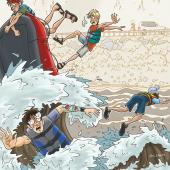
By then, everyone had realized the urgency of the situation and was racing to pack the boats willy nilly. By the time everything was loaded, we were holding them in knee-deep water. Travis made a half-hearted attempt to pump air into his boat, but gave up as passengers piled in. While afloat, the tubes sat dangerously close to the water’s edge, and the whole thing looked ready to fold in half. Fortunately, it was only a few miles to the takeout.
We pushed off, right as a grey mass came bobbing down the river. “It’s the elk!” someone shouted. The animal, we realized then, must have died over the winter next to the river—perhaps on an island in the Park—and had been washed out when spring runoff began. The place we’d found it on was only a temporary resting spot, as had been the case with our camp as well.
We floated alongside the body for few minutes until it got caught in an eddy, then continued on toward the takeout.
“Man, it would’ve sucked to have lost my raft this morning,” Travis reflected as the cars came into view.
“Yeah, and it would’ve been way worse to have lost that elk skull with it,” I added, glancing at the beast lashed haphazardly to the rear of the boat, its presence a reminder of the brutality of a Montana winter. Travis only rolled his eyes.
But like that old bull elk, we too had lived a good long life in southwest Montana, roaming the hills, foraging for food, and enjoying the wide-open spaces. Weekends like the one we’d just had serve as a reminder not to take it all for granted. Laughing on the boat with friends, rooting through the woods like truffle-hogs looking for mushrooms, watching the moon rise over Emigrant Peak—none of it is guaranteed. We’d knocked off the dust of another winter, but there was no telling where the current might take us, or what we might encounter along the way in the next year.
Regardless, it was now officially spring, and being out here in the rushing water and warm breeze was more than enough to appreciate all the reasons we call this place home, and keep each other’s company as well.
The only noise as we rounded the final bend was the splashing of water as Travis’s crew fought to bail the Yellowstone River out of their raft. There would be many more river miles to come this spring, but maybe not with that leaky old bucket-boat. This time next year, it would be someone else’s problem.