Rights of Passage
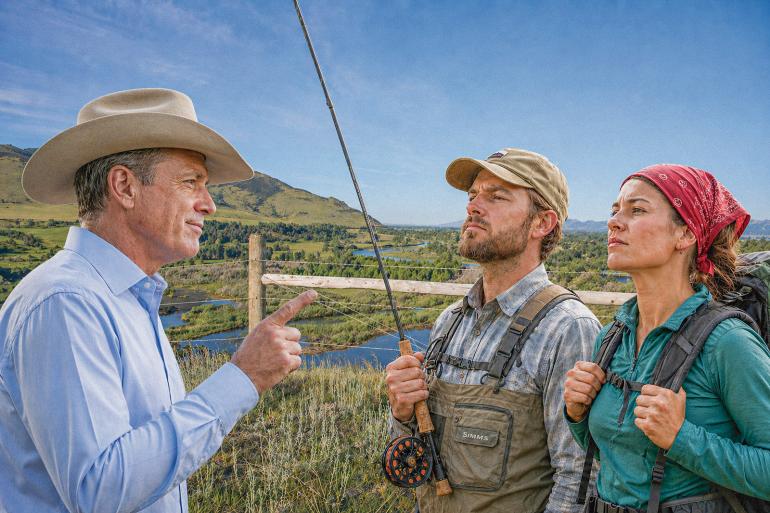
The rundown on public access.
For generations, recreation in Montana has operated on an unspoken agreement: respect the land and respect each other. But landowners who don’t mind sharing a road or parking area are being replaced by those who would rather control the landscape than share it. Yep, times are a-changin’—and recreational access is shrinking.
Luckily, Montana is widely recognized for having some of the strongest public-access laws in the country. But these only work if people understand and use them. Whether it’s questionable “No Trespassing” signs, blocked easements, or intimidating confrontations, more and more public recreators are finding themselves unsure of where they stand.
Legal public easements aren’t suggestions, they’re enforceable rights.
Well folks, knowledge is power and in these changing times, public access can use all the power it can get. Public land & water is your land & water—and knowing your rights is the first step in making sure it stays that way.
Stream Access
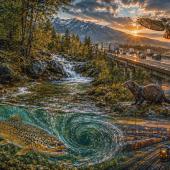
Under Montana’s Stream Access Law, you have the right to recreate on waterways up to the ordinary high-water mark, even if the surrounding land is privately owned. That means you can fish, float, and wade through running rivers and streams. There is usually a distinct line visible, where the riverbank shows a change in the soil or vegetation. (Note that this is for moving waterways—the law does not apply to lakes or ponds.) You can also legally access rivers and streams from public bridges, as long as you stay within the road easement.
Public Lands
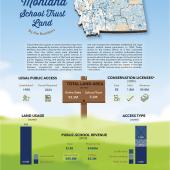
About 30% of land in Montana is federally owned and 5% is owned by state agencies. Federal ownership is broken up among the U.S. Forest Service, Bureau of Land Management, National Park Service, and the U.S. Fish & Wildlife Service, while Montana Fish, Wildlife & Parks and the Montana Department of Natural Resources & Conservation manage the state land. All of these areas are open to the public (with the exception of legal temporary closures, for reasons such as fire danger, wildlife protection, and livestock movement, but these closures must be clearly posted). Keep in mind that many of these areas rub shoulders with private property, so be sure to scan your maps thoroughly to know potential boundaries.
Easements
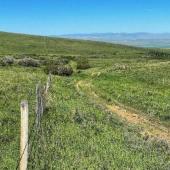
Many trails and roads crossing private land exist thanks to legal public easements. These aren’t suggestions, they’re enforceable rights. If a road or trail is historically public, legally designated, or has been used by the public for five years (“prescriptive” easement), it cannot be arbitrarily blocked off by privacy-seeking landowners. If in question, refer to the Montana Cadastral mapping site to check land ownership, access county road-department records, or use a private mapping app such as onX or Garmin Hunt to reveal current easements.
Corner Crossing
This is one of the biggest gray areas when it comes to public land. Here in Montana, corner crossing is neither legal nor illegal, as there is no specific state statute addressing the matter. However, stepping from one parcel of public land to another at a shared corner, without permission from the adjacent private landowner, can indeed be treated as trespassing—depending on local law enforcement, the county prosecutor in question, the political orientation of the authorities, and the fraternal and familial relationships between authorities and landowners. In short, proceed with caution.
Handling Discrepancies
Even if the law is on your side, access disputes can feel uncomfortable, confrontational, and confusing. A landowner may insist a road is private when it’s not. A sign might be posted without legal backing. Or you might simply not know who’s right at the moment. Here’s how to handle it:
Be calm and civil.
Document what you see. Photos of signs, gates, or any type of obstruction can be helpful if you need to report an issue.
Do your homework. Mapping tools and resources can clarify land ownership and access routes.
Tools & Resources
You don’t have to navigate this alone, and you’re not expected to have all the answers. Several organizations, agencies, and websites are dedicated to protecting public access and helping recreationists understand their rights.
Public Land & Water Access Association (PLWA): A leading voice in defending access rights in Montana. They track disputes, advocate for policy, and provide guidance for the public.
AIRS: PLWA’s Access Issue Reporting System lets recreators report encroachments, illegal signs and gates, and other access violations.
Backcountry Hunters & Anglers (BHA): Focused on protecting public lands and waters, with strong advocacy and educational resources.
U.S. Forest Service & Bureau of Land Management: Both offer maps, closures, and access information for federal lands.
Montana Fish, Wildlife & Parks (FWP): A key resource for stream-access rules, fishing regulations, and public access sites.
Montana Department of Natural Resources & Conservation (DNRC): Manages state trust lands and provides access guidelines.
Interactive Digital Maps (OnX, Garmin, Gaia GPS, BLM National Data Map, USFS Interactive Visitor Map, et. al.): Delineate property boundaries and in some cases, show easements.
Conclusion
If you encounter a blocked public road, illegal signage, or restricted access that shouldn’t be restricted, speak up. Access is one of those “use it or lose it” rights. Start by reporting the issue to the appropriate organization. The key is documentation and follow-through. One complaint might not move the needle, but a pattern of reports often will.
It is our responsibility as public recreationists to come together as a community and preserve this part of Montana’s identity. Public-land access is one of the last great equalizers, where your bank account balance or family connection doesn’t affect your ability to access or experience wild places. Know your rights. Use them respectfully. And when necessary, stand your ground, because once access is lost, it’s rarely given back.