Can't Beat a Caddis

The ins & outs of fishing a ubiquitous insect hatch.
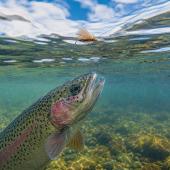
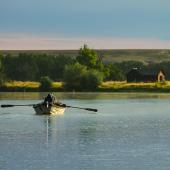
Reclined on a raft tethered to the bank of the Madison River, I was halfway through a ham sandwich when a single bug taking flight caught my eye. A brownish little figure, it took off like a tiny helicopter in a casual loop from the water. Seconds later, two more of its kind erupted from the surface. Simultaneously, the pewter belly of a rainbow trout flashed as it rolled on the surface to nip a straggler.
Sensing a prime moment for some fun, I pulled the float from my leader and clipped the worm-and-egg pattern from the tippet. Selecting a darkish tan #16 elk-hair caddis, I tied it to the 18-inch segment of 5x tippet I’d added to my line and rubbed it sparingly with floatant. Easing stealthily from my perch, I moved slowly into casting position so as not to spook the “here-and-there” trout rising sparsely for the insects.
Except in the most degraded waterways, you’ll almost always find caddisflies.”
The first cast fell a foot starboard of the target. It didn’t matter. Not a yard into the drift, the greedy maw of a sizeable rainbow engulfed the fly, succumbing to the oh-so-common and charming caddis.
“Caddis are almost universally present on trout streams,” a respected aquatic biologist once told me. “They can do well on rivers regulated by dams as well as free-flowing streams. Except in the most degraded waterways, you’ll almost always find caddis.”
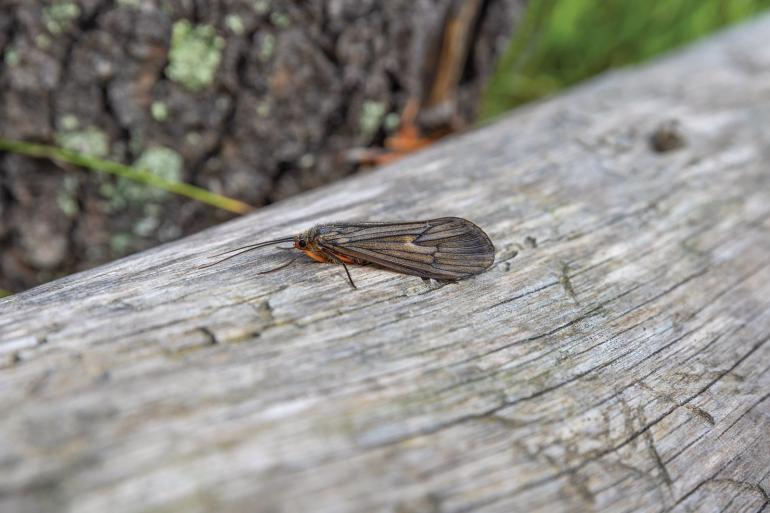
Caddis, or caddisflies, are an aquatic bug apart from the myriad of mayflies that also inhabit North American waters. Adult caddis resemble tiny moths with narrow wings. Unlike mayflies that hold their wings upright above their bodies at rest, the wings (two pairs) of a caddis are folded over its body and covered with tiny hairs. Adult caddis range in length from around 1/8 to 5/8 of an inch.
Compared to mayflies, which may only live in the adult form for a few hours or less, the adult form of the caddis normally persists for several weeks. Once hatched from their aquatic nurseries, male caddis do not return. Females, however, complete their lifecycles by depositing eggs in the water or nearby. With well over 1,000 species in North America, the size, color and lifecyle of a caddisfly can vary substantially.
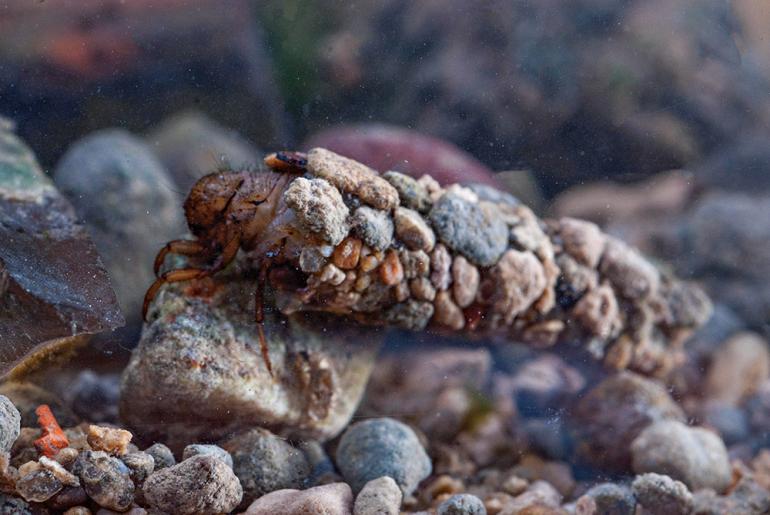
After the eggs hatch, caddis larvae inhabit the bottom of a waterbody, growing through several phases. Caddis larvae have different behaviors, depending on the species. Some wander the streambed, gleaning algae from stones. Others build little webs similar to spiders; yet another species constructs tubes from soil, sand, or other debris.
Caddis are frequently an integral part of a trout’s diet even when a prolific hatch isn’t erupting from the water.
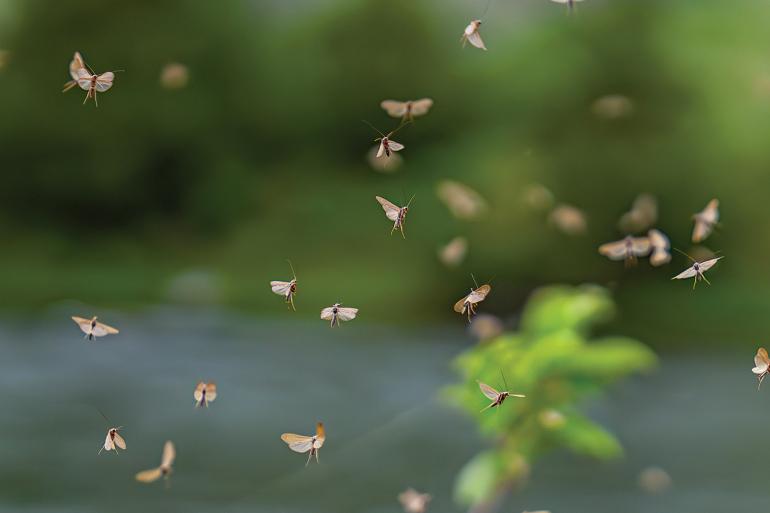
During the pupal stage, caddisflies construct a cocoon like a butterfly or moth. The completion of this stage occurs when the adult insect breaks free from the cocoon at the surface of the water. The wings of adult caddis shed water, allowing them to escape the surface quickly, unlike some other aquatic insects that struggle to become airborne. Caddis depart the water in an elliptical arc with a bouncing motion, unlike any other aquatic insect.
Caddis are strongly associated with Mother’s Day on many rivers. But myopic are the flycasters who consider caddis only during this epic hatch. Researchers have found there’s often as many (or more) caddisflies as mayflies in most streams. Caddis are frequently an integral part of a trout’s diet even when a prolific hatch isn’t erupting from the water.
Trout prey upon caddis in their larval, pupal, and adult forms. Larvae are taken as they move about the bottom of the stream. Anglers should remember that the various forms of the caddis may all be present in a stream at the same time. Even when caddis are actively hatching, a fly that mimics a pupae may be more effective than one resembling a winged adult.
The “Holy Grail” for most anglers is the spectacular dry-fly fishing associated with an intense caddis hatch. However, on the nose or tail of a hatch, anglers frequently enjoy higher catch rates. During these times, it’s easier to get the undivided attention of a trout with an artificial fly. The elk-hair caddis, in its many variations, is a widely available adult imitation. Another dry fly is the Goddard caddis, favored by females in my household who think it’s “cute.” I also like the Sledgehammer, which is popular in Great Britian on ponds and slow-moving streams, though it also works well on more intensely flowing rivers.
Fishing imitations of adult caddis is like fishing other dry flies, with a twist. Because caddis naturally hop and skitter on the surface, twitching the fly or letting it swing at the end of a drift adds natural action that often incites a strike.
During a hatch, don’t forget the emergers: caddis just escaping the pupal shuck. These are an easier meal for trout to catch than adult caddis. In some situations, fish will enthusiastically consume emergers while ignoring adults. Examples of caddis emerger patterns include Bastian’s Floating Caddis Emerger, the Emerging Caddis CDC, and the S/L Caddis Emerger. Emerger patterns can be fished dry or allowed to sink just beneath the film, which is how I often fish the perky Purple Haze.
Pupa nymphs often provide the hottest action.
If fish are rising to caddis, their movements provide a powerful clue as to their preference of emergers versus adults. Loud, splashy rises indicate trout zooming after adults, while more subtle, nipping rises are indicative of eating emergers. Not sure? Cast both on a tandem rig.
Dry flies are fun. But nymph patterns matching the larval and pupal morphs of the bugs are frequently taken more readily than the dries, even during a hatch. Caddis larvae patterns are typically fast-sinking nymphs, often paired with additional weight. Among the most popular are the Czech nymphs. Developed in eastern Europe, these flies are normally weighted with wire around the hook and often carry a tungsten beadhead. They sink quickly into riffles and pocket-water, where they may be fished with a “high stick” method involving a short, taut line from the rod tip in close proximity to the angler. Alternatively, Czech nymphs can be drifted in a traditional manner under a strike indicator just above or bouncing on the streambed where caddis larvae live.
Pupa nymphs often provide the hottest action. Pupa drift in the current as they ascend to hatch making them a simple target for trout. Try a two-fly rig of pupa imitations, such as a Beadhead Caddis Pupa or a Krystal Caddis at various depths. At the end of the drift, let the line straighten or swing before re-casting. This propels the fly in an upward motion like a real, rising pupae and often prompts the most determined strikes.
Often overlooked and occasionally misunderstood, caddis are a staple for trout in Bozeman-area streams. Many anglers who understand how to fish imitations of these intriguing insects share a simple sentiment: “You can’t beat a caddis.”
Jack Ballard grew up on a ranch west of Three Forks. He has written 13 books and hundreds of magazine articles on hunting, fly fishing, wildlife, natural history, and other topics. See more of his work at jackballard.com.