All-Star Lineup

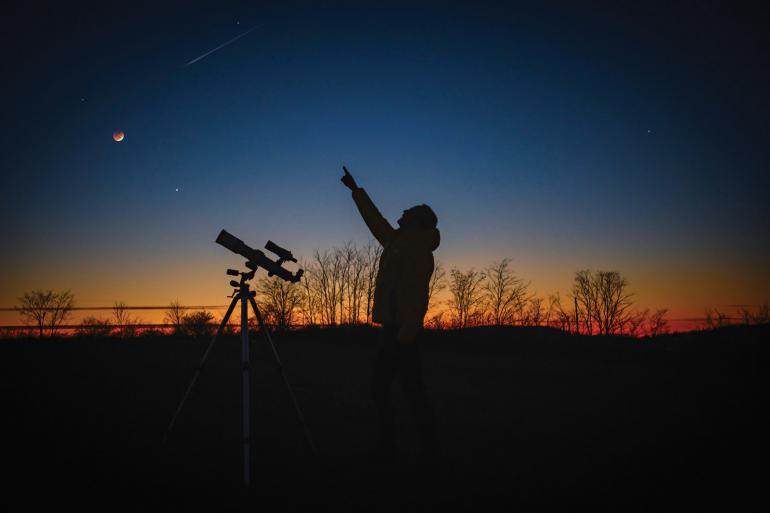
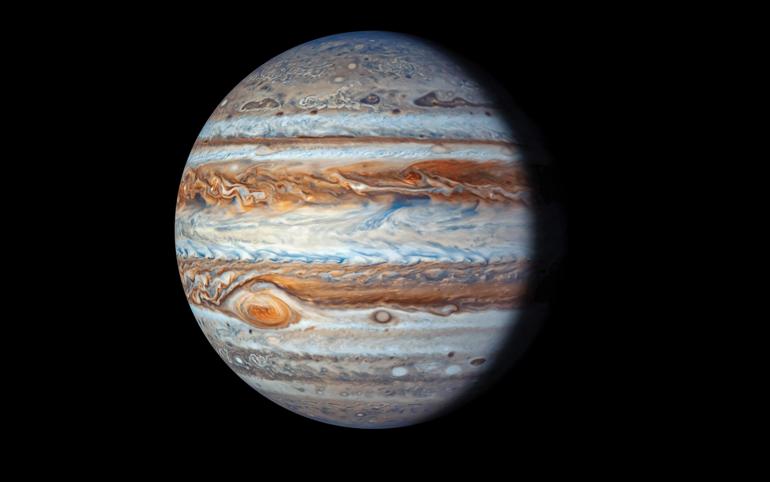
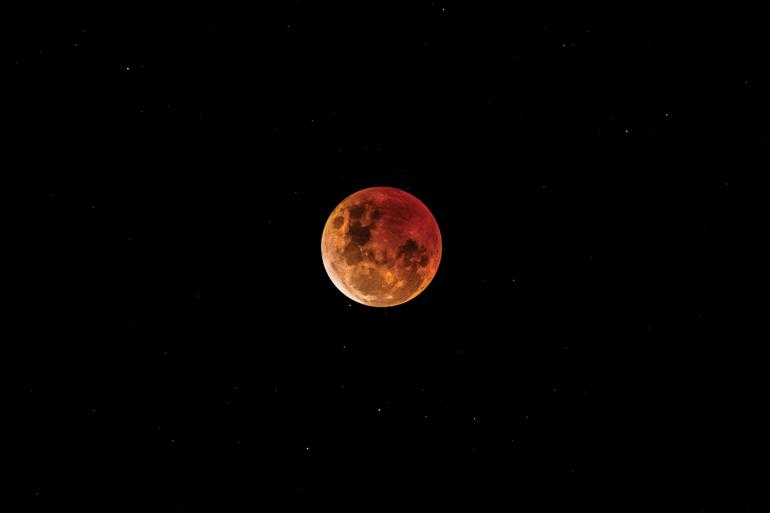
Opposing lights in the winter sky.
In Shakespeare’s Richard III, the villainous soon-to-be-king speaks of “our winter of discontent,” entirely in political rather than seasonal terms. Whether you find discontent or simply good skiing in seasonal winter, our sky this year is filled with opposition—not in political terms, but entirely in astronomical ones.
It starts with the planet Jupiter, rising on the evening of January 10 in “opposition.” This means it rises at sunset (around 5pm local time), lying opposite the sun in our sky as Earth passes in its orbit between the aforementioned bodies in space.
That puts Jupiter at its closest to us, looking biggest in our telescopes and brightest in the sky. It shines gloriously in the constellation Gemini the twins, to the left of the prominent pattern of Orion the hunter. It forms a triangle with Gemini’s main stars, Castor and Pollux, but nothing outshines brilliant Jupiter this winter. After the 10th, the planet will already be hanging in the sky by nightfall and will dominate the frigid winter nights.
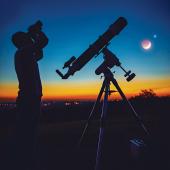
This winter, Jupiter reigns over an orderly if cold, glittering sky. Small telescopes can show its two main cloud bands and four biggest moons.
Dominion is nothing new to it, for it’s named after the Roman king of the gods. He was a god of sky and weather, said to speak loudly and carry a big thunderbolt. Jupiter was a fan of worldly order—both political and social. Yet he also had a roving eye, his Earthly dalliances creating a good deal of disorder when his goddess wife Juno wreaked her retributions.
But this winter, Jupiter reigns over an orderly if cold, glittering sky. Small telescopes can show its two main cloud bands and four biggest moons, and even a pair of steadily-held binoculars may reveal those moons when they swing to either side of the planet in their orbits, looking like tiny stars.
Oppositions this winter also include the moon, which rises opposite the sun in the sky every time it’s full—when it lies on the far side of the Earth from the sun. Full moons this winter occur on January 3rd, February 1st, and March 3rd. The last is particularly interesting, for the lineup of sun, Earth, and moon is good enough that the latter slips through the Earth’s shadow in space, creating a total lunar eclipse.
For Bozeman, the event begins in the wee hours of March 3rd, when the moon starts to pass into the outer, lighter part of the shadow called the penumbra at 1:44am local time with the moon in the south. It will be sitting just underneath the backwards question mark and triangle pattern of Leo the lion. At 2:50am, things get cracking as the moon hits the inner, darker part of the shadow called the umbra and the eclipse becomes apparent. The moon passes completely within the umbra at 4:04am, looking a bloody red-orange, brighter at the bottom where the moon’s edge lies nearest the edge of the umbra. The ruddy color results from red sunset glow scattering through Earth’s atmosphere and into the shadow.
The grisly color prompted many notions about what was going on. The Pomo Indians of California said the moon wouldn’t get out of the way of a sky-roving bear and they got into a fight. The Toba people of South America envisioned jaguars attacking the moon. The Norse claimed that a wolf had caught the moon and was gnawing away. And in most cases, people raised a clamor from below to chase away the attacking beasts. It always worked!
If you decide to raise a racket, you can be prepared to stop at 5:02am, when the moon begins to slip back out of the umbra as it sinks toward the western horizon. It will clear the umbra at 6:17am, just above the horizon with dawn well advanced, and sets still partly in the penumbra a few minutes after seven with the sun just risen.
There’s a good chance that clouds will interfere at this time of year, but if so, don’t be discontented. You can search for eclipse livestreams online and watch the proceedings while comfortably indoors.
So enjoy the opposing lights of winter, until we turn the page to a contented spring.
Jim Manning is the former executive director of the Astronomical Society of the Pacific. He lives in Bozeman.