A Stream Hides Beneath It
For decades, the stretch of Bozeman Creek passing through town has mostly been out of sight and out of mind. But there’s a small group of concerned citizens trying to change that. They’re not the first to do so, but with any luck, they’ll be the last.
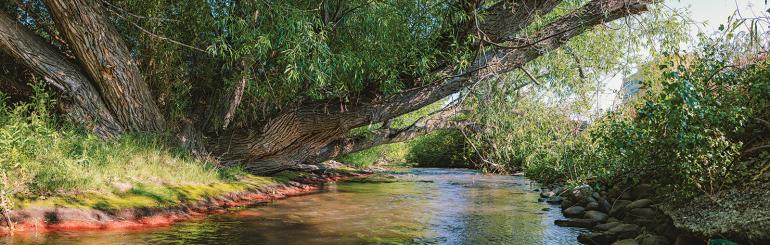
Near the corner of Rouse and Tamarack, sandwiched between Kenyon Noble’s lumber yard on one side and its distribution center on the other, stands a great willow tree on the west bank of Bozeman Creek. The old giant has five thick trunks rising from the ground, each more than three feet in diameter, and its tangle of branches casts a broad shadow on the bank. It’s the kind of tree that kids climb on, lovers make out under, birds roost in, and runners sprawl out beneath for a bit of shade. When I first sighted the willow, it looked like the creek’s guardian, sitting sentinel on its banks year after year, a fixture of the natural landscape. And yet, unless you decide to don waders, slip into Bozeman Creek at the bridge over N. Church, and wade downstream a hundred yards like I did this summer, you’d never know it was there.
This tree should be all of things mentioned above. Bozeman Creek should be our city’s signature waterway. The clear, cold stream runs straight through the heart of downtown on its way from its headwaters at Mystic Lake in the Gallatin Range down to the east branch of the Gallatin River at Story Mill Park. It should provide ample opportunities for people to walk, picnic, and loaf along its banks, the way waterways do in other municipalities.
Today, Bozeman Creek is practically invisible downtown, unless you’re sitting out on the patio of Bar IX on a summer evening, and much of it is buried beneath several feet of concrete.
Back in 1864 when Bozeman was founded, our namesake stream looped its way through the downtown area in big, lazy, S-curves, but as more buildings went up and infrastructure was installed to support the town’s growth, the creek’s shape became inconvenient. Throughout the 1880s and ’90s, Bozeman Creek was beaten, bullied, and shunted into jagged lines, eventually subdued into a series of culverts and tunnels running through the city center.
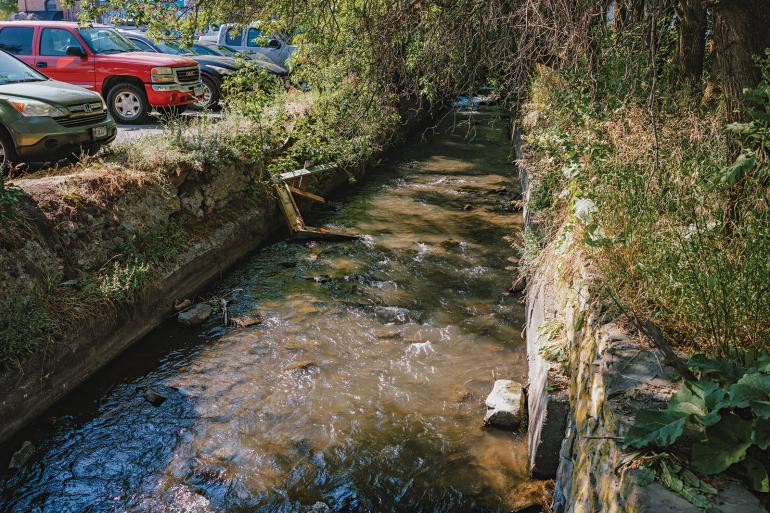
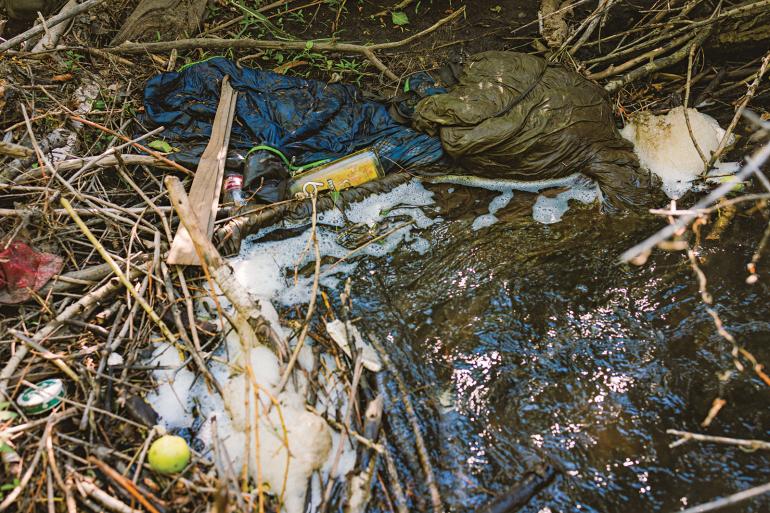
Today, Bozeman Creek is practically invisible downtown, unless you’re sitting out on the patio of Bar IX on a summer evening, and much of it is buried beneath several feet of concrete. The creek has also been polluted by discarded plastic, leaky natural-gas lines, and nutrient loads from old city wells, and it’s been designated as impaired for E. coli since 2006. Public access points are few and far between, and, save for a few creekside parks and art installations, the stretch of Bozeman Creek running from Bogert Park to Peach Street is treated like little more than a ditch.
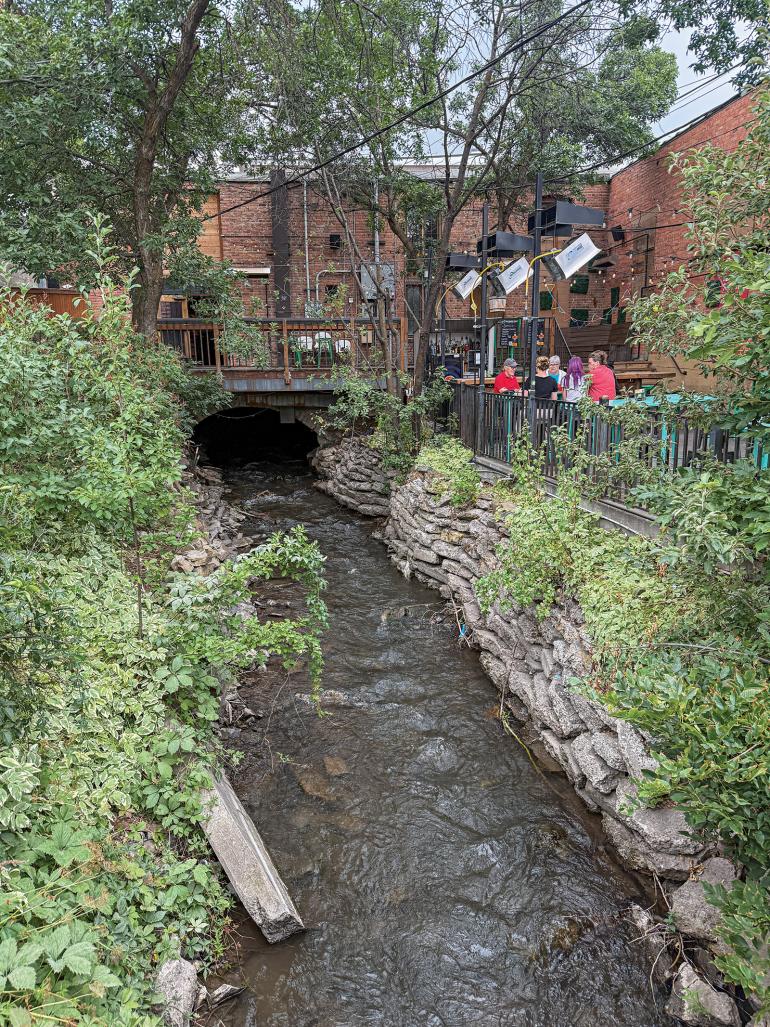
Bozeman Creek beside the Bar IX patio
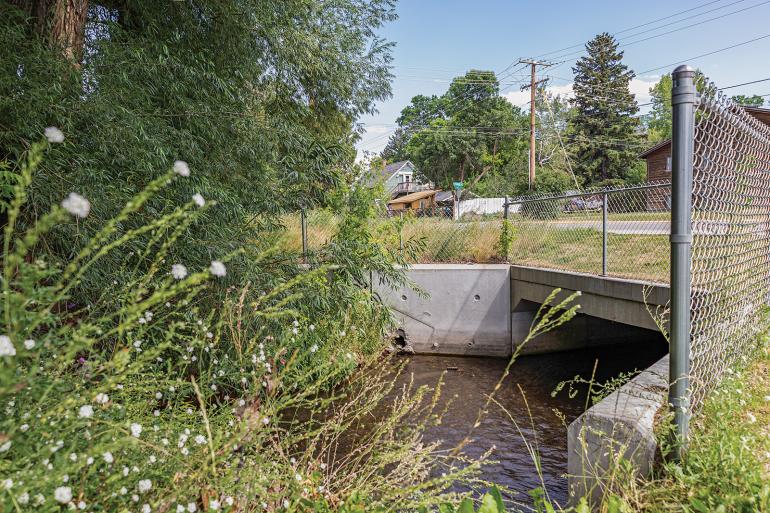
Bozeman Creek Close-Up
A ditch—that’s what Chad Dokken compares the creek to, as he clambers down into a cement culvert channeling its mild mid-July flow. The place he’s brought me does look more like a ditch than anything. There’s an empty White Claw can sitting on the “bank” as we pass what looks like a live wire dangling above the water behind someone’s house. “It seems like nobody really cares,” Dokken says. “Nothing needs to meet code. People are dumping their brush into the creek, just tossing it over their fences. And that’s the lowest offence.”
Dokken has an Instagram page (@sup_montana) where he posts weekly videos of himself paddleboarding rivers around the state. The most popular video, however, shows him running Bozeman Creek. Posted on June 1, Dokken’s reel has racked up more than 135,000 views; in it, he ducks bridges, passes under a train, and glides through all 420 feet of a tunnel burrowing beneath Main St. His caption: “Bozeman Creek is ripping no matter how hard the city has tried historically to kill it.”
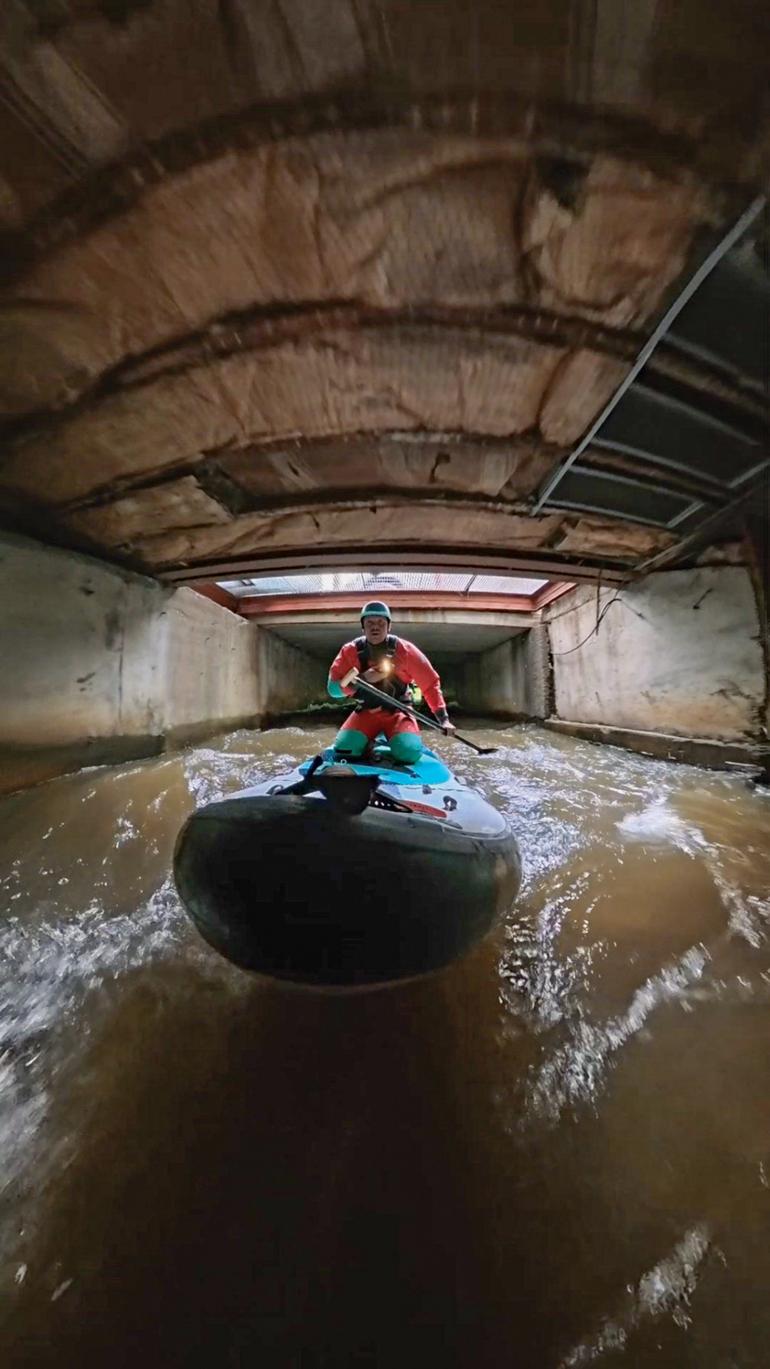
Chad Dokken floating under Nova Cafe (now Saffron)
Dokken agreed to show me around this stretch of water, and we’ve begun our tour at Gold Ave., just past the railroad tracks, where the water shoots through a long, corrugated tunnel under the highway. There, he points out the plastic mats used to hold the bank in place and tries to dislodge a bike wheel stuck in the creek bottom. “There’s a lot of riprap, you’ll find,” he tells me. “There’s a section near Main Street that has four metal chest freezers. But if you cleaned it up a bit, it’d be really cool.” As we stand in the creek, we pause our conversation to watch a whitetail doe cross 20 feet downstream.
From there, Dokken takes me downtown for a quick walking tour. He points out more culverts, tunnels, and a weird dogleg section that goes under Babcock. We pass by Bozeman Creek Family Health, and he tells me that in the middle of the building, there’s a courtyard with the creek passing right through its center.
In a city that prides itself on its relationship to the outdoors, Bozeman Creek feels like a dirty little secret.
Our last stop on the tour is the Kenyon Noble distribution center, where Dokken points out the plastic lumber wrapping that often blows into the creek. Spotting a pile of it that’s threatening to slide into the water, he sidesteps the fence to clean it up. The decomposing plastic smells rotten, and Dokken piles it all into his truck bed. When he paddled the creek in May, Dokken reported seeing loads of the same plastic wrapping in the water. He also noted “decent” fish populations (the creek contains nine fish species, including the native Yellowstone cutthroat trout), and he even noticed a natural-gas leak downtown. After he informed Northwest Energy of the leak, they sent him a swag basket as a thank-you gift.
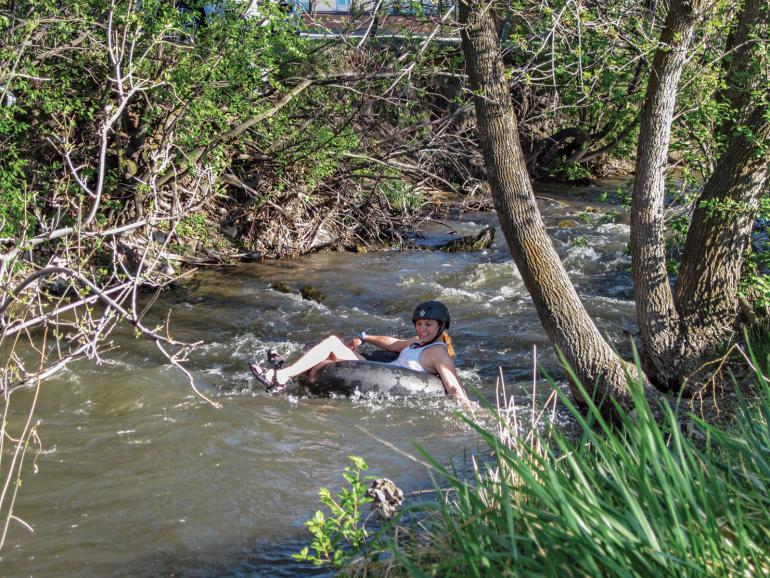
“I didn’t do this for the ecology,” he admits when we’re back in the car, referring to his viral video. “I strongly believe in ecological preservation, but I really just wanted to paddle the creek.” But after the post blew up, Dokken felt some responsibility to do what he could to help the waterway. For his part, he believes the city should create recreational stretches for tubers, paddleboarders, swimmers, and other recreationists. He expects that, if more of the creek were being used, people would stop mistreating it. “I don’t think this town would ever allow something to be used and look like shit,” he says. Looking back toward the litter-laden bank, he adds, “But I do think it would allow something to not be used and look like shit.”
I took myself on a self-guided creek tour a week after meeting Dokken, wading several sections and taking photos, and it struck me as odd that access was often so difficult. Bozeman Creek always feels awkwardly jammed between things, and even the occasional walking paths I found felt like an afterthought, hidden between small businesses, houses, and industrial parks. In a city that prides itself on its relationship to the outdoors, Bozeman Creek feels like a dirty little secret.
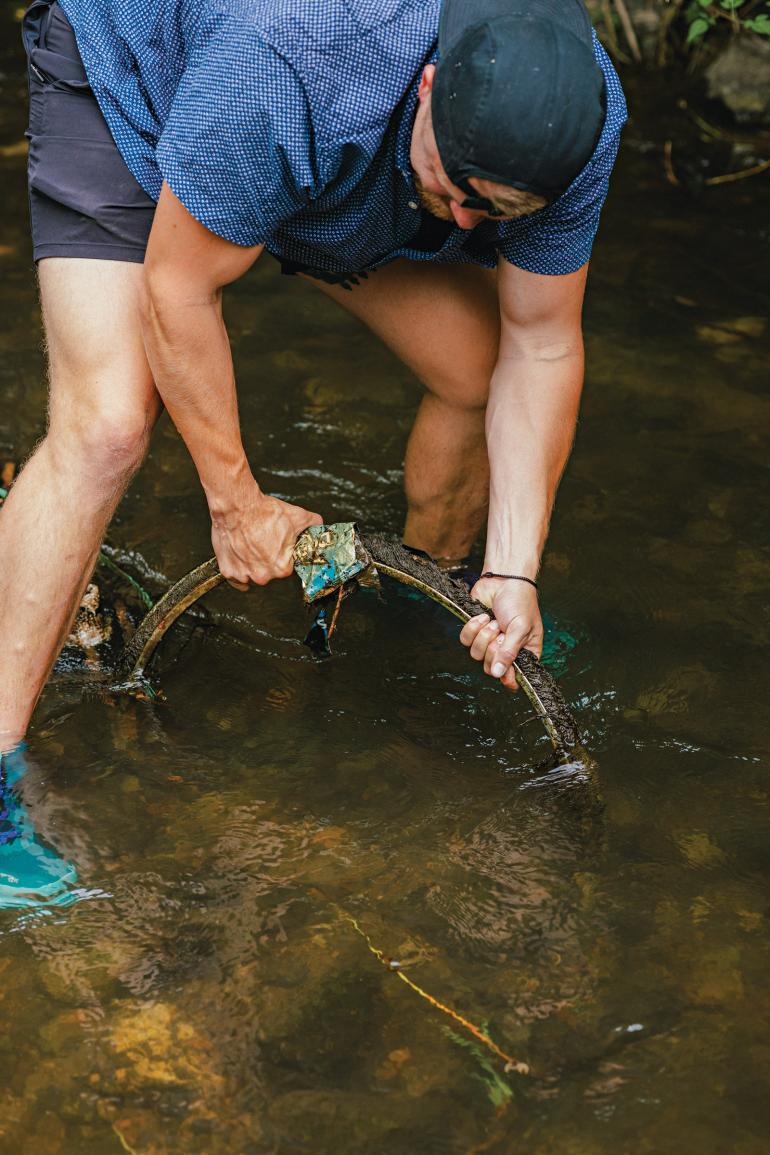
Straightened and fouled
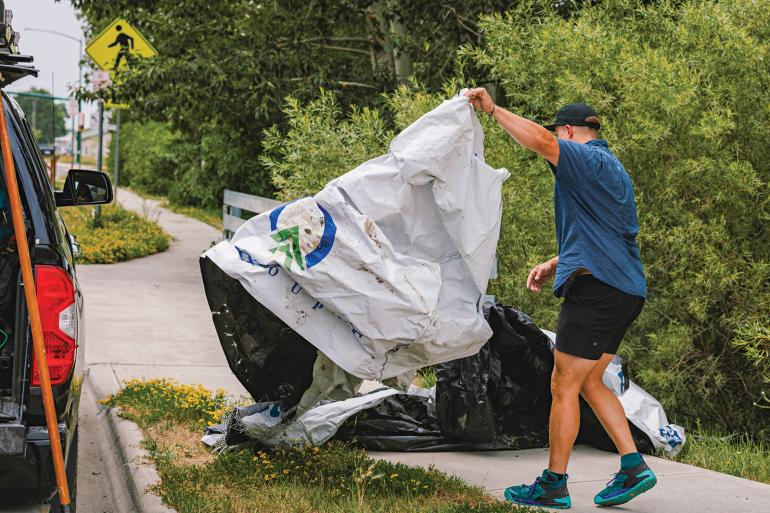
A Persistent Problem
In 2012, the City of Bozeman prepared the Bozeman Creek Enhancement Plan, a 35-page document laying out a vision for the creek’s future. In it, the authors chronicle every previous initiative that aimed to improve the creek in some way, and the list includes 2001’s Bozeman 2020 Community Plan, 2004’s Bozeman Creek Neighborhood Plan, 2009’s Downtown Bozeman Improvement Plan, and 2010’s Bogert Park Master Plan. It seems that people have been trying to improve the creek for a very long time, with very little success.
The 2012 Bozeman Creek Enhancement Plan was ambitious. Among its stated goals and strategies were providing educational opportunities for Bozeman School District students and faculty, creating thematic interpretive exhibits along the creek, providing creekside landowners with information about the ecological value of the waterway, collaborating with MDT on road-improvement projects, providing wildlife enhancements such as dipper boxes under bridges, and creating handicap fishing platforms and kid-friendly fishing areas along the creek. Which all sounds great, but 14 years later, I’d settle for a couple more walking trails.
Before it sputtered out, the 2012 initiative did manage to restore an 800-foot section of creek at Bogert Park. The stretch was converted from a straightened ditch with steep banks to a meandering stream burbling through an enhanced riparian zone with new public-access sites. The 2012 plan also left in its wake two stabilized creekbanks, a hydraulic model, several conceptual designs, and an annual creek cleanup that, based on Bozeman Creek’s current conditions, didn’t last long. Then, for a while, the will to do anything about the creek went underground, and it wouldn’t resurface until years later.
High-water hijinks
A New Movement
We’ve got to do something with the creek, we’ve got to do something with the creek, we’ve got to do something with the creek.
This refrain has been echoing in the heads of Jim Madden and Steve Nobel for years, and, at long last, something is on the verge of getting done. Madden and Nobel got involved in the effort to revitalize Bozeman Creek in 2020, when the Downtown Bozeman Partnership approached Mountain Time Arts to ask how art might help raise community awareness of the stream. Madden founded Mountain Time Arts and Nobel was also involved at the time, and the two were intrigued by the prospect. “They pointed out that there’d been scores of planning documents, and they all basically say the same thing: we’ve got to do something better for the creek,” Madden tells me. “But up until now, not much has happened in terms of actual efforts to improve the creek.”
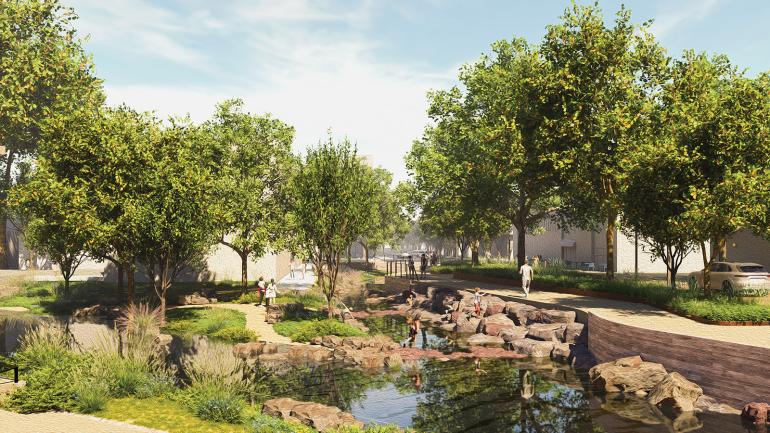
Former Bozeman mayor Terry Cunningham played a key role in injecting new energy into the Bozeman Creek question, naming it as one of the city’s top-ten priorities in 2022. Then, in 2024, the city commission adopted the Bozeman Creek Vision Plan to create (yet another) comprehensive approach. Mayor Cunningham left office in January of this year, but Nobel and Madden are working to sustain the momentum he helped create. The two artists now lead See Bozeman Creek, a citizens’ advisory group working hand-in-hand with municipal government to improve the waterway. The group wants people to “imagine Bozeman Creek’s clean water meandering through downtown so people can engage with it,” and it’s comprised of 15 architects, engineers, scientists, and other experts working toward that common goal. “Jim and I, our favorite words are ‘patient’ and ‘persistent,’” Nobel says. “We kept knocking on [the city’s] door, saying, ‘C’mon, c’mon, we’ve got a whole group of people who feel the way we do.’”
That persistence looks like it’s paying off.
What it might look like behind the Eagles
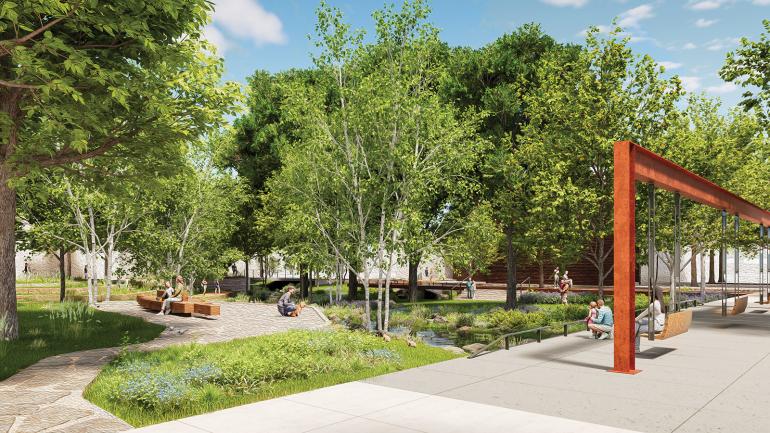
What it might look like behind the Eagles
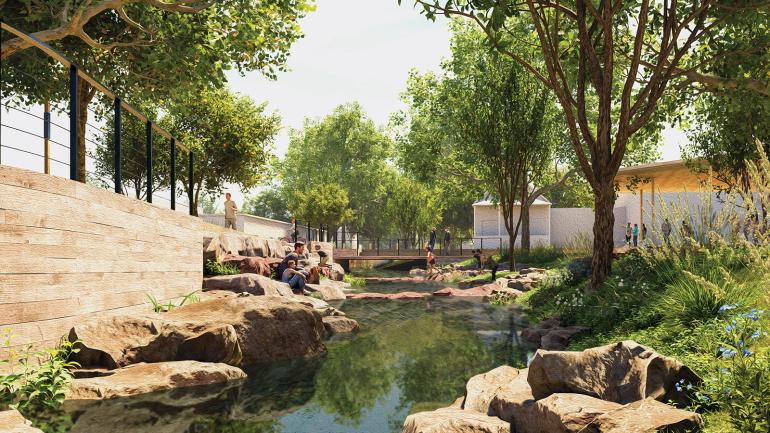
What it might look like behind the Eagles
A Potential Future
See Bozeman Creek and the city of Bozeman are almost complete with phase one of a new, aggressive initiative to revitalize the creek. In January of 2026, the city paid the urban-planning consulting firm PORT $150,000 to come up with practicable ideas for flood mitigation and creek restoration. In June, the city and See Bozeman Creek presented those ideas at a community open house at Soroptimist Park for public comment. Next spring, the city will review these ideas—and the community feedback they received on them—before charting a course of action. Madden and Noble are both grateful that city staff and officials have been so receptive to the cause. They cite mayor Joey Morrison, deputy mayor Douglas Fischer, and assistant city manager Jon Henderson as instrumental in shepherding the project along.
Nobel tells me that soon, priorities will start rising to the top. Some he refers to as “low-hanging fruit”—projects that are cheaper and require less construction and community involvement. One example is a new pocket park along a previously inaccessible stretch of creek. Another is a new trail along the water downtown on an already acquired right-of-way. “We’re going to improve the ecological health,” Madden says. “We’re going to have better community access. We’re going to draw more people to downtown.”
At the end of the day, the top priorities for me are water quality and flood management, and those have been on the city’s radar for well over a decade.
Despite See Bozeman Creek’s idealistic vision, much of the support for creek restoration is purely practical. “We’ve been pushing on the upside to this endeavor, but the reality is that the 2022 floods were the catalyst to get people talking about the upside,” Nobel explains. After the destruction those floods caused in Montana, Nobel says city leaders in Bozeman became more concerned about the possibility of flooding in Bozeman. In 2025, the city commissioned a preliminary engineering report on flood mitigation and reclamation in Bozeman Creek, and the report found that 20 separate structures along the downtown section were insufficient to weather a 100-year flood flow. Any creek improvement projects are likely to be planned with flood mitigation in mind.
“At the end of the day, the top priorities for me are water quality and flood management, and those have been on the city’s radar for well over a decade,” Mayor Morrison tells me. However, Morrison also says that the city commission intends to accomplish flood mitigation at the same time as creek beautification and increased citizen access, when possible.
For Morrison, the revitalization of Bozeman Creek is a generational project. “There will be a time of ‘before Bozeman Creek revitalization’ and ‘after Bozeman Creek revitalization,’” he says. Both Madden and Noble agree that restoration is likely to span decades, rather than months or years. “I think the main challenge is keeping up the momentum,” Madden reminds me.
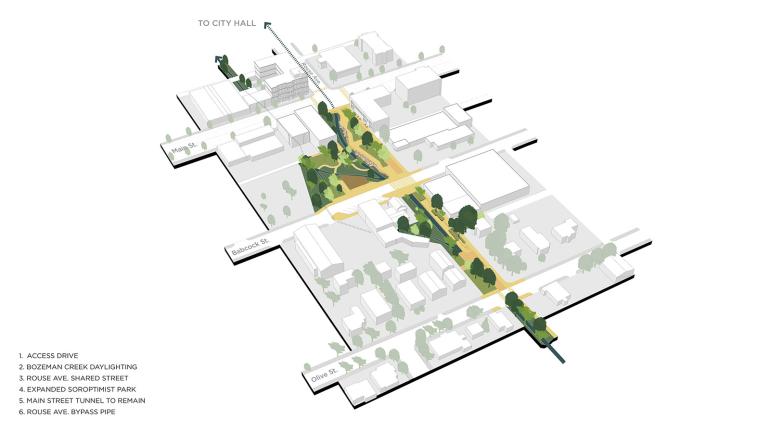
Bozeman Creek diagrams, now vs. future
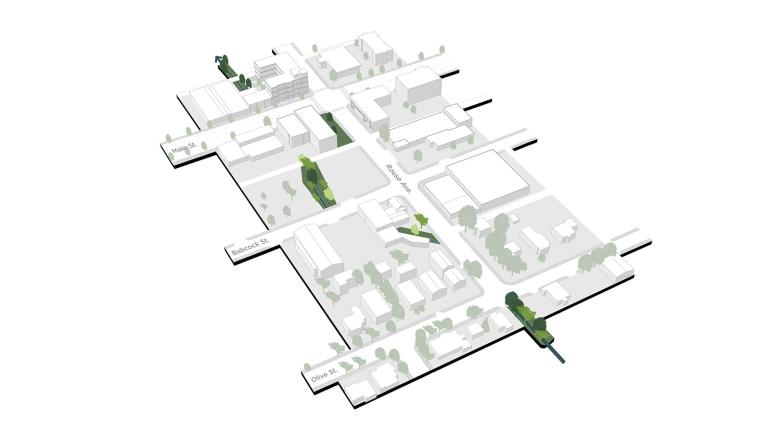
Bozeman Creek diagrams, now vs. future
Will this Really Work?
I’ll admit that after learning about initiative after initiative fizzling out, I was getting a bit cynical. For all the ideas and planning that’s been done in the past few years, the waterway remains basically unchanged. How can we trust that this latest effort will be any different?
“That’s always a possibility,” Morrison admits. But he thinks it’s unlikely. Morrison explains that after addressing crises like COVID-19 and housing shortages, city leaders are feeling like they have more room to breathe. “So long as nothing catches fire,” he says, “we should be able to deliver.”
With persistence, a little luck, and continued reciprocation from the city commission, things look promising this time around.
There will be challenges to finally turning promises into something concrete. In the downtown area, Bozeman Creek runs through a patchwork of businesses and private lots, and Madden says that uncovering the creek in those areas will be “an interesting puzzle.” It will also take a combination of public and private funds to execute these projects once priorities are decided. Madden notes that a lot of federal funds are available for flood mitigation, and he hopes that applying for those will help achieve their goals. “So far, we haven’t gotten to the real hard part yet, which is actually getting something on the ground built,” he admits. But he and Nobel are committed to solving the puzzle. “It’s the right thing to do to honor that water and treat it with respect,” Madden affirms. “That’s what motivates me.”
“Jim and I are both artists at heart,” Nobel adds. “It’s what we do, and I think making art is an extension of creative problem-solving. We typically look at a problem and instantly tap into our internal creativity to say, ‘There’s got to be a better way.’” For now, See Bozeman Creek’s vision of the waterway only exists in the imagination. But with persistence, a little luck, and continued reciprocation from the city commission, things look promising this time around. Maybe I’m a sucker, but I’ve got my hopes up.
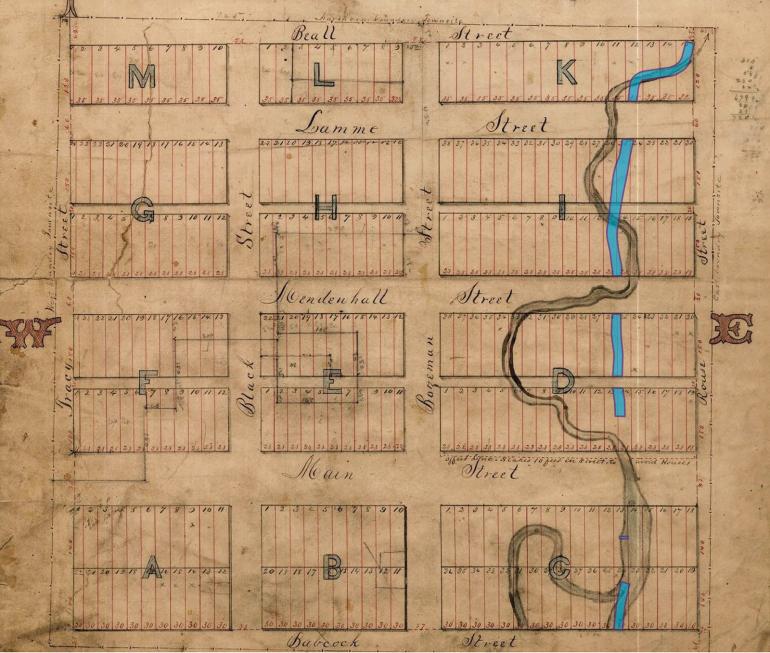
Bozeman Creek Alignment, 1870 vs. now
Getting My Feet Wet
Standing in the furrow that Bozeman Creek is forever carving into the earth, I can hardly see beyond its banks. All I can hear, other than the creek’s constant babble, is the distant whine of power tools from a construction site a couple blocks away. On a satellite map, Bozeman Creek looks insignificant, marked only by streaks of green foliage wedged between buildings and city streets. But when you’re in it, the creek is strangely vast. Even though it can’t be more than a quarter-mile from Tamarack to the bridge connecting the Kenyon Noble yards, it feels like it takes ages to wade down it.
The stretch I’m in now, where the great willow lives, was the subject of one of the proposals See Bozeman Creek presented at their June open house. The idea was to create a continuous creekside trail connecting Bozeman’s northeast neighborhood with Story Mill Park. That may not be possible until the current property owners sell, but, for a moment, I entertain the idea—especially after looking at a map and finding an existing city road easement along the stream’s west bank, starting at Tamarack and running north for a hundred yards or so. Tying into another existing easement—E. Juniper Street, which abuts Rouse—could provide a continuous two-block trail, half of it along Bozeman Creek.
In time, maybe this stretch of stream will be transformed into a riparian corridor bursting with greenery that feeds off the creek’s flow. Perhaps a bike path will appear along the bank, giving people in the neighborhood the opportunity to finally see the water that’s been hiding in plain sight for decades. And who knows, maybe the old willow tree will finally get a few visitors.
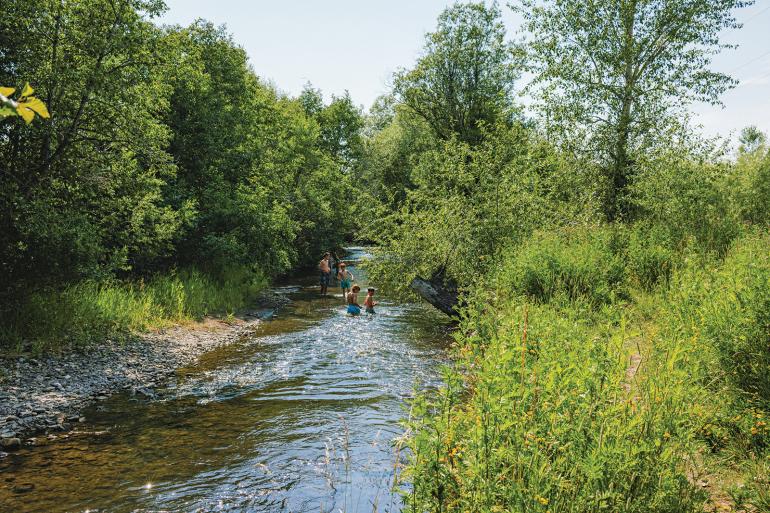
This should happen everywhere