Randonee Renaissance
Behind the scenes of skimo racing in Montana.
From casual competitions to gold medals, “skimo”—short for ski-mountaineering—has gone mainstream. However, this burgeoning sport wouldn’t have advanced as it has without Matt Madsen, a Montana-based skimo enthusiast and entrepreneur. Matt spends his time in Dillon, where he operates a bike-and-coffee shop, but he also owns M Sports, through which he’s established programs such as the Indigenous Ascent Coalition and competitions like the Big Sky Skimo Cup.
Matt also works with USA Skimo as a national referee and puts on races at the national level. As evidenced by its debut in the 2026 Winter Olympics, skimo is racing to the top. If the U.S. beats Canada in the Skimo World Cup in Solitude, Utah this December, they’ll likely compete in the upcoming Olympic Games. But let’s take a step back—what exactly is skimo?
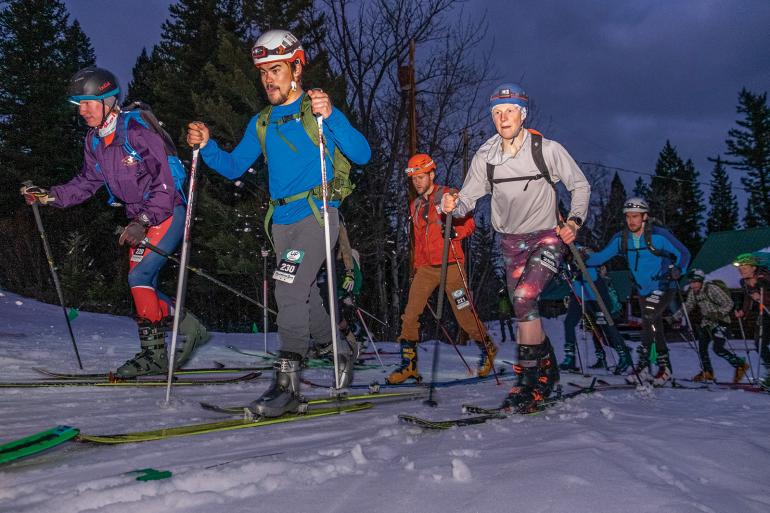
That depends on who you ask, but Matt puts it simply and succinctly: “It’s basically going up and down a mountain as fast as you can using ski gear to ascend and descend.”
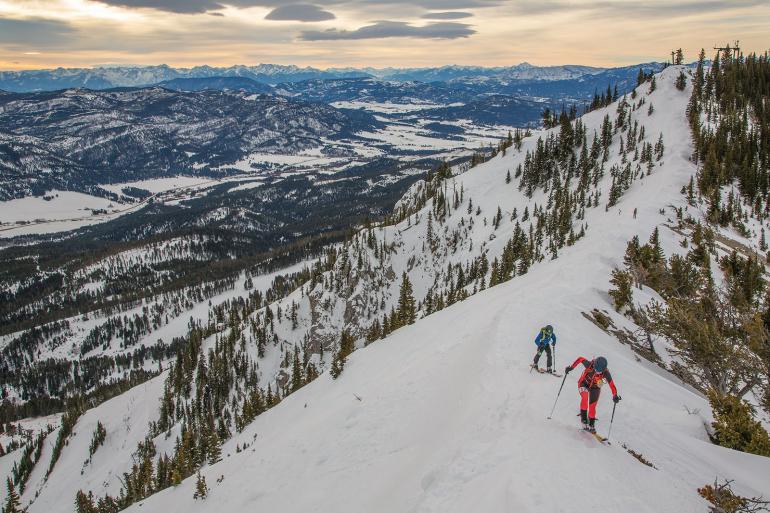
SkiMo draws on fundamental backcountry skiing and mountaineering skills—route-finding, endurance, and a general knowledge of alpine terrain.
While there are several different event categories, with distances varying across events, they all draw on fundamental backcountry skiing and mountaineering skills—route-finding, endurance, and a general knowledge of alpine terrain. In skimo, the “transition” is an essential element that entails changing from one form of travel to another—i.e., switching from skinning to skiing or vice-versa. “When you’re talking about winning and losing races by seconds, the transition can make or break it,” Matt says.
However, skimo hasn’t quite taken off in the U.S. like it did in Europe, even though the sport’s roots can be traced back to the ski-mountaineering done by the U.S. Army’s 10th Mountain Division. Equal parts sport and an excuse to get outside, skimo exists on a spectrum. At one end, there’s Rando Radness in Missoula, which is designed to be fun, with a focus on community-building and providing an opportunity for people to try out the sport. Matt says that while the sport’s debut at the Olympics is “awesome,” it’s just the elite of the elite, and his own focus remains on local expansion.
In that vein, Matt helped found the Big Sky Skimo Cup—now in its fifth year—to build a more integrated statewide community. This race series integrates individual events at local ski hills around the state. “For some people, when they go to a race, it’s the first time they've ever been to one of these smaller ski areas in Montana,” Matt says. “And so they get an opportunity to experience what our state has to offer.”
The Whitefish Whiteout and the Bridger Skin to Win Randonnée Rally are some of Montana’s classic races, while the Jack & Jill Race at Teton Pass (near Choteau) has become the Montana State Championship. “We’ve added races at Maverick, we’ve added races at Red Lodge, and they had some great opportunities to showcase what Montana has to offer, work on building that community, and kind of introduce people to the sport,” Matt says. “If you want to do it on touring gear, awesome, show up and do it on touring gear. If you want to get into race gear, awesome, show up and get into race stuff.”
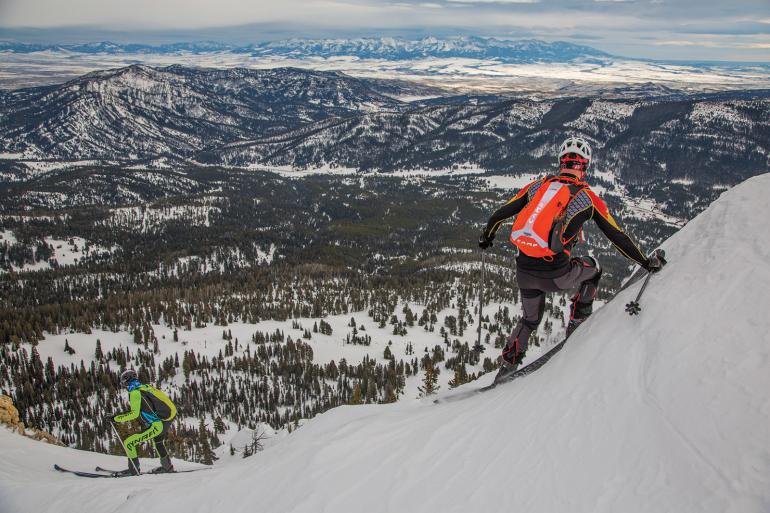
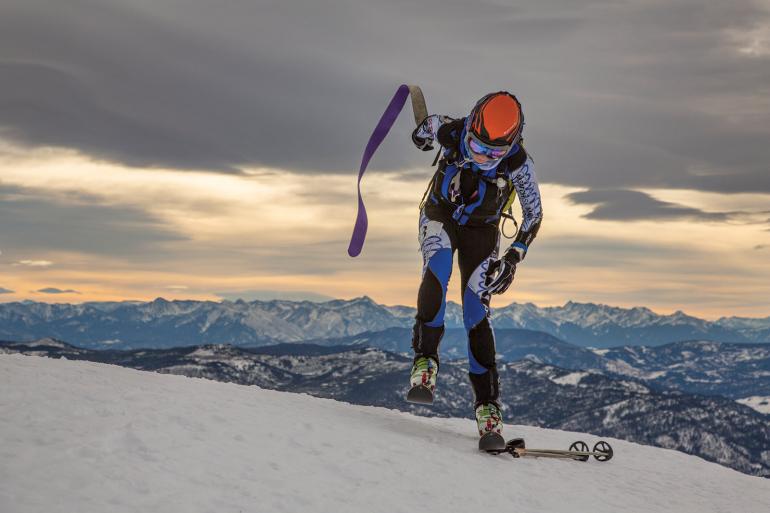
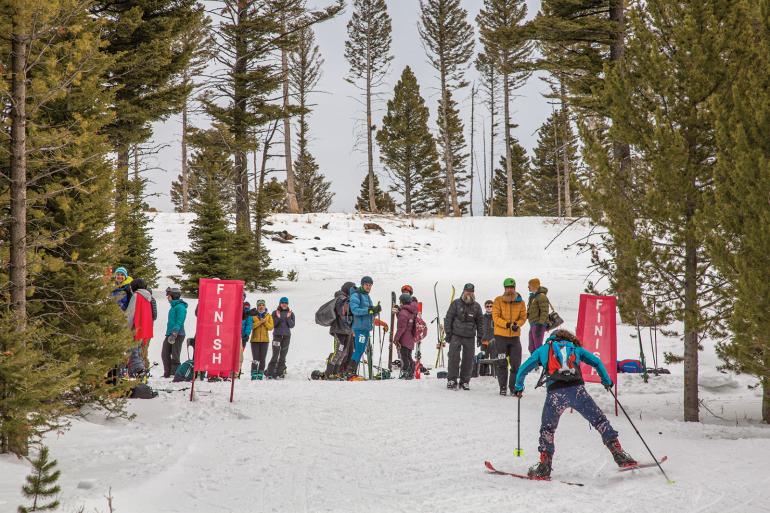
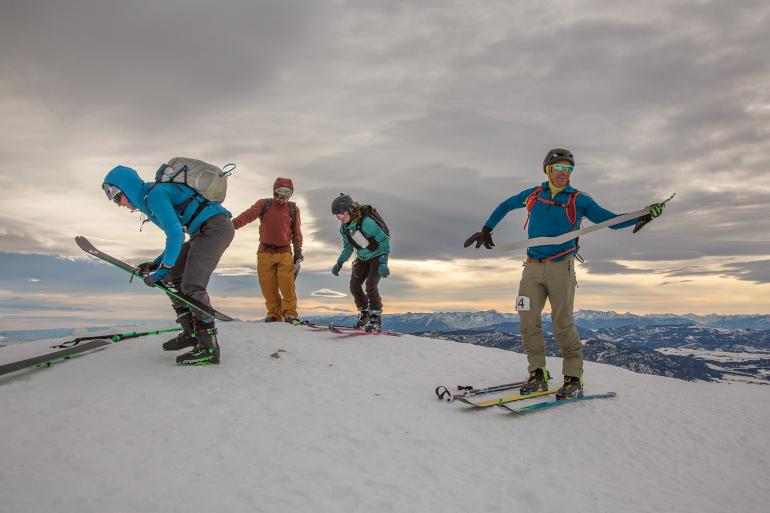
These days, the average skimo racer is someone who began as an adult, and in Montana, he or she likely came from a backcountry-skiing background, explains Michela Adrian, head coach of the Bridger Ski Foundation (BSF) skimo team and USA skimo volunteer. Michela says that recently, the focus has shifted to youth teams, partially because of the cohesive race schedule. She notes that the kids have a good chance of pushing the sport forward, especially in Montana. “I think we're up and coming,” she says.
Supporting this perspective is the growing popularity of skimo around Bozeman, with a weekly series at the old Bear Canyon ski area outside of town, as well as a larger single event, 12 Hours of Bear Canyon. Most of the participants are backcountry skiers out to test themselves in race conditions, with only a few hardcores decked out in lightweight skimo gear.
Michela notes that her skimo friends from Colorado typically don’t backcountry ski; the lion’s share of racers often only skimo in-bounds at resorts, where uphill access is more commonplace. “Whereas in Montana, most of us backcountry ski all year long but also race,” she points out. “It’s a little less structured here, because of the lack of uphill access during the ski season.”
In Montana, each resort has different etiquette and rules for uphill access (if they allow it at all). Racers often have to train outside the resort, and practicing in the backcountry brings its own risks. It’s therefore essential to understand standard backcountry-safety criteria and familiarize oneself with avalanche safety & rescue techniques.
“These kids are gnarly. They don’t even give a second thought to the crazy weather. They’re just so hearty and rowdy.” —Nicole Edwards, Indigenous Ascent Coalition
Another hurdle is equipment, Michela notes. For those hoping to be competitive, finding appropriate (read: lightweight) skimo gear has historically required money and/or connections. Luckily for her, she notes, “I was able to get a Frankenstein-esque version of race bindings. My friend had bought them from some guy in France who made them in his garage.”
And while, as Michela points out, “The recent progression of backcountry gear has improved access,” gear-acquisition can still be difficult. To combat this, she helps provide youth teams with rental gear through BSF. Matt, for his part, helps fund the Indigenous Ascent Coalition, a nonprofit based out of East Glacier near the Blackfeet Reservation. The group’s mission is to elevate indigenous athletes in the realm of outdoor recreation. The skimo team recruits reservation youth to participate in skimo, according to Nicole Edwards, founder of the coalition. “Being Native and growing up on the reservation, I found there were limited resources and access to skiing,” Nicole says. “So, my mission is to get our Native youth out into skiing and other sports that they otherwise wouldn’t have the opportunity to access.”
The group is funded by a combination of private donations, grants, and fundraising conducted by the kids themselves. Nicole notes that while the surrounding mountains in Glacier National Park are in the Blackfeet tribe’s back yard, youth on the reservation may not pursue backcountry skiing, often due to a lack of resources and avalanche education. But once properly equipped and informed, notes Nicole, “These kids are gnarly. They don’t even give a second thought to the crazy weather. They’re just so hearty and rowdy.”
In addition to access, Nicole helps youth connect with their cultural upbringing and cultivate a lasting connection to the land. She says that conversations in the backcountry often turn to deeper topics and that route-finding or making important decisions can improve their ability to problem-solve and think critically. “I feel like there are a lot of people in the outdoor community whose lives were changed by recreating in the mountains and skiing in the backcountry. I think it helps a lot with mental health, suicide prevention, and awareness,” she says. “The impact it has on the youth here is profound.”