Walking the Line

The art of setting a skintrack.
“If you don't like the road you’re walking, start paving another one.” —Dolly Parton
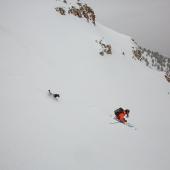
It’s early, really early. You and your backcountry buddy beat the morning light with a classic alpine start—and you’ve beat the crowd, too, as you’re the first car at the trailhead. Ullr was hard at work overnight, with several feet of fresh snow and even more up above. You finish gearing up and getting your packs in order. Finally, when you’re both ready, he looks at you and asks, “Alright, who’s got first shift on the skintrack?”
Importance
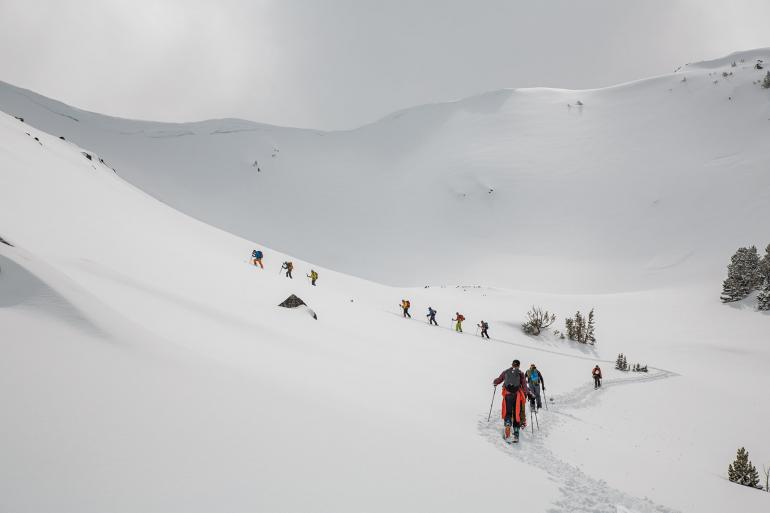
The skintrack isn’t just a means to an end—it’s the backbone of a good tour. A well-set track is smooth, efficient, and safe, weaving elegantly through the terrain like a debonair guest at a dinner party. A bad one, on the other hand, is a crooked, energy-sapping sufferfest that can ruin a powder day before you even summit.
Think of setting the skintrack as equal parts science and art. It’s a recipe for success: a dash of route-finding, a pinch of pacing, and a hint of reading the mountain. You’re not just walking uphill; you’re tracing the contours of the day. Others who follow will either praise your work or quietly curse its clumsy construction.
Safety
There’s a fine line between adventurous and dangerous. A good skintrack avoids obvious hazards like steep convexities, wind-loaded slopes overhead, and gullies that could funnel debris. The track should stay well under 30 degrees and use trees, ridgelines, and benches as natural buffers.
Take the time to plan each leg so you’re never directly beneath suspect slopes, and make sure you have safe zones for regroups. If something feels off—snowpack, slope, or gut feeling—reroute. The extra few minutes are worth it. And don’t blindly trust someone else’s track. Just because it’s there doesn’t mean it’s smart. Don’t be afraid to blaze your own trail if the current route looks suspect.
Efficiency
The goal isn’t heroics; it’s an easy, natural flow. The best skin tracks move with the mountain, not against it.
Keep your angles mellow. (Around 10 to 12 degrees.) Too steep and you’ll burn quads and lose grip. Too flat and you’ll zigzag endlessly—your kick turns will likely improve, but at what cost? Look ahead and use the terrain to your advantage: benches for breaks, tree wells for natural turning points, and ridges for direct paths and shallower snowpack.
Taboos
There are several cardinal sins of the skintrack that deserve special mention:
• Postholing in the track. If you’re bootpacking, stay off the skintrack. Deep heel holes make life miserable for skiers behind you, so find a different route. (Snowshoes are acceptable, though not preferred.)
• Dog (and human) pee. If your pup joins the party, keep it from marking its turf. And please, for the love of all that is holy, absolutely no dog poop in the skin track. It’s a skinner’s worst nightmare.
• Cutting across ski lines. When setting a route, think ahead to avoid slicing through obvious descent paths. Don’t detract from a pristine line.
• Be mindful of other groups, especially above you. If there are folks bootpacking up a couloir or at the crux of some exposed terrain, it’s best to leave them be. Set a new track or pick a new spot.
• Keep the flow. If you’re setting a quick pace, pass slower groups when the opportunity comes. Don’t tailgate; it’s not fun for anyone. On the flip side, if you’re moving slower, step aside when you can. We get out into the backcountry to avoid traffic, not cause more of it.
On a similar note, Bozeman’s got plenty of narrow, luge-like ski-outs, so if you’re on your way up, step off to let descenders pass. Descenders, stay in control and don’t come up on folks too fast or close.
When done right, setting the skintrack is something to enjoy rather than dread. It’s a dance between snow, slope, and stamina. You learn to read the mountain, conserve energy, and keep the group going uphill and gaining ground. A good skintrack goes unnoticed when done well and can end your day early when botched. It’s the unsung hero of the tour. So next time your partner asks who’s taking the first shift, you’ll know what to do.