Cornering the Market
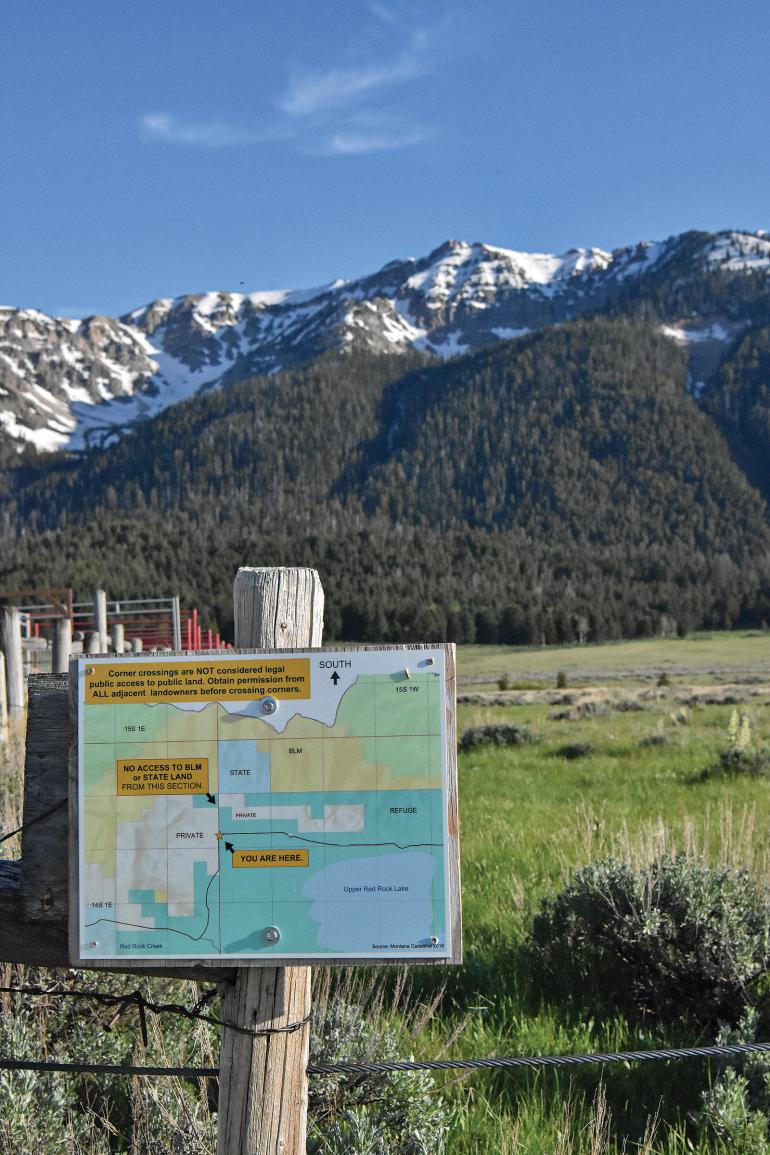
Property lines are not walls.
If the debate over corner crossing in Montana was solely about access to 871,000 acres, it sure would be a lot simpler. Instead, it has become one of the most contentious public-land issues in the American West. Court cases have drawn national attention. Social media debates have become increasingly polarized. Hunters, landowners, and public-land advocates often find themselves talking past one another rather than to one another.
The reason, I believe, is that corner crossing is not fundamentally a disagreement about access. It is a disagreement about what ownership means. Not private ownership; public ownership. Montanans have a well-developed understanding of private-property rights. We agree (and cherish the fact) that property owners have the right to use, enjoy, protect, and exclude others from their land. We recognize those rights as fundamental, and rightly so. Public lands, however, are not always given the same respect. This is where the dispute begins.
Property rights are strongest when they are balanced against the legitimate interests of neighboring owners, and that principle should apply whether the neighboring owner is a private citizen or the public itself.
If public ownership is real ownership, what rights accompany it?
The corner-crossing debate has exposed a philosophical divide in how people think about public-property rights near a boundary. Throughout our legal history, property owners have accepted limitations on the use of their property when that use unreasonably interferes with neighboring owners. We recognize this principle in building setbacks, drainage law, nuisance law, easements, airplanes, drones, and countless other examples. Yet in the corner-crossing debate, many arguments seem to assume that property rights at a public/private corner are absolute. Why do we apply that logic to public property when we have never treated private-property rights that way before? Property rights are strongest when they are balanced against the legitimate interests of neighboring owners, and that principle should apply whether the neighboring owner is a private citizen or the public itself. Property rights are not defined solely by geometry. They are shaped by practical realities and the impacts one property’s use may have on another.

The corner-crossing debate should be approached in much the same way. Throughout our legal history, we have recognized that ownership interests near a boundary are not absolute. We routinely evaluate whether a claimed use of property serves a legitimate and practical purpose and whether that use imposes unreasonable burdens on neighboring owners. Applied to corner crossing, I struggle to identify a practical use of the small volume of private airspace immediately surrounding a survey corner that outweighs the burden imposed on the public’s ownership interest in the adjoining public parcel. In my view, protecting that airspace effectively denies millions of co-owners access to land held in the public trust while providing little practical benefit to the adjoining landowner.
Reasonable people may disagree with that conclusion. But if we accept that public- and private-property rights deserve equal consideration, then we must be willing to evaluate both interests honestly and weigh their practical impacts. That is the same process we have used for generations to resolve conflicts between neighboring property owners, and I believe it remains the best path forward here as well. The balance is not one landowner being able to access four parcels at a corner while the other can access none. The balance is stepping from one parcel to another without setting foot on private land.
Until we are willing to view public and private ownership through the same framework, the debate over corner crossing will continue to be about far more than a survey corner.
Dylan Pipinich is the board president of the Public Land & Water Access Association (PLWA).