Walk This Way
Selecting the right hunting boots & pack.
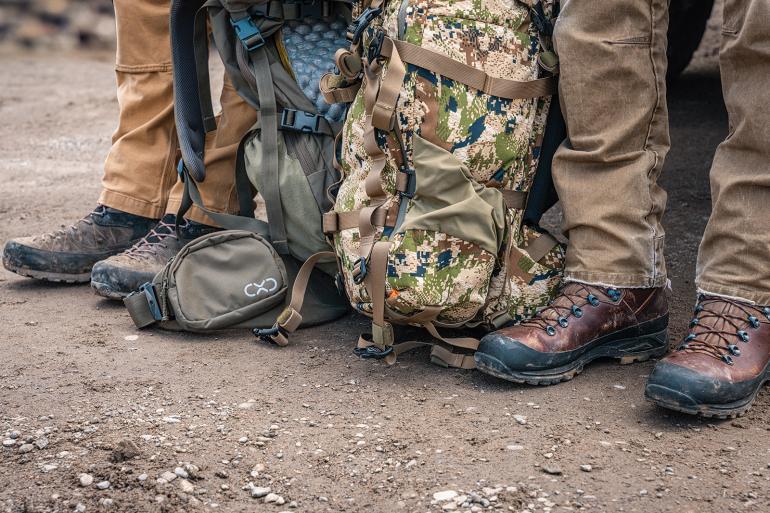
Hunting can take you far off the beaten path, to remote drainages and hidden meadows—often using your own two feet to get there. You’ll need some specialized gear, but little is more important than a good pair of boots and a sturdy pack. Both come in a variety of styles suited for different purposes, so consider what type of terrain you plan to hunt, how far from a road you’ll be, how much you prioritize comfort, and how much you’re willing to spend. Here are a few options for both boots and packs.
Boots
Early in the season, for archery or upland birds, standard hiking boots are all you’ll need. As long as you’re in fairly dry country, without too many creek-crossings or much swampy terrain to traverse, the low weight and high breathability of hiking boots will pay off in spades. You’ll move easier, quieter, farther, faster, better. Check out LOWA’s extensive lineup at a local store or online.
After romping around in hiking boots for a season or two, you’ll find that they wear out quickly when used off-trail in rugged terrain. The stitches blow out and the soles peel off. When that happens, it’s time to upgrade to a pair of full-leather mountain boots. These boots are typically around 10-inches tall, provide good breathability, and have strong rubber outsoles. They come in insulated and non-insulated varieties. Our favorite is Kenetrek; you can try on a pair at their Four Corners store.
To up the ante even further, people who plan to sit for long periods of time or slosh around through wet ground would be wise to consider pac boots. While they’re available in a number of styles and heights, they’ve all got a single-piece rubber outsole, a full leather upper, and an insulated wool or synthetic liner on the inside. Whether it’s elk up high, late-season pheasants, or sitting in a duck blind, your toes will thank you. Again, Kenetrek makes a fine pac boot.
Packs
If you want to stay light on your feet and aren’t expecting to drop a bull elk, a daypack should suffice for most hunting situations. A medium-sized, 30- or 40-liter pack should have plenty of room for essentials, including food, water, and extra clothing. Some are even designed specifically for hunters, with multiple heavy-duty compression straps and rigid frames—so if you do tag an animal, it’ll handle a front quarter for the first trip out. Any brand will do, but we like local (and legendary) Mystery Ranch, which has loads of options; Stone Glacier makes a great hunting-specific daypack, too.
If your fall seasons are devoted entirely, or at least predominately, to chasing big game, a hunting pack designed for meat-hauling is a worthy investment. Most are designed with carbon or metal frames that detach from the body, allowing you to pack meat away from your extra gear and easily distribute the weight, keeping things clean, balanced, and organized. Durability is not something you need to question with these setups. The only downside is the hefty price tag, no matter the brand. Most locals swear by Mystery Ranch and Stone Glacier, though Kifaru and Exo have excellent reputations, as well.
As a beginner hunter looking to go on multi-day hunting expeditions, a standard backpacking pack will do just fine. Most have a solid hip belt to take weight off the shoulders; however, things can get a little tricky once an animal is down. To keep weight centered higher in the pack, bring some cam straps to cinch around the meat and the entire pack. It won’t be as comfortable as a hunting-specific pack, but it’ll get the job done at a much lower cost. Once again, Mystery Ranch can set you up right and proper, but other options from companies such as Gregory and Osprey will also get the job done.