Toasty Toes
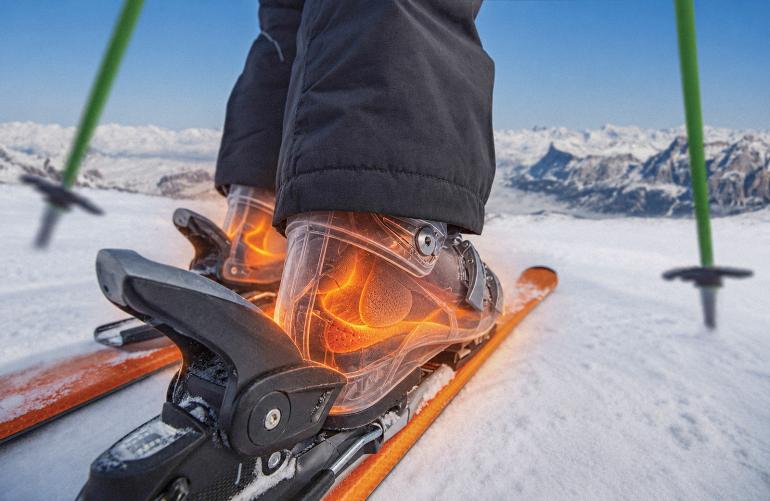
Keeping your feet warm in winter.
Should you get cold feet in the metaphorical sense staring down the Big Couloir at Big Sky, back out and traverse to Liberty Bowl and all is forgiven (except the masochistic significant other who dragged you there). Get cold feet in the literal sense while skiing the more forgiving line or huddled in a duck blind on the Missouri River in December, and there’s really no one to blame but yourself.
From the time I was a preschooler trudging after my dad while he checked expectant Black Angus cows in February until a few years ago, frozen toes have sullied more outdoor experiences than I care to remember. Improvements in my own understanding of heat retention to the extremities lowered the strikeouts as an early adult. Recent advances in heated footwear have nearly eliminated discomfort in any sort of winter outing.
It’s easier to keep your feet warm than to make them warm when cold. Whenever possible, start an outing with your footwear at around room temperature or slightly warmer.
Assuming you’re sliding your tootsies into well-insulated footwear, pay attention to the following factors. First, avoid socks or footwear so tight that they inhibit circulation. Your toes should wiggle freely. Second, remember that damp is cold. Whether your boots are for skiing or trekking, make sure they are completely dry. Ski boots can be tricky. Moisture is frequently trapped between the plastic shell and the liner even when the inside of the liner feels dry. Removing the liners from the shell allows them to dry completely. Finally, understand that it’s easier to keep your feet warm than to make them warm when cold. Whenever possible, start an outing with your footwear at around room temperature or slightly warmer. The trick is to avoid excessive heat that makes your feet sweat when donning the boots. But if they’re warmish to start, your circulation has a boost from the beginning.
Disposable toe warmers are a temporary savior in frigid conditions. They create heat when the active compound—iron powder and charcoal—is exposed to oxygen. That fact is important. When used inside a boot that greatly reduces their exposure to oxygen (think wading shoes submerged in a river), their heat wanes. In such instances, allow them several minutes of exposure to air before use to fully activate the chemical reaction. When practical, unlacing or loosening footwear to promote some air circulation to the warmers at intervals will up their output.
My wife, Lisa, and I coach ski racing at numerous locations across the country all winter. Athletes can take breaks to warm their toes on frigid days. We cannot. Lisa uses heated socks from Hotronic to avoid frostbite and keep her feet comfortable. I opt for heated footbeds in my boots, also from Hotronic.
As an additional trick, you can stash the disposable warmers in the toe area of your liners to heat them before skiing.
On very long, cold days, conserving battery power until the final run is important. We always try to start with our boots at room temperature before catching the first chair so the battery power is maintaining, not raising, the temperature.
Battery performance decreases as temperatures get colder. With heated socks, the batteries are typically worn against the leg under insulated pants, which keeps them warmer than the outside air. With footbed heaters, however, the batteries are attached to the outside of the ski boot, directly exposed to the cold. If the air temperature is below 20 degrees Fahrenheit, I apply adhesive toe warmers to the batteries while skiing which noticeably increases output and longevity. As an additional trick, you can stash the disposable warmers in the toe area of your liners to heat them before skiing. Another tip is to run the footbed heaters at their lowest level for around 15 minutes before booting up to start with warm liners.
Beyond skiing, winter also finds me waterfowl hunting and fly fishing. I use the same strategy for keeping my feet warm during these activities as when skiing, but with heated socks instead of footbeds. Unlike disposable warmers, heated socks do not need an oxygen supply to function.
For the most part, I’m a low-tech outdoorsman. When it comes to recreating comfortably in the depths of winter, I’ll take every advantage available to keep my toes toasty.