Lion in the Night

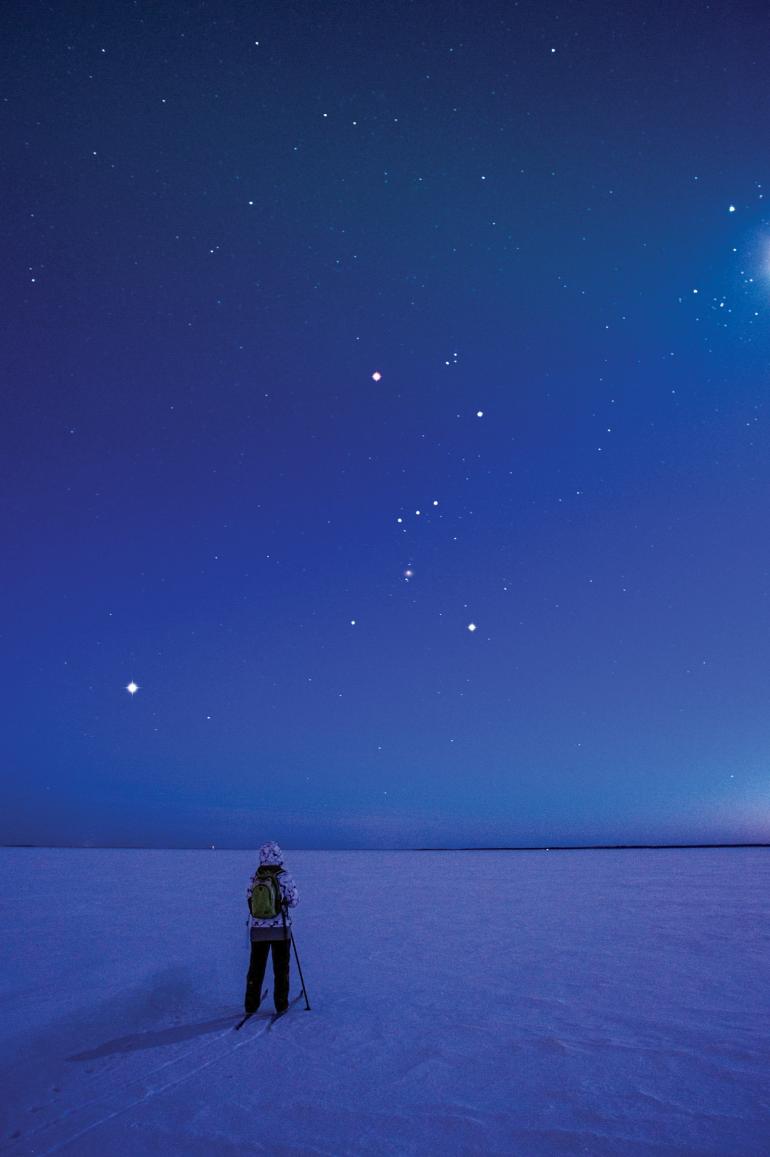
Highlights of a winter's starry sky.
If the super El Nino effect warming the Pacific Ocean doesn’t muck up our weather too much, we should find the latter part of winter still crisp and snowy. But on those singular nights when the sky is clear and cold, take a peek out late between the curtains, and you’ll see bright lights in the sky with ancient pedigrees leering down at you.
As the planets of our solar system orbit the sun at different distances and speeds, our Earth regularly “laps” the more distant and slower ones, briefly placing us between them and the sun. These are times of “opposition,” when these more distant planets lie opposite the sun in our sky, rise at sunset, and thus shine down on us the entire night. This is the time we lie closest to them in space, so they’re also at their brightest in the sky. And two of them come to such opposition this February against the stars of one of the oldest constellations we have.
If you’re writing your sweet nothings in anticipation of Valentine’s Day and you see that the night is clear, go out and have a look. You’ll find star-belted Orion the hunter stalking his quarry high in the south, heading west. In the east, a fierce creature will be leaping up behind him: the constellation of Leo the lion. Look for the sickle shape of stars, like a backward question mark, tracing his head, mane and chest (the question mark’s period is the bright star Regulus, his heart), followed by a triangle marking his hind quarters and tail.
The stars and planets will be shining brightly, so be sure to look for the vintage pattern of Leo the lion, bedazzled this winter with distant worlds.
Cuneiform records show that a lion was pictured in these stars in ancient Mesopotamia at least 4,000 years ago, when their skywatchers were organizing the band of Zodiacal constellations through which the planets drifted as a way to keep track of the moving lights of the sky. The Greeks adopted the pattern and made it the ravaging Nemean lion whom Heracles (Hercules) dispatched as the first of his Twelve Labors. And this winter, the feisty feline is ornamented with two bright planets.
On the right side of the sickle lies the slower-moving, brilliant Jupiter (Marduk to the Babylonians and head of their pantheon) shining in Leo’s face; we lap it every year. On the left side of the sickle, near the lion’s heart, lies the faster and luridly red-orange Mars (the Babylonian Nergal, god of war and pestilence) whom it takes us two years and change to catch up with and pass, as we do this winter. Jupiter’s opposition date falls on February 10 when it rises as the sun sets, and Mars follows on February 19.
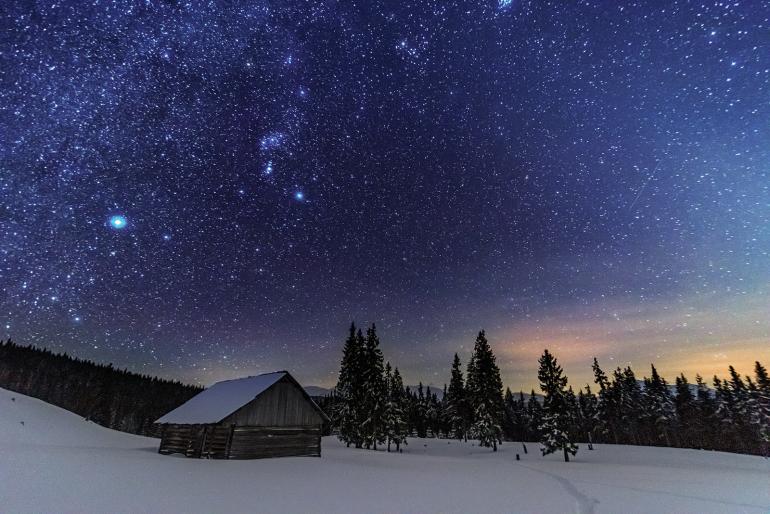
While these planets happen to lie this winter in the same direction in space, they’re vastly different distances from us. Giant Jupiter glints from some 405 million miles away, while the diminutive Red Planet lies at just 63 million miles. The bigger Jupiter’s cloud bands are much more reflective of sunlight than Mars’ red desserts, so Jupiter outshines Mars by about three times. But Mars will still be plenty bright enough—rivaling the brightest star Sirius down and left of Orion—to hit you in the eye as well.
The moon also gets into the act on the 19th when it lies near to Jupiter in the sky as Mars rises at sunset. The moon rises full the very next night a little below Regulus. There’s a penumbral lunar eclipse that day as well, when the moon skims through the lighter outer part of Earth’s shadow; but alas, the eclipse is finishing up by the time the moon rises for us, and exits the invisible shadow edge less than ten minutes after it clears the horizon.
The moon rejoins the two planets in the sky again on March 18, just two days before the equinox that officially ushers in spring. Mars will have been crossing the sickle and drifting closer to Jupiter in the sky in the interim, and they reach their closest alignment on March 30. Then they drift apart as we all move in our orbits and our vantage point continues to change.
Whatever weather El Nino throws at us, the stars and planets will be shining brightly, so be sure to look for the vintage pattern of Leo the lion, bedazzled this winter with distant worlds.
Jim Manning is the former director of the Astronomical Society of the Pacific. He lives in Bozeman.