Cold Storage
What the midden knows.
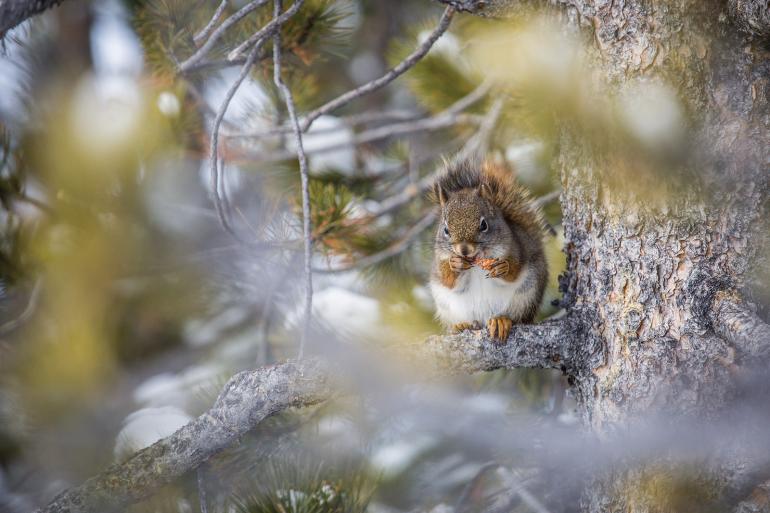
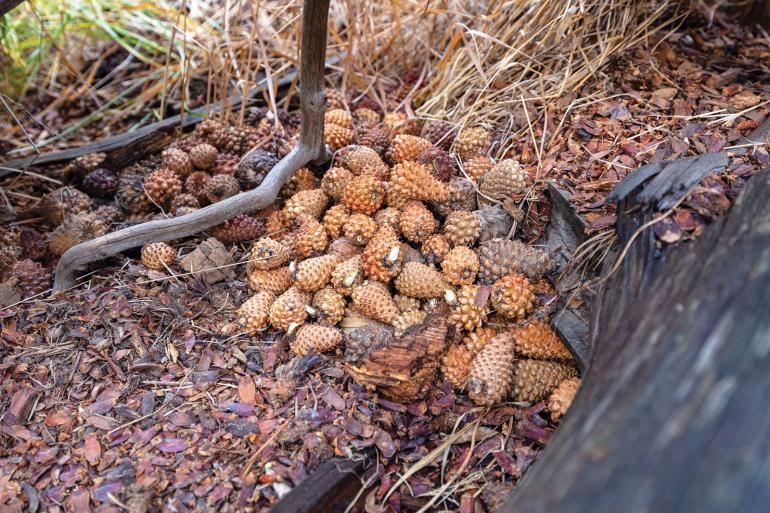
There’s a spot along the Hyalite drainage where the lodgepole crowd is close enough to blot out the sky, and if you stand still there in January, ankle-deep in snow, you’ll eventually hear it before you see it: a furious, ratcheting chatter coming from somewhere overhead, aimed squarely at you. Follow the sound down to the base of the tree and you’ll find the reason for all the fuss: a mound of shredded cone scales, sometimes waist-high, sometimes wider than a kiddie pool, packed hard against the trunk like a snowdrift that decided to become a pantry. It’s not trash. It’s a fortune, and the squirrel screaming at you built it with nothing but instinct and a few months of very hard work.
Tamiasciurus hudsonicus, the American red squirrel, is one of the smallest year-round residents of these mountains and gets none of the luxury of skipping winter. The bears a few hundred feet up are already asleep, running on stored fat, their metabolisms idling low enough to survive on almost nothing until spring. The squirrel gets no such deal. It must eat, actively and daily, through five months of subzero mornings, without an ounce of body fat to spare. And it manages that not through toughness, exactly, but through a piece of food chemistry so elegant it makes human refrigeration look like a blunt instrument.
A Small Window
The whole operation starts in a rush. Conifer cones are only harvestable for a matter of weeks each fall; mature enough to hold a full seed crop, but not yet dry enough to curl open and scatter that crop to the wind, which is exactly what the tree wants and exactly what the squirrel can’t allow. So, for four to six frantic weeks every September and October, a red squirrel does almost nothing else. It climbs, clips a still-green cone free with its teeth, lets it drop, climbs back down, and hauls it off—sometimes 15,000 cones in a single season, per squirrel, one tree at a time—to a central cache built up over years in the same spot its mother and grandmother likely used.
That cache is the pile you just found. Biologists call it a midden, but the word undersells it. A mature midden isn’t a heap so much as an engineered climate: years of packed, decomposing cone litter that holds cold and crucial moisture, long after the surrounding forest floor has dried and frozen solid.
Fooling the Cone
Here’s the trick hiding inside that pile: a conifer cone opens and closes the way a hygrometer does. Dry air makes its scales flex outward, curling open to release seed. Wet air makes them clamp shut. A cone has no idea whether it’s buried under a snowpack or sitting in a September drizzle; it can only respond to the humidity immediately around it. So a green cone driven deep into a cool, damp midden gets, in effect, told a lie it can’t detect: that it’s still raining, that the moment to open never arrived. It stays sealed. Its seeds stay locked away from the wind and the fungi that would otherwise rot an exposed cone within a season. The squirrel, without understanding a molecule of what it’s doing, has built a humidor that will keep food edible clear through March and, if the harvest was good, clear through the following winter too.
Not every cone earns equal trust in this system. Around Bozeman, the harvest runs mostly to lodgepole pine and Douglas fir, with Engelmann spruce and subalpine fir filling in at higher elevation, and, for a lucky squirrel whose territory includes a strand of it, whitebark pine, whose seeds are so fat-rich that a grizzly will tear a midden apart just to steal them. Lodgepole does the heaviest lifting. Its cones are famously stubborn and slow to open even under ideal conditions, which is exactly why squirrels stack them on top of the pile as a long game: insurance cones, some of them still viable years after they were cut.
Defending the Larder
A squirrel guards its midden with a ferocity out of proportion to its size, because the math is unforgiving: lose the cache, and there is no making it through winter. That chattering isn’t noise; it’s a border alarm, aimed at every other squirrel, chipmunk, and passing hiker in range. A young squirrel born too late in the season to build a midden of its own has two options: inherit one or take one from something weaker.
The larder runs deeper than cones, too. All summer, while the harvest window is still months off, a squirrel picks mushrooms—some of them toxic to nearly everything else in the forest—and wedges them into the crooks of branches to cure in the sun, stockpiling a side supply of protein the seed cache can’t provide on its own. On the coldest days, when even a squirrel decides the air outside isn’t worth it, it can simply stay curled in its nest and draw down what’s already stored below, because the freezer, unlike almost everything else in a Montana winter, is one thing that never runs out on schedule.
So, the next time you break trail and come across one of these piles, give it the beat of respect it’s earned. It looks like debris, but it’s the most sophisticated storage system anything in these woods has built, assembled by an animal that figured out long before we did that cold and wet beat warm and dry when the thing you’re trying to keep alive wants badly to escape.