The Sky Is Falling

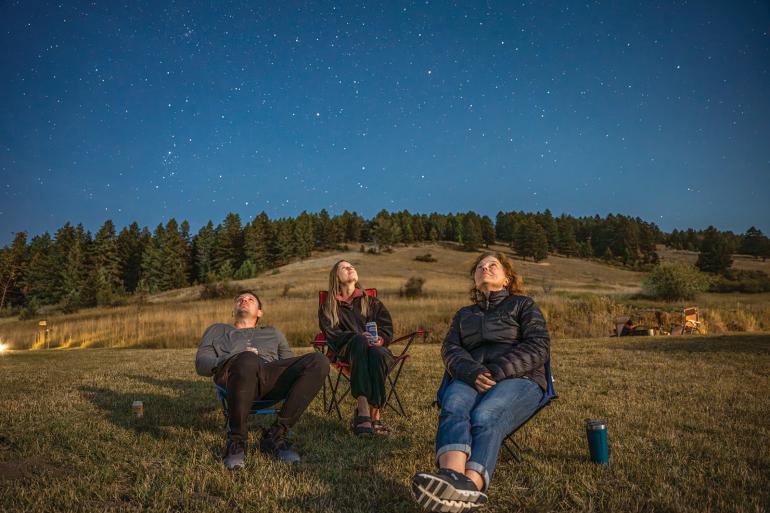
Autumn stargazing.
Writer and naturalist Hal Borland once opined: “Autumn is the eternal corrective.” Who could stand with autumn on a hilltop, he asked, and fail to see the span of the world and the meaning of the rolling hills reaching to the far horizon?
Montana has plenty of span in any season, where rolling hills and craggy mountains give way to the arc of the Big Sky overhead. Fall is particularly good for gaining perspective from our view of the heavens, for in no other season can we see farther, or get a bigger picture.
Pick a crisp, clear autumn evening and head out after nightfall, say around 9pm. Look high southeast for a large square of medium-bright stars that will swing just south of overhead as night passes. This is the Great Square of Pegasus, the famous winged horse of the Greeks, born of the scalding blood of the slain Medusa and pictured upside down and rising from the ocean out of which he came. (The Sioux fancied a turtle here, as did the Chinese, and native tribes of the Caribbean coast of South America found a barbeque grill.)
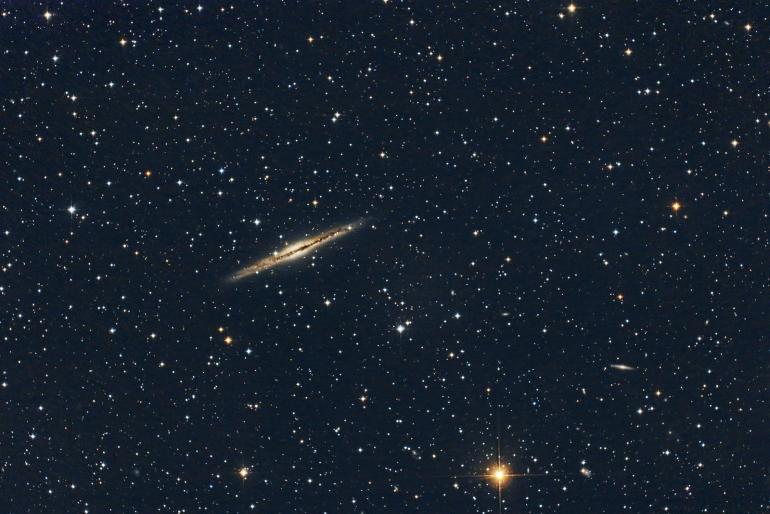
This light left the galaxy when ice-age mammoths were roaming North America.
Look a little up and left of the upper left-hand star of the square—the star Alpheratz—and if the night is clear and moonless and dark, you may be able to glimpse, out of the corner of your eye, a ghostly, oblong smudge of faint light. This is the farthest object in the universe that we can see with the naked eye: the Andromeda Galaxy. (Go ahead and cheat and use binoculars if you need to.)
This galaxy, named for the constellation Andromeda the princess in whose direction it lies, sits about 2.5 million light years away. That means it took 2.5 million years for the light you’re seeing from its stars to scream across space at the speed of light and hit you square in the eye. This light left the galaxy when ice-age mammoths were roaming North America.
Compared to Andromeda, the other naked-eye lights of the sky are “relatively” close. The stars of the Great Square, for example, snuggled within our own Milky Way Galaxy, range up to nearly 500 light years away. The current twinkles we’re getting from Alpheratz, the closest at 97 light years, left the star as Wall Street was crashing in 1929, triggering the Great Depression.
Face southwest and you’re facing in the direction of the invisible but notable Voyager 1 spacecraft. It lies in the direction of the star Alpha Ophiuchi sitting above the southwest horizon on early fall evenings. Some 46 years after its last planetary flyby, Voyager 1, our most distant cosmic emissary, is now 16.1 billion miles away—a “light-day,” its signals taking a full 24 hours to get back to us.
Lying below Pegasus this fall is the amber-colored planet Saturn, which reaches “opposition” on October 4. On that night, it rises at sunset, lying opposite the sun in the sky, and is already up by nightfall thereafter. Though closest to us at opposition when Earth and Saturn are on the same side of the sun, it still lies some 784 million miles away—70 minutes at light speed.
The meteors that liberally bombard the autumn sky are virtually in our face.
On September 26, the rising Harvest Moon lies just above the planet, a mere 236,000 miles or so distant, about a second and a quarter away at light speed. (The moon will pass by Saturn in the sky again on October 23, November 20, and December 17.)
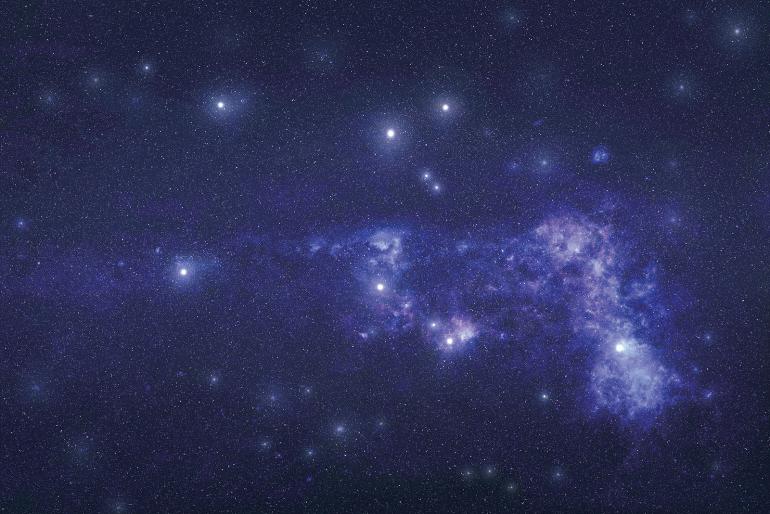
But the meteors that liberally bombard the autumn sky are virtually in our face. The Orionids, for example, peaking on the night of October 21-22 (producing about a dozen per hour under good conditions), or the Geminids, peaking on the night of December 13-14 (up to several dozen per hour), are flaring bits of cometary debris that burn up around 40-60 miles above our heads.
And if you want to observe a bit of the universe even closer than that, you can go to the Museum of the Rockies meteorite display and stand a foot away from space rocks that survived the passage through Earth’s atmosphere.
Looking for perspective this fall? Just look up. The “eternal corrective” of the sky is waiting for you.
Jim Manning is the former director of the Astronomical Society of the Pacific. He lives in Bozeman.